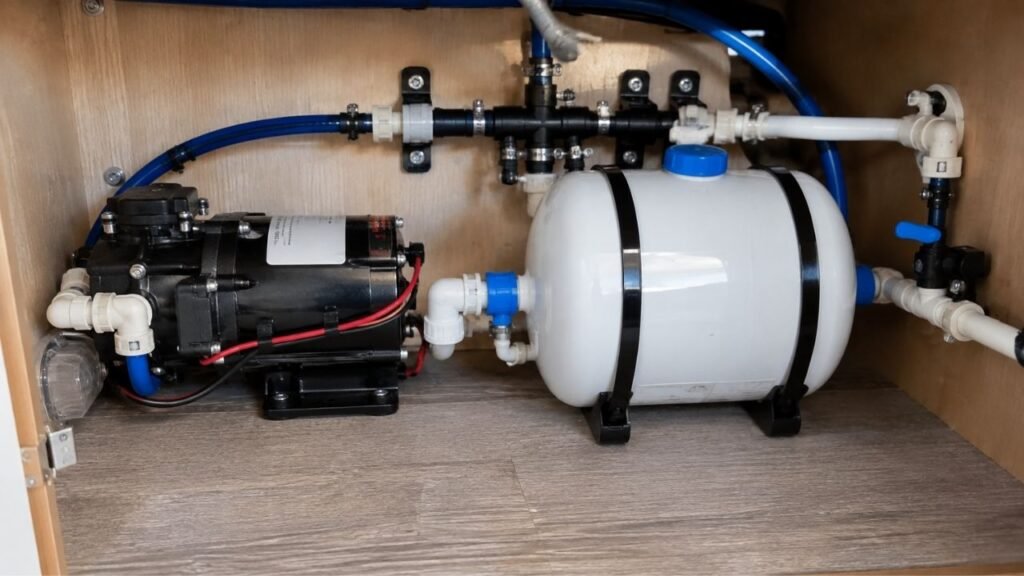
An RV water pump moves freshwater from your tank and creates plumbing pressure, while an accumulator tank temporarily stores pressurized water. The accumulator does not replace the pump. Instead, it helps compatible pumps cycle less often and deliver smoother low-flow performance.
In this guide, I’ll explain exactly what each component does. I’ll also show you when an accumulator helps, when it does not, and which setup makes more sense for your RV.
Key Takeaways
- An RV water pump actually moves water through your plumbing.
- An accumulator tank stores pressurized water for short-term use.
- You can normally use an RV water pump without an accumulator.
- Accumulators can reduce short cycling, pulsing, and frequent pump starts.
- Some bypass and variable-speed pumps may not need an accumulator.
- An accumulator cannot fix a weak, clogged, leaking, or undersized pump.
- Your onboard pump normally stays off when using campground city water.
- Accumulator pre-charge should follow your specific manufacturer’s instructions.
RV Water Pump vs Accumulator Tank: Quick Comparison
The easiest way to understand these components is to compare their jobs. They work differently, but they can complement each other in the same freshwater system.
| Comparison Point | RV Water Pump | RV Accumulator Tank |
| Main purpose | Moves freshwater through the RV | Stores a small amount of pressurized water |
| Creates water flow | Yes | No |
| Creates plumbing pressure | Yes | No, it stores existing pressure |
| Uses electricity | Usually 12V DC | No |
| Needed for fresh-tank water | Yes | Usually optional |
| Typical location | Between freshwater tank and plumbing | On the pressure side after the pump |
| Helps reduce cycling | Depends on pump design | Yes, when correctly matched |
| Helps smooth pulsing | Sometimes | Often |
| Helps reduce pump starts | No | Yes |
| Increases pump capacity | No | No |
| Replaces a weak pump | No | No |
| Needs pressure adjustment | Pump switch may be preset | Air pre-charge may need checking |
| Works during city-water hookup | Pump normally stays off | Usually unnecessary for supplying city pressure |
The biggest distinction is simple. The pump does the actual work. The accumulator manages stored pressure.
What Does an RV Water Pump Actually Do?
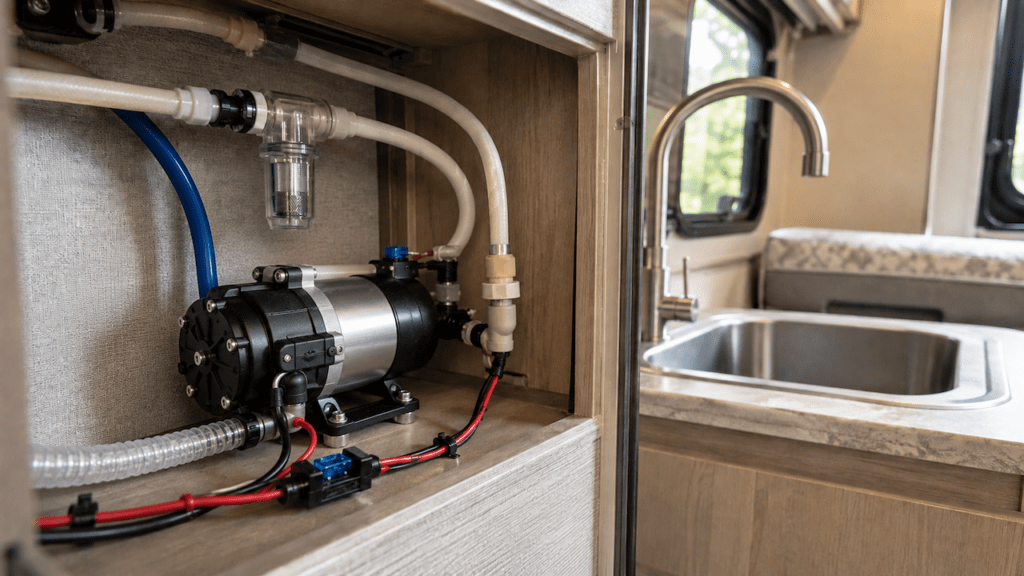
Your RV water pump is the heart of the onboard freshwater system. When you are camping without pressurized city water, this small electric pump gives your faucets, toilet, and shower usable water flow.
It Pulls Water From the Freshwater Tank
The pump draws water directly from your RV’s freshwater tank.
Water normally travels through an inlet strainer before reaching the pump. That strainer catches debris that could damage the diaphragm or valves.
The pump then pushes water toward your plumbing fixtures.
Without the pump, water inside the fresh tank usually cannot provide useful faucet pressure on its own.
That is why your pump becomes especially important while boondocking.
It Creates Flow and Plumbing Pressure
Two terms appear constantly when comparing RV water pumps: GPM and PSI.
GPM means gallons per minute. It tells you how much water the pump can deliver.
PSI means pounds per square inch. It describes water pressure.
A pump needs enough flow for your normal water use. It also needs appropriate pressure for your RV plumbing.
Higher numbers are not automatically better.
A pump with excessive pressure may not be suitable for older plumbing. A very high-flow pump may also draw more current than necessary.
The right pump should match your RV and typical water demand.
Its Pressure Switch Controls Pump Operation
Most standard RV freshwater pumps operate automatically.
When you open a faucet, plumbing pressure begins dropping.
The pump’s pressure switch detects that drop and starts the motor.
Water begins moving from the freshwater tank toward your faucet.
Once you close the faucet, pressure begins rising again.
The pump eventually reaches its shutoff pressure and stops.
You normally do not need to manually switch the pump repeatedly.
However, low faucet flow can sometimes create another behavior.
The pump may repeatedly start and stop every few seconds.
That behavior is commonly called short cycling.
The Pump Is Mainly Used With Your Freshwater Tank
This point causes plenty of confusion among newer RV owners.
Your onboard pump is mainly intended for freshwater stored inside your RV.
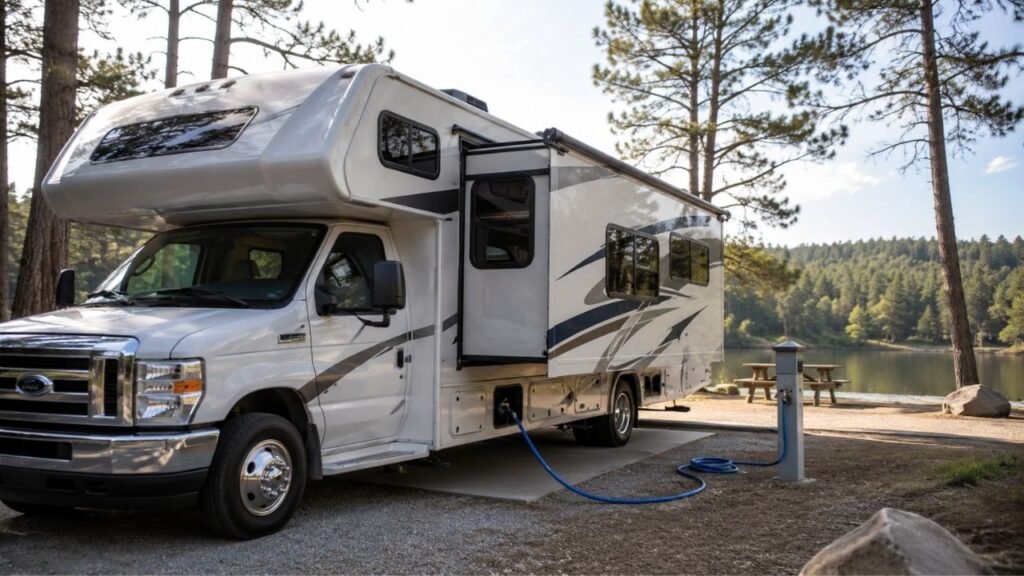
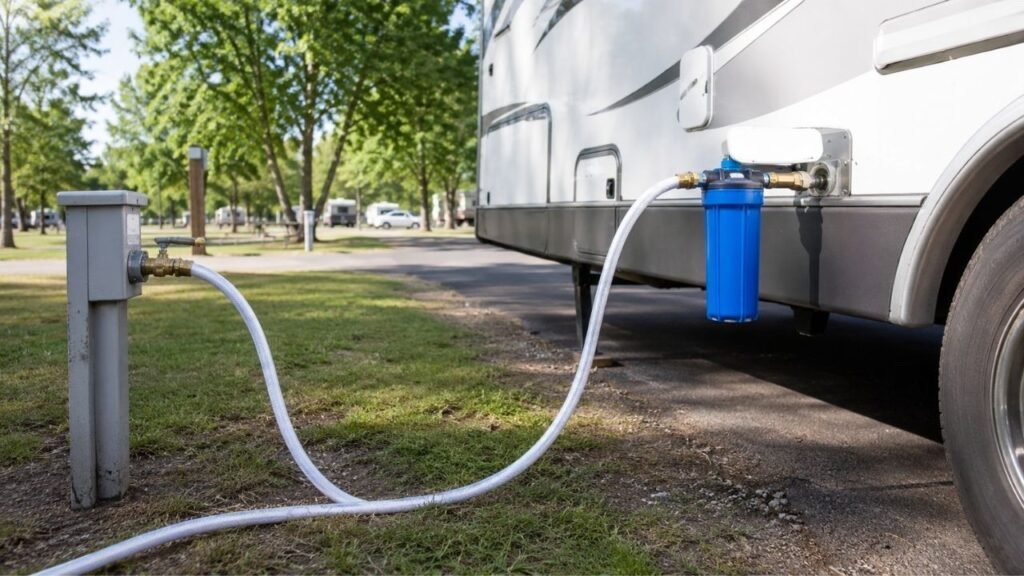
When you connect directly to campground city water, the incoming supply already has pressure.
You therefore normally leave the onboard pump turned off.
The campground water travels through your city-water connection instead.
A water pressure regulator may still be needed at the hookup. That protects your RV plumbing from excessive campground pressure.
Turning your freshwater pump on is not normally the solution for weak city-water pressure.
What Does an RV Accumulator Tank Actually Do?
An accumulator tank has a very different purpose. It does not pull water from your freshwater tank and cannot replace the pump.
Instead, it acts like a small pressure reserve inside your plumbing system.
It Stores Water Under Air Pressure
Most RV accumulator tanks contain an internal bladder or diaphragm.
One side contains pressurized air.
The other side receives water from the pump.
When your pump pressurizes the system, water enters the accumulator.
That water compresses the trapped air inside the tank.
Compressed air then stores energy.
When you open a faucet, that air can push stored water back into the plumbing.
No electric motor is required inside the accumulator.
It simply uses stored pressure.
It Supplies Small Water Draws Before the Pump Starts
Imagine washing your hands very quickly.
Without an accumulator, opening the faucet may immediately lower pressure enough to start the pump.
With an accumulator, stored water may handle part of that demand first.
The same thing can happen during:
- A quick hand rinse
- A short toilet flush
- A small nighttime water draw
- A lightly opened bathroom faucet
- Brief dish rinsing
Eventually, pressure falls low enough for the pump to start.
The pump then supplies your fixture and recharges the accumulator.
This process reduces how frequently the pump must start.
It Reduces Short Cycling and Pulsing
Short cycling happens when the pump starts and stops repeatedly.
You may notice it when opening a faucet only slightly.
The pump begins running and quickly raises system pressure.
It then reaches its shutoff point and stops.
Water pressure falls again almost immediately.
The pump restarts.
This cycle can continue repeatedly.
An accumulator adds pressurized storage between those pressure changes.
That gives your plumbing more usable water before another pump start.
The result is often smoother low-flow performance.
It Can Reduce Pump Noise and Water Hammer
An accumulator can also make your freshwater system feel quieter.
It does not physically make the pump motor silent.
Instead, it can reduce how frequently that motor needs to start.
That matters when the pump sits near your bed or seating area.
Frequent nighttime starts can become especially annoying.
The accumulator may also soften sudden pressure changes inside plumbing lines.
Those pressure changes can contribute to rattling or knocking.
This effect is sometimes called water hammer.
However, an accumulator cannot fix every noise problem.
Poor mounting, loose pipes, and rigid plumbing can still transmit vibration.
It Does Not Increase Your Pump’s Maximum Capacity
This is one of the most misunderstood accumulator benefits.
An accumulator does not permanently increase your pump’s GPM.
It also does not turn a weak pump into a stronger one.
For example, adding a tank to a 3-GPM pump does not suddenly create continuous 5-GPM performance.
The accumulator only provides stored water for a limited period.
Once that stored pressure drops, the pump must handle demand again.
Think of the tank as a buffer rather than a booster.
How the Water Pump and Accumulator Work Together
A typical setup follows this general path:
Freshwater tank → inlet strainer → water pump → accumulator tank → RV plumbing → faucets, toilet, and shower
The pump first pulls water from your freshwater tank. It then pressurizes the plumbing and fills the accumulator.
Once system pressure reaches the pump’s shutoff point, the pump stops.
Now imagine opening your bathroom faucet slightly.
Instead of immediately starting the pump, the accumulator releases stored water.
The compressed air inside pushes water toward the faucet.
As that stored pressure falls, the pump eventually reaches its restart point.
The pump turns on and continues supplying water.
After you close the faucet, the pump restores system pressure.
It also refills the accumulator before shutting off again.
This partnership works especially well with compatible pressure-switch pumps.
Do You Need an Accumulator Tank With an RV Water Pump?
Most RV water pumps can operate perfectly well without an accumulator. Whether you should add one depends heavily on pump design and system behavior.
With a Standard Pressure-Switch Pump
Traditional diaphragm pumps often benefit the most from accumulator tanks.
These pumps normally run at one fixed motor speed.
When demand becomes very low, the pump may repeatedly hit cutoff pressure.
That can create noticeable pulsing and short cycling.
An accumulator gives the system more stored capacity between cycles.
You may notice a significant improvement during low-flow faucet use.
However, you still need proper installation and pre-charge.
With an Internal-Bypass Pump
Some newer RV pumps include an internal bypass system.
A bypass allows some water to circulate inside the pump.
This can help the pump handle low-flow demand more smoothly.
The result may be less severe cycling without an external accumulator.
That does not mean every bypass pump rejects accumulators.
It simply means the benefit may be smaller.
Always check the pump manufacturer’s recommendations before adding one.
With a Variable-Speed Water Pump
Variable-speed pumps operate differently from basic fixed-speed models.
Instead of repeatedly switching fully on and off, they adjust motor speed.
A small water demand may cause slow pump operation.
A larger demand makes the pump speed increase.
This design can provide very smooth pressure without an accumulator.
Some variable-speed pump manufacturers specifically state that an accumulator is unnecessary.
Adding one may provide little benefit in those systems.
When the Manufacturer Says Not to Use One
Never assume an accumulator improves every RV water pump.
Some pumps have control systems designed around specific pressure behavior.
Adding extra pressure storage may interfere with those controls.
Your pump owner’s manual should therefore be the final authority.
If the manufacturer recommends against an accumulator, follow that guidance.
More components do not automatically mean better performance.
When Adding an Accumulator Tank Is Worth It
An accumulator makes the most sense when you have an actual pressure-management problem. Adding one simply because another RVer has one may not improve anything.
Consider adding a compatible accumulator when:
- Your pump repeatedly starts and stops during low-flow use.
- Water pulses noticeably when a faucet is barely open.
- Pump starts are loud enough to disturb people sleeping.
- Plumbing lines knock when the pump changes pressure.
- You frequently conserve water using very low faucet flow.
- Your standard pressure-switch pump cycles more than expected.
- You want slightly smoother shower or sink pressure.
- Your pump manufacturer approves accumulator use.
If your existing system already runs smoothly, you may notice little difference.
That is especially true with advanced bypass or variable-speed pumps.
Problems an Accumulator Tank Will NOT Fix
An accumulator is useful, but it is not a universal repair. Several common RV water problems require completely different fixes.
An accumulator will not correct:
- An undersized freshwater pump
- A worn-out pump motor
- Damaged pump diaphragms
- Low battery voltage
- Undersized electrical wiring
- A clogged pump inlet strainer
- An empty freshwater tank
- A suction-side air leak
- Kinked water lines
- Blocked faucets or aerators
- Plumbing leaks
- A faulty check valve
- Weak campground water pressure
- Excessive campground water pressure
- Pump vibration caused by poor mounting
- Loose PEX or plumbing lines
Pay particular attention if your pump cycles when every fixture is closed.
That should not simply be hidden with an accumulator.
Pressure may be leaking somewhere inside the system.
Check faucets, toilet valves, fittings, water-heater connections, and pump components.
Finding that problem protects your RV from hidden water damage.
Accumulator Pre-Charge vs Pump Pressure: Why the Settings Matter
An accumulator only works correctly when its air pre-charge suits the system. Understanding three pressure terms makes setup much easier.
What Is Pump Cut-In Pressure?
Cut-in pressure is the point where your pump begins operating.
Imagine your system sitting fully pressurized.
You open a faucet and pressure begins falling.
Eventually, pressure reaches the pump’s cut-in setting.
The pump then starts supplying water.
Different pump models use different cut-in pressures.
What Is Pump Cut-Off Pressure?
Cut-off pressure is where the pump stops.
After closing the faucet, the pump keeps running briefly.
Pressure continues rising inside the plumbing.
Once it reaches the pump’s cut-off setting, the motor stops.
Cut-off pressure is therefore higher than cut-in pressure.
These two settings create the pump’s normal operating range.
What Is Accumulator Pre-Charge Pressure?
Pre-charge means the air pressure inside the accumulator.
You measure it while the water side is depressurized.
That air pressure affects how much water the accumulator accepts.
It also affects how efficiently stored water is released.
An incorrect setting may reduce the tank’s usefulness considerably.
Do Not Assume Every RV Accumulator Should Be Set to 10 PSI
You may see universal pressure numbers mentioned online.
I would not treat them as rules.
Accumulator designs and pump pressure settings vary.
One tank may arrive pre-charged near 10 PSI.
Another system may require a different value.
Some manufacturers recommend matching pre-charge to pump cut-in pressure.
Others specify their own procedure.
Follow the instructions for your particular tank and pump combination.
That is safer than copying a pressure setting from another RV.
How Pre-Charge Is Checked
The basic procedure is usually simple:
- Turn the RV water pump off.
- Open a faucet and release plumbing pressure.
- Locate the accumulator’s air valve.
- Check pressure with an appropriate gauge.
- Adjust pressure according to manufacturer specifications.
- Close the faucet and restart the pump.
- Test the system for normal cycling.
Never check pre-charge while the water side remains fully pressurized.
That can give you a misleading reading.
Pump and Accumulator Specs That Actually Matter
Specifications can quickly become confusing when shopping for RV plumbing parts. Focus on the numbers that actually affect compatibility and daily performance.
Pump Flow Rate in GPM
GPM describes how much water a pump can move.
Smaller trailers often need less flow.
Larger RVs may need more capacity for simultaneous fixtures.
For example, running a shower and kitchen faucet together increases demand.
Choosing enough flow matters more than simply buying the biggest pump available.
Your freshwater tank size should also influence your expectations.
Very high flow can empty a small tank surprisingly quickly.
Pump Pressure and Pressure-Switch Settings
The pump’s operating pressure needs to suit your RV plumbing.
Do not assume higher pressure always gives a better shower.
Excessive pressure can stress fittings and older plumbing components.
The pressure switch also determines pump cycling behavior.
That matters when matching the pump to an accumulator.
Knowing cut-in and cut-off settings makes setup much easier.
Standard, Bypass, or Variable-Speed Pump Design
Pump design matters significantly when considering an accumulator.
A basic pressure-switch pump may show substantial improvement.
A bypass pump may already manage low-flow demand more smoothly.
A variable-speed pump may need no accumulator at all.
This factor is often more important than diaphragm chamber count.
Check how the pump controls pressure before buying accessories.
Accumulator Volume and Usable Drawdown
Accumulator size can also be misleading.
A one-liter accumulator does not necessarily provide one liter of usable water before your pump starts.
Part of the tank contains compressed air.
Usable water depends on pre-charge and pump pressure settings.
Larger tanks generally provide more pressure reserve.
However, they also require more installation space.
For most RVs, even a relatively small tank can noticeably reduce cycling.
Potable-Water Rating and Fitting Compatibility
Anything touching your freshwater supply should use appropriate materials.
Choose an accumulator designed for potable freshwater systems.
The same applies to hoses, fittings, sealants, and replacement components.
Also check connection sizes before ordering.
RV water pumps commonly use particular threaded or quick-connect fittings.
Buying compatible parts makes installation far easier.
RV Water Pump Alone vs Pump With Accumulator: Which Setup Should You Choose?
Neither setup is automatically best for every RV. I would choose based on how your existing plumbing behaves rather than simply adding more equipment.
Choose a Water Pump Alone If…
A pump-only system makes sense when everything already works properly.
You may not need an accumulator if:
- Water flow already feels smooth.
- Short cycling is not happening.
- Pump noise does not bother you.
- Installation space is extremely limited.
- Your pump has an effective internal bypass.
- You use a variable-speed pump.
- The manufacturer advises against an accumulator.
Simple systems also mean fewer fittings that could eventually leak.
There is nothing wrong with keeping a good setup simple.
Choose a Pump Plus Accumulator If…
Adding an accumulator makes more sense with compatible standard pumps.
It may be worthwhile when:
- Low-flow faucet use causes repeated cycling.
- Water pressure feels noticeably pulsed.
- Nighttime pump starts are annoying.
- You frequently use small amounts of water.
- Plumbing pressure changes create knocking.
- Your manufacturer approves accumulator installation.
The improvement can be especially noticeable in smaller, quieter RVs.
There, every pump start tends to sound louder.
Upgrade the Pump Instead If…
Sometimes the accumulator is not the component you need.
Consider replacing or upgrading the pump when it cannot meet normal demand.
Warning signs may include:
- Very weak flow at every fixture
- Failure to reach normal shutoff pressure
- Excessive mechanical noise
- Repeated overheating
- Poor performance despite good voltage
- Worn pump components
- Insufficient flow for multiple fixtures
- Frequent loss of prime
Adding an accumulator to a worn pump delays the real repair.
Fix the underlying problem first.
Common RV Water Pump and Accumulator Myths
These components are simple once you understand their actual roles. Unfortunately, several common myths make troubleshooting harder than necessary.
- Myth: An accumulator replaces the RV water pump.
Fact: The accumulator cannot pull water from the freshwater tank. - Myth: An accumulator permanently increases water pressure.
Fact: It only stores pressure already created by the pump. - Myth: Every RV water pump needs an accumulator.
Fact: Many pumps work perfectly well without one. - Myth: Every accumulator should be set to 10 PSI.
Fact: Correct pre-charge depends on your specific system. - Myth: More accumulator capacity always improves pressure.
Fact: Larger tanks mostly increase stored volume between pump cycles. - Myth: An accumulator fixes a weak RV pump.
Fact: It cannot repair mechanical or electrical pump problems. - Myth: Turning on your pump boosts campground city water.
Fact: Normal city-water operation already uses an external pressurized source. - Myth: Cycling always means you need an accumulator.
Fact: Cycling with every faucet closed may indicate leakage.
Understanding these differences can save you unnecessary parts and frustration.
Basic Installation and Maintenance Differences
Both components are relatively simple, but they need different attention. A few basic checks can prevent most freshwater-system problems.
RV Water Pump Maintenance
Start by keeping the pump inlet strainer clean.
Debris can restrict water and make the pump work harder.
Check flexible hoses and fittings for leaks.
Make sure the pump remains firmly attached to its rubber mounts.
Loose mounting screws can greatly increase vibration.
Also inspect electrical connections periodically.
Low voltage can make a healthy pump behave like a failing one.
Finally, winterize the pump before freezing temperatures reach your RV.
Accumulator Tank Maintenance
Accumulator tanks usually need very little maintenance.
However, their air pre-charge can gradually change.
Check it periodically according to manufacturer recommendations.
Recheck it whenever short cycling suddenly returns.
You should also inspect the tank for leaks or corrosion.
If water appears from the air valve, the internal bladder may have failed.
A damaged bladder usually means replacing the accumulator.
Remember to include the tank during your normal RV winterizing process.
Final Verdict
The difference between these two components is straightforward. Your RV water pump moves freshwater and creates pressure. The accumulator simply stores some of that pressure for later use.
Most RVs can operate normally with a water pump alone. You should not feel that an accumulator is automatically required.
However, a compatible accumulator can be a worthwhile upgrade when your pump short cycles, pulses at low flow, or starts too frequently.
Just make sure you are treating the correct problem.
If your pump is weak, leaking, clogged, or electrically underpowered, fix that issue first. An accumulator should improve a healthy system, not hide a failing one.
Related FAQs
Can an RV Water Pump Work Without an Accumulator Tank?
Yes. Most RV freshwater pumps are designed to operate without an accumulator. The tank is generally an optional upgrade used to reduce cycling and smooth pressure with compatible pump systems.
Does an RV Accumulator Tank Increase Water Pressure?
An accumulator does not increase your pump’s maximum pressure. It stores pressurized water and can make pressure feel steadier during small or low-flow water demands.
Does an Accumulator Tank Make an RV Water Pump Quieter?
It can reduce perceived noise by decreasing how frequently the pump starts. However, it will not fix vibration caused by poor mounting, rigid plumbing, or a damaged pump.
Why Does My RV Water Pump Cycle On and Off Quickly?
Rapid cycling commonly happens when water demand is lower than the pump’s output. Incorrect pressure settings, restricted plumbing, leaks, or pump design can also contribute to cycling.
Where Should an RV Accumulator Tank Be Installed?
An accumulator is normally installed on the pressurized side after the freshwater pump. Exact placement should follow the instructions supplied with your pump and accumulator.
What PSI Should an RV Accumulator Tank Be Set To?
There is no universal PSI setting for every accumulator. Correct pre-charge depends on your pump’s pressure range and the tank manufacturer’s instructions, so always use the specified setting.
Do I Need an RV Water Pump When Connected to City Water?
Normally, no. Campground city water already enters your RV under pressure, so the onboard freshwater pump usually remains turned off while using that connection.
Can I Add an Accumulator Tank to Any RV Water Pump?
Not always. Many standard pressure-switch pumps work well with accumulators, but some bypass and variable-speed pumps may not require one or may have specific manufacturer restrictions.
Can an Accumulator Tank Fix Low RV Water Pressure?
Not permanently. It can provide brief stored pressure, but consistently weak flow usually points toward pump capacity, voltage, plumbing restrictions, clogged filters, or another underlying issue.
How Do I Know if My RV Accumulator Tank Is Bad?
Common signs include returning short cycling, inability to hold proper pre-charge, unusual pressure behavior, or water coming from the accumulator’s air valve, which may indicate bladder failure.
Does an RV Accumulator Tank Use Electricity?
No. The accumulator itself needs no electrical connection. It uses compressed air and water pressure created by the RV freshwater pump.
Can I Add an Accumulator Tank to My Existing RV Water System?
Usually, yes, if your current pump supports accumulator use and you have enough installation space. Confirm fitting sizes, potable-water compatibility, pressure requirements, and manufacturer recommendations before installing one.

Steven Parker writes about everyday RV life, from setup tips to long-term living decisions. His content reflects a calm, experienced approach to RV ownership and travel. He focuses on comfort, reliability, and realistic expectations.