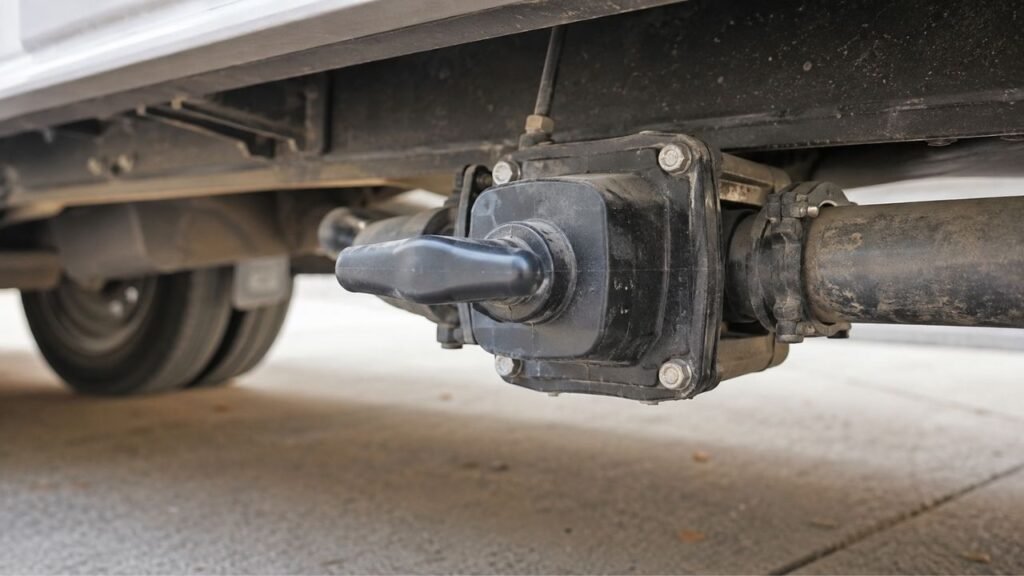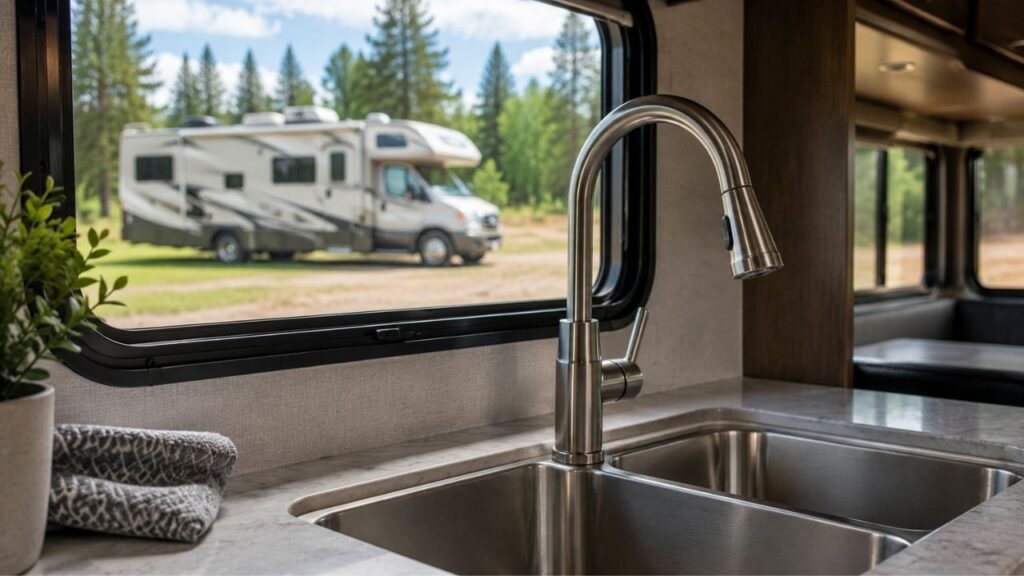
If your RV water pump pulses at only one faucet, the problem is usually local to that fixture. A clogged aerator, restricted spray head, kinked hose, partially closed valve, or faucet cartridge can reduce flow enough to make the pump repeatedly start and stop.
The good news is that this problem is usually easy to isolate. I’ll walk you through the quickest tests first, then show you when the faucet is responsible and when you should finally start looking at the pump itself.
Key Takeaways
- One-faucet pulsing usually points toward that faucet, not the pump.
- A clogged aerator is one of the most common causes.
- Remove the aerator before adjusting anything on your water pump.
- Opening another faucet can help confirm a low-flow restriction.
- Hot-only pulsing usually points toward the hot-water branch.
- Cold-only pulsing usually points toward the cold-side plumbing.
- Pulsing at every faucet suggests a broader pump or plumbing problem.
- Avoid changing pump pressure settings without checking your manual.
Why Would an RV Water Pump Pulse at Only One Faucet?
When every other faucet works normally, that detail matters. It usually means your pump can still build pressure and supply water correctly.
The Faucet Is Releasing Less Water Than the Pump Supplies
Most RV water pumps respond automatically to pressure changes.
When you open a faucet, water pressure drops. The pump senses that drop and starts supplying more water.
Problems begin when one faucet cannot release enough water.
The pump may supply water faster than the restricted faucet releases it. Pressure quickly rises again, causing the pump to shut off.
A moment later, pressure drops and the pump restarts.
That repeated cycle creates the pulsing sound and uneven water flow.
Pressure Reaches the Shutoff Point Too Quickly
Think of the pump as constantly watching system pressure.
The basic cycle looks like this:
- You open the faucet.
- Water pressure falls.
- The pump turns on.
- The restricted faucet releases limited water.
- Pressure quickly builds again.
- The pump switches off.
- Pressure drops again.
- The pump restarts.
This sequence can happen several times within a few seconds.
Why the Other Faucets May Work Normally
If your bathroom sink and shower work correctly, your pump probably has enough capacity.
That shifts attention toward the problem faucet itself.
Its aerator, internal cartridge, hose, spray head, or supply line may be restricting flow.
That is why I recommend checking the faucet before touching pump adjustments.
Is Some RV Water Pump Pulsing Normal?
A small amount of cycling can be normal when water demand is extremely low.
For example, your pump may switch on and off when you barely crack a faucet open. The pump delivers more water than the tiny opening can release.
That alone does not necessarily mean something is broken.
However, rapid pulsing with the faucet fully open deserves investigation.
You should also investigate if the problem suddenly appears after months of normal operation.
A noticeable surge in water flow is another sign of excessive cycling.
What Does the Pulsing Pattern Tell You?
Before removing parts, pay attention to exactly when the pulsing happens. The pattern can quickly narrow down the likely cause.
| What You Notice | Most Likely Problem Area | Best First Test |
| Only one faucet pulses | Faucet restriction | Remove the aerator |
| Pulsing stops when fully open | Very low water demand | Compare different flow settings |
| Pulsing stops with another faucet open | Restricted fixture flow | Inspect the first faucet |
| Only hot water pulses | Hot-side restriction | Test hot supply separately |
| Only cold water pulses | Cold-side restriction | Inspect the cold supply |
| Pull-out faucet pulses | Spray head or hose restriction | Remove the spray head |
| Every faucet pulses | Pump or main plumbing issue | Check pump inlet and strainer |
| Pump runs with faucets closed | Pressure loss somewhere | Check leaks and valves |
| Faucet is weak on city water | Faucet or branch restriction | Inspect the fixture |
This table is useful because it keeps troubleshooting focused.
You do not want to disassemble your pump when one dirty aerator causes everything.
What Causes an RV Water Pump to Pulse at One Faucet?
Several localized restrictions can create this exact symptom. I recommend checking them in the following order.
A Partially Clogged Faucet Aerator
The aerator is the small screen attached to the faucet outlet.
It can collect sediment, calcium deposits, sand, plastic fragments, and plumbing debris.
Even a partially clogged aerator may reduce flow significantly.
Your faucet may still produce water, making the blockage easy to overlook.
However, that reduced flow may be enough to trigger rapid pump cycling.
This is why the aerator should usually be your first check.
A Restrictive Faucet Aerator or Flow Limiter
Sometimes the aerator is perfectly clean but naturally restrictive.
Many newer faucets use low-flow inserts to reduce water consumption.
That can be useful when conserving freshwater while boondocking.
However, extremely low flow can cause some pumps to cycle repeatedly.
This is especially noticeable with fixed-speed demand pumps.
A Clogged Pull-Down or Pull-Out Spray Head
Many RV kitchen faucets now use removable spray heads.
Those heads often contain small internal passages and screens.
Mineral buildup or sediment can restrict those passages over time.
Try running water after removing the spray head.
If the pulsing disappears, the spray head is probably responsible.
A Kinked or Twisted Faucet Hose
Pull-out faucets usually have a flexible hose under the sink.
That hose can become twisted, pinched, or sharply bent.
Items stored underneath the sink may also press against it.
Check the entire hose while moving the faucet head.
A damaged or kinked hose can significantly limit water flow.
Debris Inside the Faucet Cartridge
Removing the aerator does not always solve the problem.
Sometimes debris becomes lodged inside the faucet cartridge.
The cartridge controls how water passes through the faucet body.
Sediment or worn internal parts can partially block that flow.
This issue becomes more likely when both hot and cold pulse.
A Partially Closed Shutoff Valve
Some RV faucets have individual shutoff valves underneath the sink.
A valve may look open while remaining partially closed internally.
Make sure the handle or valve is fully positioned.
Do not force a stiff valve because older plastic fittings can crack.
A Pinched Hot or Cold Supply Line
RV plumbing runs through tight cabinets and wall cavities.
A flexible supply hose may become pinched during installation or storage.
Pulsing on only hot or only cold helps narrow this down.
Follow the affected supply line as far as you can see.
Look for sharp bends, crushing, or twisted fittings.
Trapped Air in One Plumbing Branch
Air usually affects more than one fixture.
However, a recently serviced plumbing branch may trap air locally.
This can happen after winterizing, repairs, or draining the freshwater system.
The faucet may sputter, spit, or surge until the air escapes.
Running that faucet fully open can often purge the trapped air.
Pump Pressure-Switch Behavior at Very Low Flow
The pump itself may simply react strongly to very low water demand.
A restricted faucet causes pressure to rise quickly.
That can place the pump near its stop-and-start pressure threshold.
This does not automatically mean your pressure switch is defective.
The restriction may simply be exposing normal pump behavior.
How Do I Stop My RV Water Pump From Pulsing at One Faucet?
Start with the easiest tests before touching the pump. Most single-faucet problems can be identified without special tools.
1. Open the Faucet Fully
Turn the problem faucet completely open.
Test the cold side first, then the hot side.
Finally, test both together if you have a mixing faucet.
Notice whether pulsing becomes faster, slower, or disappears entirely.
If the pulsing stops at higher flow, restriction is likely involved.
2. Remove the Faucet Aerator
This is the fastest and most useful diagnostic test.
Unscrew the aerator from the faucet outlet.
You may be able to remove it by hand.
Use a cloth if you need light assistance from pliers.
Avoid crushing or scratching the aerator housing.
Now run the faucet without the aerator installed.
If the pump suddenly runs smoothly, you found the restriction.
3. Clean or Replace the Aerator
Inspect the aerator carefully before reinstalling it.
Look for:
- White mineral buildup
- Sand or grit
- Rust particles
- Plastic fragments
- Damaged mesh
- Debris between screens
- Misaligned internal inserts
You can rinse loose debris under clean water.
For mineral deposits, soak removable parts in white vinegar.
Rinse everything well before putting the aerator back together.
Replace the insert if its screen or internal parts are damaged.
4. Test the Pull-Out Spray Head Separately
If your faucet uses a removable sprayer, disconnect it.
Run water directly through the flexible hose.
If the pump stops pulsing, inspect the spray head.
Check both spray and stream modes if your head has them.
Debris sometimes affects one mode more than the other.
5. Inspect the Flexible Faucet Hose
Look under the sink while moving the spray head.
Make sure the hose slides without folding or twisting.
Move stored items away from the plumbing.
A storage bin or cleaning bottle may be squeezing the hose.
Also check where the hose passes through cabinet openings.
6. Compare Hot and Cold Water Separately
This test can save you considerable troubleshooting time.
Run cold water by itself.
Then run hot water by itself.
If only one side pulses, follow that specific supply branch.
If both sides pulse equally, look closer at the faucet itself.
7. Check Faucet Supply Lines and Valves
Inspect both supply hoses beneath the faucet.
Make sure neither hose is sharply bent or crushed.
Check any nearby shutoff valves.
They should be completely open during your test.
Also inspect fittings for sediment or damaged washers.
8. Purge Air From the Problem Line
Open the faucet fully and let it run.
You may hear sputtering while trapped air escapes.
Run both hot and cold water if necessary.
This is especially worthwhile after de-winterizing your RV.
It also helps after plumbing work or an empty freshwater tank.
9. Open Another Faucet at the Same Time
This is one of my favorite diagnostic tests.
Leave the problem faucet running while it pulses.
Then open another faucet somewhere else in the RV.
Listen to the pump.
If it suddenly runs continuously, the pump likely handles higher demand normally.
That makes low flow at the original faucet more suspicious.
You can then focus on that fixture instead of replacing the pump.
10. Test the Faucet on City Water
Turn off the onboard water pump first.
Connect your RV to a regulated city-water source.
Now test the same faucet again.
If that faucet remains weak compared with others, inspect the fixture.
The restriction is probably somewhere around that faucet or branch line.
If city-water flow is normal, investigate pump-related low-flow behavior next.
Should I Clean or Replace the Faucet Aerator?
Cleaning is usually worth trying first because aerators are simple parts.
If you find dirt or mineral buildup, clean the screens thoroughly.
Replacement makes more sense when the plastic insert is cracked.
You should also replace damaged mesh or badly corroded components.
Try not to install an excessively high-flow aerator just to stop cycling.
Higher flow uses freshwater faster when you are camping off-grid.
Fix the restriction while keeping reasonable water conservation in mind.
What If My RV Water Pump Pulses Only on Hot Water?
Hot-only pulsing usually means the restriction is somewhere on the hot side.
Start by checking the faucet with the cold supply operating separately.
Then inspect these common hot-side trouble spots:
- Hot-water supply hose
- Partially closed valve
- Faucet cartridge
- Water-heater bypass valve
- Trapped air
- Debris in hot-water fittings
- Restricted water-heater outlet
- Kinked hot-water line
This symptom often appears after de-winterizing.
One bypass valve may not have been returned correctly.
Debris can also move through the system after the first refill.
If cold water stays perfectly steady, the pump itself becomes less suspicious.
What If My RV Water Pump Pulses Only on Cold Water?
Cold-only pulsing points toward the cold-water side of that fixture.
Inspect the cold supply hose first.
Make sure it is not bent, twisted, or partially blocked.
Then check the cold shutoff valve if your RV has one.
Debris may also be trapped inside the faucet cartridge.
If hot water runs normally, the pump can probably supply adequate pressure.
That keeps your troubleshooting focused on the cold branch.
Why Did the Pulsing Start After De-Winterizing My RV?
De-winterizing can move air and debris throughout your RV plumbing. That makes single-faucet pulsing especially common after seasonal storage.
Common causes include:
- Trapped air in the branch line
- Sediment entering the aerator
- Mineral debris loosening during flushing
- Bypass valves left incorrectly positioned
- Partially opened winterizing valves
- Debris entering the faucet cartridge
- Sediment reaching the spray head
Start by running the affected faucet without its aerator.
Then purge both hot and cold lines completely.
Check your water-heater bypass configuration before deeper troubleshooting.
What If Removing the Aerator Does Not Stop the Pulsing?
Do not assume the pump is bad yet. Several other restrictions can exist farther inside the fixture.
Remove the Spray Head
If your faucet has a pull-out sprayer, disconnect it.
Test the hose directly without the head installed.
Steady flow means the spray head contains the restriction.
Inspect the Faucet Cartridge
A cartridge can become clogged internally.
This may require removing the faucet handle and cartridge.
Follow the faucet manufacturer’s instructions whenever possible.
Take pictures during disassembly so reassembly stays straightforward.
Compare the Branch Supply
If practical, disconnect the faucet supply line carefully.
Place the line somewhere safe before testing water flow.
This helps determine whether the restriction is upstream.
Take extra care around electrical equipment and cabinet materials.
Check for Local Filters
Some RV owners install additional filters under individual sinks.
A clogged filter can reduce flow through only one fixture.
Check any cartridge, screen, or inline filter near the faucet.
Replace it if flow improves after bypassing the filter.
Start Investigating the Pump Last
If every local check fails, then look toward the pump.
You may be dealing with pressure-switch or bypass behavior.
However, verify other fixtures carefully before changing pump settings.
When Is the RV Water Pump Actually the Problem?
When symptoms spread beyond one fixture, your diagnosis changes. That is when I would start looking farther upstream.
Possible pump-related signs include:
- Several faucets pulse at similar flow rates
- Water pressure is weak throughout the RV
- The pump struggles to prime
- The pump never reaches normal pressure
- The inlet strainer is clogged
- The pump cycles with every faucet closed
- The pump makes new or unusual noises
- The motor receives low electrical voltage
- Internal pump valves are damaged
- The pressure switch behaves inconsistently
- An internal bypass is misadjusted or failing
If only one faucet misbehaves, stay focused on that fixture.
Replacing a functioning water pump would not fix a clogged faucet.
Should I Adjust the RV Water Pump Pressure Switch?
Pressure-switch adjustment should be one of your last troubleshooting steps. The correct procedure depends on your exact pump model.
Check the Exact Pump Model First
Find the manufacturer’s label on the pump.
Record the model number and rated pressure.
Determine whether your pump uses an internal bypass.
Different pumps use different pressure and bypass arrangements.
Why Pressure Adjustment Can Affect Cycling
The pressure switch decides when the pump starts and stops.
Changing its setting changes those operating thresholds.
That may influence how the pump behaves at low faucet flow.
However, it will not remove an actual plumbing restriction.
Why You Should Not Adjust Screws Blindly
Randomly turning adjustment screws can create new problems.
You could make the pump cycle more frequently.
You may also prevent it from shutting down properly.
Always follow instructions for your specific pump model.
Never rely on a generic number of adjustment turns.
Will an Accumulator Tank Stop Single-Faucet Pulsing?
An accumulator tank can smooth water pressure and reduce pump cycling.
However, I would not use one to hide a clogged faucet.
Fix the restriction first.
Then decide whether normal low-flow cycling still bothers you.
An accumulator stores a small amount of pressurized water.
That helps reduce repeated pump starts during very small water demands.
Some RV pump designs already manage low-flow operation internally.
Those systems may not require an accumulator at all.
Check your pump manufacturer’s recommendations before adding one.
Can Rapid Pulsing Damage an RV Water Pump?
A few normal cycles during low water flow are not an emergency.
The bigger concern is frequent, rapid cycling that continues unnecessarily.
Every pump start places some load on electrical components.
Repeated switching can also increase pressure-switch wear.
That is why sudden rapid cycling deserves attention.
You do not need to panic or immediately replace the pump.
Find the restriction and correct the underlying cause first.
How Can I Prevent One-Faucet Pulsing From Coming Back?
A little routine plumbing maintenance can prevent many repeat problems.
- Check faucet aerators periodically.
- Clean mineral deposits before buildup becomes severe.
- Flush plumbing after making repairs.
- Purge lines thoroughly after de-winterizing.
- Keep storage away from flexible water hoses.
- Prevent pull-out hoses from twisting.
- Inspect supply lines for sharp bends.
- Keep faucet valves fully open.
- Clean your pump inlet strainer regularly.
- Investigate sudden changes in water flow.
- Follow manufacturer guidance before adjusting pump settings.
Hard water can clog small faucet passages surprisingly quickly.
Regular inspection is usually easier than troubleshooting later.
Final Words
If your RV water pump pulses at only one faucet, start there.
Remove the aerator, compare hot and cold water, and inspect the sprayer.
Then check hoses, valves, and the local plumbing branch.
Opening another faucet can also reveal whether low flow causes cycling.
Only move toward pump adjustments after those tests fail.
That approach saves time and helps you avoid replacing good parts.
Related FAQs
Why Does My RV Water Pump Pulse When the Faucet Is Barely Open?
Your pump may cycle because the faucet releases very little water. Pressure rises quickly, shuts the pump off, then falls enough to restart it. Mild cycling at extremely low flow can be normal for some fixed-speed RV pumps.
Why Does My RV Water Pump Stop Pulsing When I Open Another Faucet?
Opening another faucet increases total water demand. The pump can then run continuously without reaching its shutoff pressure so quickly. This usually suggests the original faucet is providing too little flow.
Can a Clogged Aerator Make an RV Water Pump Cycle On and Off?
Yes. A clogged aerator restricts water leaving the faucet. The pump builds pressure faster than the faucet releases water, causing repeated starting and stopping until the restriction is removed.
Why Does My RV Kitchen Faucet Pulse but the Bathroom Faucet Does Not?
The kitchen faucet may have a clogged aerator, restricted spray head, kinked hose, blocked cartridge, or partially restricted supply line. Normal bathroom flow makes a general pump problem less likely.
Why Does My RV Water Pump Pulse Only With Hot Water?
Hot-only pulsing usually indicates a restriction in the hot-water branch. Check the hot supply line, faucet cartridge, bypass valves, water-heater connections, and trapped air before inspecting the pump.
Why Does My RV Water Pump Pulse After De-Winterizing?
Air, sediment, and loosened debris can enter faucet screens during de-winterizing. Incorrect bypass valve positions can also affect flow. Flush each fixture and inspect the problem faucet’s aerator first.
Should an RV Water Pump Run Continuously With a Faucet Open?
Not always. Pump behavior depends on faucet flow and pump design. Higher water demand usually keeps a fixed-speed pump running, while very low flow may cause normal intermittent cycling.
Can Low-Flow RV Faucets Cause Water Pump Cycling?
Yes. A low-flow faucet may release less water than the pump supplies. Pressure then reaches the shutoff threshold quickly, causing repeated cycling even when the pump itself works correctly.
Will Replacing the Faucet Stop RV Water Pump Pulsing?
It can if the faucet contains the restriction. However, clean the aerator, test the spray head, inspect the cartridge, and check supply hoses before replacing the entire fixture.
Why Does My RV Water Pump Cycle With Every Faucet Closed?
That is a different problem from single-faucet pulsing. It usually suggests pressure is dropping somewhere from a leak, faulty check valve, internal pump issue, or another plumbing problem.

Steven Parker writes about everyday RV life, from setup tips to long-term living decisions. His content reflects a calm, experienced approach to RV ownership and travel. He focuses on comfort, reliability, and realistic expectations.