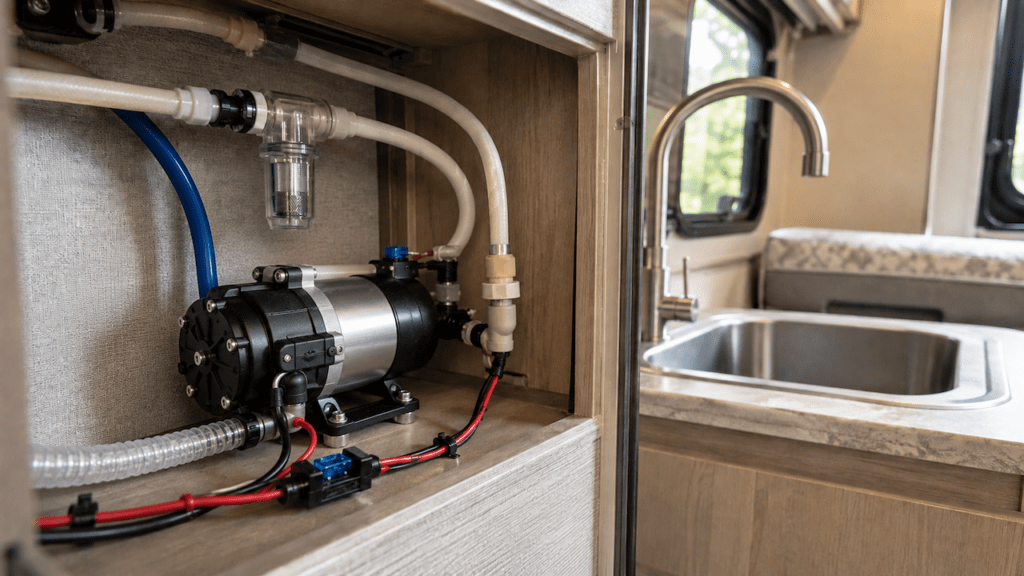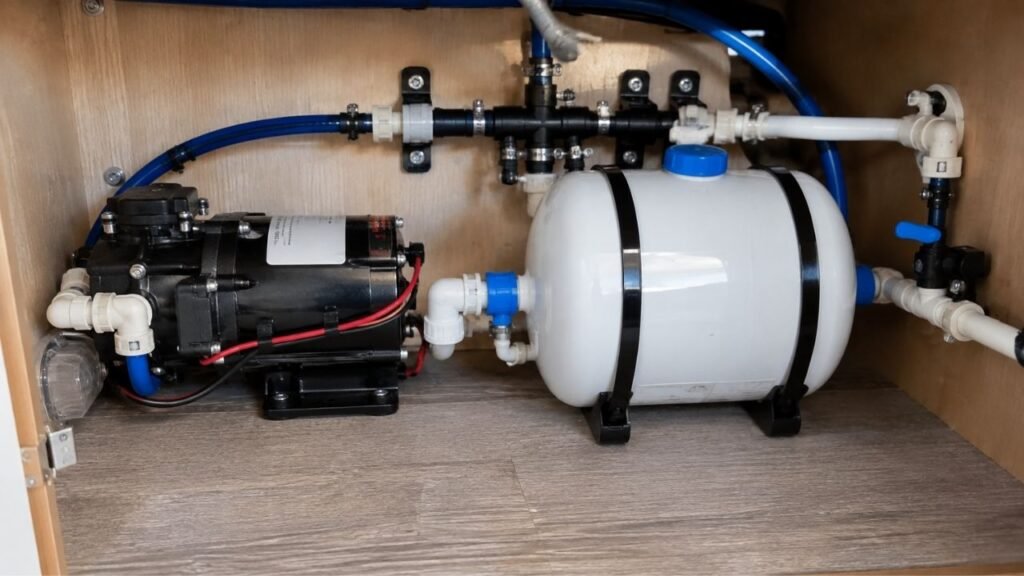
An RV water pump can feel warm during normal operation. However, excessive heat usually means the pump is running too long, cycling repeatedly, struggling with restricted water flow, receiving poor electrical power, or developing an internal problem.
In this guide, I’ll help you figure out what the heat means, what to check first, and when an overheating RV water pump may need repair or replacement.
Key Takeaways
- A slightly warm RV water pump is not always a problem.
- A pump that becomes extremely hot needs troubleshooting.
- Continuous running can quickly increase motor temperature.
- Plumbing leaks often cause unnecessary pump cycling.
- A clogged strainer can restrict water entering the pump.
- Air leaks on the inlet side can make pumping difficult.
- Poor wiring or voltage drop can affect pump performance.
- Some pumps can run dry briefly but still overheat.
- Thermal shutdown usually indicates excessive heat buildup.
- Always check your exact pump specifications before making adjustments.
Is It Normal for an RV Water Pump to Get Hot?
Yes, an RV water pump can become warm while operating. The electric motor naturally produces some heat whenever it runs.
A few minutes of normal water use may leave the motor warm. That alone does not mean anything is wrong.
The bigger concern is how quickly the temperature rises. You should also watch how the pump behaves while getting hot.
I would investigate further if the pump:
- becomes extremely hot after light water use;
- shuts itself off while running;
- starts working again after cooling;
- smells like hot plastic or electrical wiring;
- produces weak water pressure as it heats;
- repeatedly blows a fuse;
- runs when every faucet is closed.
There is no single exterior temperature that applies to every RV pump. Motor design, compartment temperature, pressure, and runtime all affect heat.
That is why pump behavior matters more than guessing by touch.
Why Is My RV Water Pump Hot to the Touch?
Several problems can make an RV water pump hotter than expected. I recommend starting with the simple plumbing causes before assuming the motor has failed.
The Pump Is Running Too Long
Long runtime is one of the easiest ways to overheat a pump.
Most RV fresh-water pumps operate only when water pressure drops. You open a faucet, the pump starts, and it stops afterward.
Problems begin when the motor rarely gets a chance to rest.
This can happen during:
- long showers;
- tank flushing;
- extended outdoor shower use;
- filling containers;
- plumbing maintenance;
- a leak that prevents shutoff.
Some RV pumps are designed for intermittent operation. They may tolerate longer runs, but they are not necessarily meant to operate continuously.
If the motor becomes very hot during ordinary water use, investigate why it is staying on.
A Plumbing Leak Is Keeping the Pump Running or Cycling
A small leak can keep an RV pump surprisingly busy.
Demand pumps automatically maintain pressure inside the plumbing system. If pressure slowly drops, the pump turns on again.
You may hear a short burst every few minutes.
Common leak locations include:
- faucet cartridges;
- toilet water valves;
- PEX fittings;
- exterior showers;
- water heater connections;
- low-point drains;
- pump fittings;
- city-water inlet check valves.
Some leaks are obvious because water appears on the floor.
Others are hidden behind cabinets or inside the underbelly.
A leaking toilet valve can also pass water without creating an obvious puddle.
Close every faucet and appliance using water. Then listen carefully.
If the pump cycles when nobody uses water, pressure is escaping somewhere.
The more frequently it cycles, the more heat the motor can build.
The Pump Strainer or Inlet Is Restricted
Your RV pump needs a steady supply of water.
Many systems have a small strainer installed before the pump inlet. It catches debris before that debris enters the diaphragm assembly.
Over time, the strainer can collect:
- plastic tank debris;
- sediment;
- mineral deposits;
- construction debris;
- pieces of sealing material.
A dirty strainer reduces the amount of water reaching the pump.
The same problem can happen if the inlet hose becomes kinked.
Check the entire suction line between the tank and pump.
Look for:
- flattened flexible hose;
- sharp bends;
- closed valves;
- partially closed valves;
- clogged strainers;
- damaged fittings.
Always turn the pump off before opening its strainer.
Relieve water pressure first so you do not create a mess.
The Pump Is Starved for Water or Losing Prime
An RV pump cannot work properly without a reliable water supply.
Sometimes the fresh tank is simply empty.
Do not completely trust the tank level monitor. RV tank sensors are well known for giving inaccurate readings.
Confirm the actual water level whenever possible.
Also inspect the valve arrangement if you recently winterized or de-winterized your RV.
A winterization valve accidentally left in the wrong position may make the pump draw air instead of tank water.
You could also have a suction-side air leak.
Common locations include:
- loose pump fittings;
- cracked inlet hoses;
- damaged strainer bowls;
- loose strainer seals;
- winterization hoses;
- poorly tightened clamps.
This type of leak can be confusing.
You may not see water dripping anywhere.
The inlet side is under suction, so the pump can pull air inward instead.
Air entering the system often causes sputtering faucets and inconsistent pressure.
Rapid Cycling Is Increasing Motor Heat
Short cycling means the pump repeatedly starts and stops within a short period.
For example, you may open a faucet slightly and hear:
run, stop, run, stop, run, stop.
That behavior puts additional demand on the motor.
Possible causes include:
- very low faucet flow;
- restrictive shower heads;
- clogged faucet aerators;
- dirty filters;
- restrictive plumbing;
- pressure-switch behavior;
- incorrect pressure settings.
Some amount of cycling can occur with low-flow fixtures.
Constant aggressive cycling deserves attention.
The first step is checking simple restrictions before adjusting anything inside the pump.
The Pump Is Working Against Too Much Restriction
Restrictions can also occur after the pump.
A clogged filter or partly closed valve can reduce water flow downstream.
The pump may still build pressure, but the overall system works poorly.
Possible restrictions include:
- clogged water filters;
- dirty faucet aerators;
- restrictive shower heads;
- kinked outlet hoses;
- partially closed valves;
- damaged plumbing lines.
Start with removable filters and aerators.
If water pressure improves after removing a clogged component, you have likely found the restriction.
Replace heavily contaminated filters rather than forcing the pump to work through them.
Low Voltage or Wiring Problems Are Affecting the Pump
RV water pumps normally depend on the 12-volt electrical system.
Poor electrical delivery can affect how the motor performs.
Possible problems include:
- weak house batteries;
- excessive voltage drop;
- undersized wiring;
- loose electrical connections;
- corroded terminals;
- damaged switches;
- poor ground connections.
Do not rely only on battery voltage measured while nothing is running.
A battery can look acceptable at rest but drop considerably under load.
The more useful test is voltage directly at the pump terminals while the pump operates.
Compare that reading with the requirements for your exact model.
Also feel the electrical connectors carefully after operation.
A warm or discolored connector can indicate electrical resistance.
Turn the system off before repairing any wiring problem.
Poor Ventilation Is Trapping Motor Heat
The pump’s installation location matters more than many RV owners realize.
Water pumps are often hidden inside:
- cabinets;
- bed platforms;
- wet bays;
- enclosed storage compartments;
- utility spaces.
These locations can become extremely warm during summer.
The motor generates heat while operating. That heat needs somewhere to go.
A tightly enclosed compartment can slow heat dissipation.
Some manufacturers specify minimum ventilation or installation-space requirements.
Check your pump manual before changing its location.
Also make sure insulation, stored equipment, towels, or other items are not packed directly around the motor.
Do not add ventilation openings where they could expose electrical components to water.
The Pressure Switch or Internal Bypass Has a Problem
A demand pump normally shuts off after reaching its preset pressure.
The pressure switch controls this behavior.
If the switch sticks or becomes damaged, the pump may continue running.
Some pumps also use an internal bypass system.
Problems with those settings can affect cycling and shutoff behavior.
You may notice that:
- the pump never completely stops;
- pressure seems unusually high;
- pressure fluctuates;
- the pump cycles constantly.
I would not start turning adjustment screws randomly.
Improper pressure adjustment can create additional problems.
If external plumbing checks look good, follow the manufacturer’s adjustment procedure.
Otherwise, let an RV technician test the pressure switch and bypass system.
The Diaphragm or Pump Head Is Mechanically Binding
Most RV demand pumps use a diaphragm-style pumping mechanism.
Internal components can eventually wear or become damaged.
Possible problems include:
- damaged diaphragms;
- debris inside valves;
- freeze damage;
- hardened internal seals;
- damaged valve assemblies;
- mechanical binding.
A pump that has frozen during winter storage deserves extra attention.
Even a small amount of trapped water can damage plastic or internal components.
Mechanical resistance makes the motor work harder.
That additional workload can produce excessive heat.
You may also hear unusual grinding, clicking, or strained motor sounds.
The Motor Itself Is Failing
Sometimes the pump motor is simply reaching the end of its useful life.
Motor problems can include:
- worn internal components;
- damaged windings;
- overheating insulation;
- internal electrical resistance;
- mechanical wear.
A failing motor may become hot even when the plumbing system appears normal.
You might also notice:
- burning smells;
- unusual noises;
- repeated thermal shutdown;
- fuse failures;
- weakening pump performance.
Do not assume the motor is bad immediately.
First eliminate supply, restriction, leak, wiring, and ventilation problems.
If everything else checks out, motor failure becomes much more likely.
What Does the Pump’s Behavior Tell You?
The exact way your pump behaves can narrow the problem quickly. Use the table below as a starting point before taking anything apart.
| What You Notice | Most Likely Causes | What to Check First |
| Pump is hot and runs constantly | Leak, air entering inlet, low water, pressure problem | Tank level, valves, leaks |
| Pump is hot and cycles with faucets closed | Pressure leak, toilet valve, check valve | Plumbing and fixtures |
| Pump is hot with weak flow | Clogged strainer, filter, kinked line | Strainer and hoses |
| Pump is hot and water sputters | Air leak, low tank, lost prime | Inlet fittings and tank |
| Pump is hot but no water comes out | Empty tank, blocked inlet, lost prime | Water supply and valves |
| Pump stops, cools, then works again | Thermal protection activating | Find overheating cause |
| Pump repeatedly blows a fuse | Motor overload, wiring issue, binding | Wiring and pump condition |
| Pump gets hot during long showers | Extended runtime, restriction, poor ventilation | Runtime and airflow |
| Pump runs with no water being used | Plumbing pressure loss | Faucets, toilet, fittings |
| Pump heats more on low battery | Voltage drop, poor connections | Voltage at pump terminals |
What Should I Do Immediately If My RV Water Pump Is Very Hot?
If the pump feels excessively hot, do not keep running it repeatedly. A few simple steps can prevent a minor problem from becoming an expensive failure.
- Switch the pump off.
- Stop repeatedly restarting it.
- Let the motor cool naturally.
- Check for a burning electrical smell.
- Look for melted or discolored wiring.
- Confirm the fresh tank contains water.
- Check that supply valves are fully open.
- Inspect the pump strainer for debris.
- Look underneath the RV for leaks.
- Check visible fittings around the pump.
- Restart only after correcting obvious problems.
Some pumps contain thermal protection.
The motor may shut itself off when it gets too hot.
It can then restart automatically once the temperature drops.
For that reason, always switch the pump circuit off before putting your hands near it.
How Do You Troubleshoot an Overheating RV Water Pump?
You can solve many overheating problems without replacing the pump. Work through these checks in order so you avoid replacing good parts unnecessarily.
Step 1: Confirm the Fresh Tank Has Water
Start with the easiest possibility.
Make sure the fresh tank actually contains water.
If possible, verify visually instead of relying completely on the tank monitor.
A pump drawing from an empty tank may continue running without building pressure.
Step 2: Check the Water-Supply Valves
Look at the plumbing valves near the pump and fresh tank.
Make sure the pump can actually draw from the tank.
Pay special attention if your RV was recently:
- winterized;
- de-winterized;
- sanitized;
- repaired;
- connected to city water.
A valve left in the wrong position can interrupt the water supply.
Step 3: Inspect and Clean the Pump Strainer
Switch off the pump.
Open a faucet briefly to relieve pressure.
Locate the strainer near the pump inlet.
Remove the bowl according to its design.
Clean out any visible debris.
Also inspect the screen for damage.
Check the sealing gasket before reinstalling the bowl.
A loose or damaged strainer seal can allow air into the suction line.
Step 4: Inspect the Inlet Hose for Kinks and Air Leaks
Follow the hose from the fresh tank toward the pump.
Look carefully around every fitting.
Check for:
- loose clamps;
- cracked hoses;
- flattened sections;
- loose threaded fittings;
- damaged seals.
Remember that a suction leak may pull air without leaking water outward.
Listen for unusual sucking or bubbling sounds.
Step 5: Prime the Pump and Purge Trapped Air
Turn the pump back on.
Open a faucet and allow water to flow.
Do not immediately shut the faucet when it begins sputtering.
Let the system purge trapped air.
Repeat the process through the RV.
Check:
- kitchen faucet;
- bathroom faucet;
- shower;
- outside shower;
- toilet.
You want steady water without large bursts of air.
Step 6: Check Whether the Pump Shuts Off
Close every fixture.
Listen to the pump.
A properly pressurized system should normally allow the pump to shut down.
If the motor continues running, something is preventing cutoff pressure.
Possible causes include:
- a leak;
- incoming air;
- restricted supply;
- pressure-switch problem;
- internal pump problem.
This single test can tell you a lot.
Step 7: Listen for Cycling With No Water Use
Leave every faucet closed.
Wait several minutes.
If the pump suddenly runs for a second or two, pressure is dropping.
Inspect the easiest leak points first.
Check:
- toilet valve;
- kitchen faucet;
- bathroom faucet;
- outside shower;
- water heater;
- visible PEX fittings;
- pump connections.
Also look underneath the RV.
Water can travel a surprising distance before becoming visible.
Step 8: Check for Flow Restrictions
Remove or inspect components that commonly restrict flow.
Start with:
- water filters;
- faucet aerators;
- shower heads;
- strainers;
- shutoff valves.
Replace clogged filters.
Clean mineral buildup from aerators.
Make sure every needed valve opens completely.
Step 9: Measure Voltage at the Pump While Running
Use a multimeter if you are comfortable with basic 12-volt testing.
Set the meter correctly for DC voltage.
Measure directly across the pump’s electrical supply while it operates.
Compare the reading with your specific pump’s requirements.
A significant voltage drop between the battery and pump deserves investigation.
Do not probe wiring carelessly around water.
If electrical troubleshooting is unfamiliar to you, this is a good point to involve a technician.
Step 10: Inspect Wiring, Grounds, and Connectors
Turn the circuit off before touching connections.
Look for:
- loose terminals;
- corrosion;
- damaged insulation;
- undersized replacement wire;
- poor crimp connections;
- weak grounds;
- overheated connectors.
Pay attention to discoloration.
A darkened connector often indicates previous overheating.
Repair damaged wiring before continuing pump tests.
Step 11: Check the Pump’s Ventilation
Look at the space surrounding the motor.
Remove anything blocking normal airflow.
Do not pack storage items directly against the pump.
Check your owner’s manual for installation-space requirements.
Some pump designs need more surrounding air than others.
Hot summer weather makes ventilation even more important.
Step 12: Compare Current Draw With the Pump Specification
Current draw can provide another useful clue.
You will need an appropriate meter and safe testing method.
Compare the measured current with the specifications for your exact model.
Do not use a random amperage number from another pump.
Different pumps operate at different pressures and electrical loads.
Unusually high current can point toward mechanical or electrical problems.
Step 13: Suspect an Internal Pump Problem
If water supply, plumbing, voltage, wiring, and ventilation all check out, focus on the pump itself.
Possible internal failures include:
- stuck diaphragm;
- damaged valve assembly;
- freeze damage;
- pressure-switch failure;
- motor failure.
At this point, repair or replacement may be more practical than further adjustment.
Why Does My RV Water Pump Get Hot and Then Stop Working?
A pump that gets hot, shuts off, then works again after cooling may be activating its thermal protection.
Many RV pump motors contain protection designed to interrupt power when temperatures rise too high.
Once the motor cools, that protection may reset.
The important point is this:
Thermal protection explains why the pump stopped. It does not explain why the pump overheated.
You still need to find the underlying cause.
Common possibilities include:
- excessive runtime;
- blocked water flow;
- poor ventilation;
- mechanical binding;
- electrical problems.
Do not keep restarting the pump every time it cools.
Repeated overheating can eventually damage the motor.
Why Is My RV Water Pump Hot but Not Pumping Water?
A hot pump with little or no water output usually points toward a supply, priming, restriction, or internal pump problem. Start with the water source before blaming the motor.
No Water Is Reaching the Pump
Check the fresh tank first.
Then inspect the tank outlet and supply valves.
A closed valve can completely stop water from reaching the pump.
The Pump Is Drawing Air
An inlet leak can prevent reliable priming.
Look around fittings, hoses, and the strainer.
Even a small amount of incoming air can disrupt pump performance.
The Pump Inlet Is Blocked
Clean the strainer.
Inspect the hose.
Make sure debris has not entered the inlet fitting.
A blocked inlet can leave the motor running with almost no water movement.
The Pump Has Lost Prime
This commonly happens after:
- winterization;
- storage;
- tank draining;
- plumbing repairs.
Open a faucet and let the pump attempt to prime.
Make sure the inlet line contains water and does not draw air.
The Pump Has an Internal Failure
If the motor runs but cannot move water, the diaphragm or valve assembly may be damaged.
If the motor barely turns and becomes hot quickly, internal binding may be occurring.
A pump that has suffered freeze damage is especially suspicious.
Can an RV Water Pump Overheat Even If It Can Run Dry?
Yes.
This confuses many RV owners.
Some water pumps are advertised as capable of running dry without immediate damage.
That does not automatically mean they can operate dry forever.
Dry-run capability and continuous-duty operation are two different things.
A pump may tolerate temporary dry operation while still having:
- intermittent-duty limits;
- thermal protection;
- ventilation requirements;
- motor temperature limits.
That is why I recommend checking the manual for your exact pump.
Do not assume every pump handles dry running the same way.
If the fresh tank is empty, turn the pump off rather than letting it run unnecessarily.
Can Low Battery Voltage Cause an RV Water Pump to Run Hot?
Low voltage or excessive voltage drop can contribute to poor pump operation.
The more useful question is whether the pump receives proper voltage while actually running.
Several things can reduce voltage reaching the motor:
- discharged batteries;
- undersized wiring;
- long wire runs;
- corroded terminals;
- loose switches;
- poor grounds.
Check voltage directly at the pump under load.
Then compare that reading with the pump manufacturer’s specification.
Do not immediately replace the pump because battery voltage appears low.
First correct the electrical supply and test again.
Can a Clogged Water Filter Make an RV Water Pump Overheat?
A severely clogged filter can contribute to poor pump operation.
The effect depends on where the restriction is located.
There are two components RV owners often confuse.
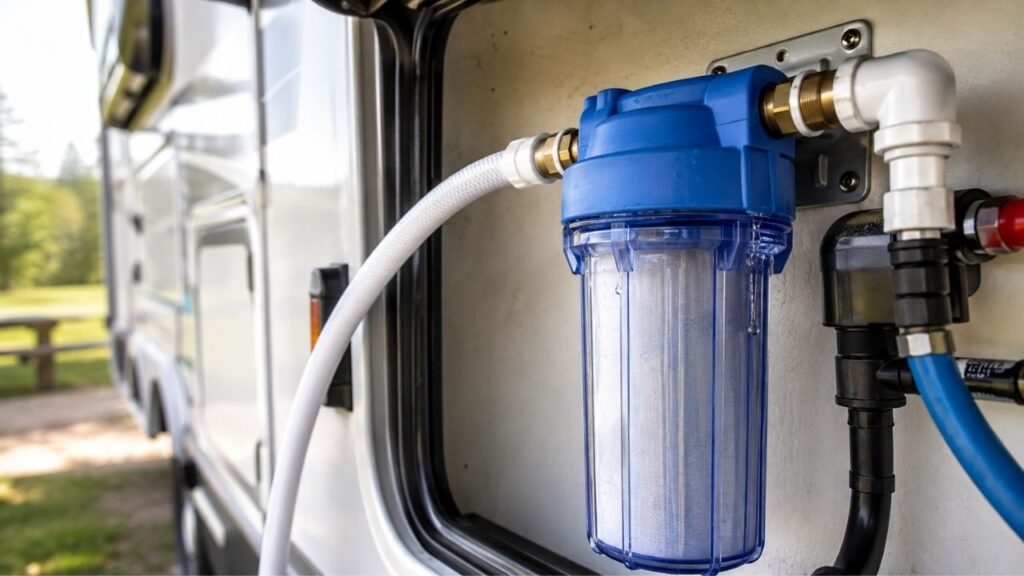
The pump inlet strainer protects the pump from debris.
A water filter cartridge usually treats water somewhere downstream.
A clogged inlet strainer can starve the pump.
A clogged downstream filter can restrict water delivery and increase backpressure.
Either problem can change how often and how long the pump runs.
Replace dirty filters instead of forcing water through heavily restricted media.
Could Hot Weather Make My RV Water Pump Overheat?
Yes, high ambient temperatures can make an existing heat problem worse.
RV utility compartments can become extremely warm in summer.
This is especially noticeable in direct sunlight.
The motor already creates heat whenever it operates.
If the surrounding air is hot, that heat cannot escape as quickly.
Long pump runs become more demanding in those conditions.
Make sure your pump has the ventilation required by its manufacturer.
Avoid packing storage tightly around the motor.
Hot weather alone may not indicate a failing pump.
However, it can expose problems that were barely noticeable in cooler conditions.
Does an Accumulator Tank Stop an RV Water Pump From Overheating?
An accumulator tank can reduce cycling in some RV water systems.
It stores a small amount of pressurized water.
That can reduce how often certain pumps start during low-flow use.
However, an accumulator is not a universal fix for overheating.
It will not repair:
- a clogged strainer;
- a plumbing leak;
- bad wiring;
- a damaged motor;
- a closed valve;
- an air leak.
Some modern bypass-style pumps are specifically designed to work without an accumulator.
Check the pump manufacturer’s recommendations before installing one.
Fix the actual overheating cause first.
Then consider an accumulator if it suits your plumbing system.
How Can I Prevent My RV Water Pump From Overheating Again?
A little preventive maintenance can keep your pump cooler and more reliable.
- Keep the pump inlet strainer clean.
- Maintain enough water in the fresh tank.
- Fix suction-side air leaks quickly.
- Purge trapped air after de-winterizing.
- Verify winterization valves before each trip.
- Investigate unexplained cycling.
- Replace heavily clogged filters.
- Clean restrictive faucet aerators.
- Keep electrical connections tight.
- Maintain clean ground connections.
- Use properly sized wiring.
- Keep storage away from the pump motor.
- Follow the manufacturer’s duty limits.
- Winterize the pump correctly.
- Do not randomly change pressure settings.
I also recommend listening to your pump occasionally.
You will quickly learn what normal operation sounds like.
Changes in sound, runtime, or cycling often appear before complete failure.
When Should You Repair or Replace an Overheating RV Water Pump?
Not every hot pump needs replacement. Many problems come from the surrounding plumbing or electrical system rather than the pump itself.
Repair may make sense when the issue involves:
- a dirty strainer;
- loose fitting;
- damaged hose;
- replaceable pressure switch;
- serviceable pump head;
- loose wiring;
- faulty connector;
- replaceable check valve.
Replacement becomes more reasonable when:
- the motor repeatedly reaches thermal shutdown;
- the pump smells burned;
- internal components bind repeatedly;
- the housing has freeze damage;
- the pump repeatedly blows the correct fuse;
- current draw remains abnormal;
- pressure stays poor after troubleshooting;
- replacement parts cost nearly as much as a new pump;
- reliability has become unpredictable.
Do not replace the pump before checking the plumbing.
A brand-new pump can overheat too if the original restriction or wiring problem remains.
Final Words
An RV water pump becoming slightly warm is not automatically a problem.
What matters is whether it becomes excessively hot, runs too long, cycles unnecessarily, loses pressure, shuts down, or shows electrical warning signs.
I would start with the simple checks first.
Confirm the water supply, clean the strainer, inspect the inlet hose, look for leaks, and verify that the pump shuts off properly.
Then move into electrical testing and internal pump diagnosis.
That approach helps you avoid replacing a perfectly good pump because of a clogged strainer or loose fitting.
Most importantly, use the specifications for your exact pump model whenever you check voltage, current draw, pressure, duty cycle, or adjustment settings.
Related FAQs
Should an RV Water Pump Be Hot to the Touch?
An RV water pump can feel warm after normal use because its 12-volt motor produces heat. It becomes concerning when the pump feels excessively hot, repeatedly shuts down, smells burned, loses pressure, or overheats after only light use.
How Hot Is Too Hot for an RV Water Pump?
There is no single safe exterior temperature for every RV water pump. Pump designs and installation conditions vary, so repeated thermal shutdown, burning smells, extremely rapid heating, or worsening performance are better warning signs than relying on one temperature number.
Why Does My RV Water Pump Get Hot and Shut Off?
The pump may be reaching its thermal protection limit. Excessive runtime, restricted water flow, poor ventilation, electrical problems, or internal mechanical resistance can cause the motor to overheat until thermal protection interrupts operation.
Why Does My RV Water Pump Keep Running After I Close the Faucet?
A pump that keeps running may be unable to build shutoff pressure. Check for plumbing leaks, suction-side air leaks, an empty tank, restricted inlet flow, open valves, and possible pressure-switch or internal pump problems.
Why Does My RV Water Pump Cycle When No Water Is Being Used?
Cycling without water use usually means system pressure is slowly dropping. Possible causes include a leaking faucet, toilet valve, loose plumbing fitting, pump check valve, city-water inlet check valve, or an internal pump leak.
Can an RV Water Pump Burn Out From Running Dry?
It depends on the pump. Some RV pumps are designed to tolerate temporary dry running, but that does not necessarily mean unlimited dry operation. Check your pump’s manual and turn it off when the fresh tank is empty.
How Long Can an RV Water Pump Run Continuously?
There is no universal continuous-runtime limit for all RV water pumps. Many common models are intended for intermittent operation, so check the manual for your specific pump rather than assuming it can run continuously without overheating.
Can a Bad Pressure Switch Cause a Water Pump to Overheat?
Yes. A faulty pressure switch can prevent the pump from shutting off when system pressure reaches the correct level. The longer the motor runs unnecessarily, the more heat it can produce.
Can a Clogged Strainer Make an RV Water Pump Hot?
Yes. A clogged inlet strainer can restrict water reaching the pump and make the system perform poorly. Clean the strainer and inspect the inlet hose whenever an overheating pump also has weak or inconsistent water flow.
Can a Weak RV Battery Damage the Water Pump?
A weak battery or excessive voltage drop can cause poor pump performance and contribute to electrical problems. Measure voltage at the pump while it operates and compare the result with the specifications for your exact model.
Should I Leave My RV Water Pump On All the Time?
Many RV owners leave the pump switched on while using the fresh tank system, but turning it off when leaving the RV can reduce the risk of unnoticed leaks. A pump should not run continuously just because the switch remains on.
Why Does My RV Water Pump Work Again After Cooling Down?
The motor may have an internal thermal protector that temporarily interrupts power when the temperature becomes excessive. Once the motor cools, the protection can reset, allowing the pump to operate again until the overheating problem returns.
Does My RV Water Pump Need More Ventilation?
Possibly. Pumps installed in tight, hot compartments may struggle to release motor heat. Check the installation requirements for your exact pump and make sure stored items or insulation are not blocking required airflow.
When Should I Replace an Overheating RV Water Pump?
Consider replacement when the pump repeatedly overheats after plumbing and electrical problems have been corrected, develops a burning smell, suffers internal binding, has severe freeze damage, repeatedly trips protection, or becomes unreliable.

Steven Parker writes about everyday RV life, from setup tips to long-term living decisions. His content reflects a calm, experienced approach to RV ownership and travel. He focuses on comfort, reliability, and realistic expectations.