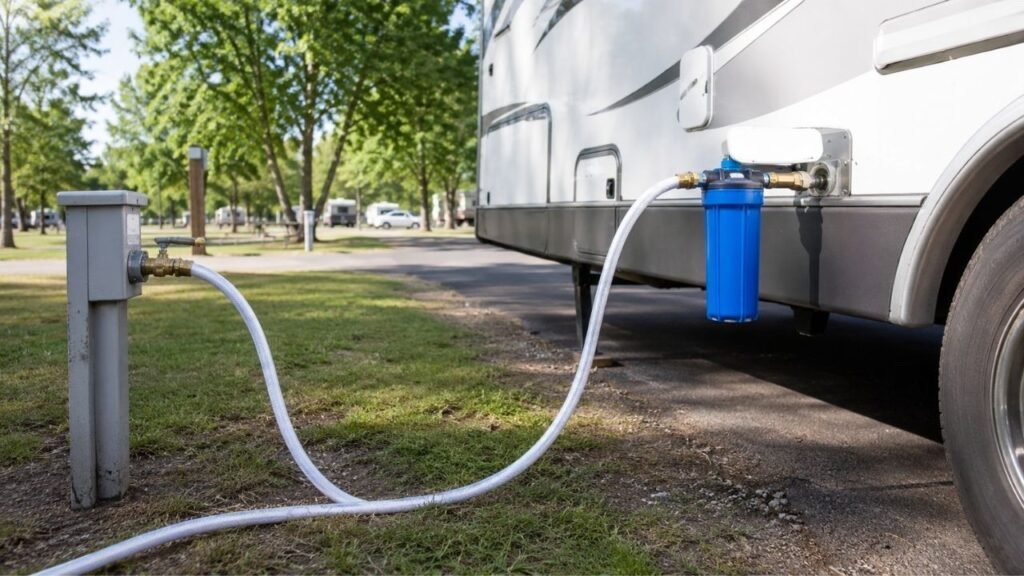
Yes, an RV water filter can reduce the water pressure you feel at faucets and showers because it adds resistance to the water line. A clean, properly sized filter may cause only a small change, while a clogged, restrictive, or undersized filter can noticeably weaken RV water flow.
If your shower suddenly feels weak after adding a filter, don’t assume the filter itself is defective. I’ll show you how to tell normal filter resistance from an actual problem, find the restriction, and improve water flow without giving up filtration.
Key Takeaways
- Every RV water filter creates some resistance as water passes through it.
- A clean, properly sized filter should still provide comfortable water flow.
- Clogged cartridges are one of the most common causes of severe flow loss.
- Finer filtration can increase resistance, but micron rating is not the only factor.
- A pressure regulator, hose, inlet screen, or campground supply can mimic a bad filter.
- Bypassing the filter briefly is one of the fastest troubleshooting tests.
- Never remove a pressure regulator permanently just to improve water flow.
How Much Can an RV Water Filter Reduce Water Pressure?
There isn’t one exact PSI loss that applies to every RV water filter. The pressure drop depends on the filter design, cartridge condition, incoming water pressure, water demand, and how much water you are trying to move.
A Clean Filter Usually Causes Limited Resistance
A new filter should create some resistance because water must travel through filtration media instead of moving through an open hose.
In a properly sized RV filtration setup, that resistance may be small enough that you barely notice it.
Your kitchen faucet may feel normal. Your shower may still have a comfortable spray. Filling a cup or washing dishes may not feel any different.
That changes when the filtration system is too restrictive for the amount of water your RV needs.
A Clogged Filter Can Cause a Large Pressure Drop
Sediment slowly collects inside many RV water filters.
Depending on the campground, that sediment may include:
- Sand
- Rust
- Dirt
- Silt
- Mineral particles
- Pipe debris
As those particles occupy the filter media, water has fewer open pathways available.
You may first notice the shower becoming weaker. Later, opening a second faucet may cause both fixtures to slow dramatically.
That gradual decline is one of the strongest clues that the cartridge is becoming clogged.
Higher Water Demand Makes the Problem More Noticeable
Your filter may appear perfectly fine when only one faucet is running.
Then someone turns on the shower while you are washing dishes, and suddenly both fixtures become weak.
That happens because the system must move more gallons per minute through the same filter.
A marginal filter might handle one fixture comfortably but become a major restriction when two or three fixtures demand water at the same time.
Water Pressure vs. Water Flow: Why the Difference Matters
RV owners often use the terms water pressure and water flow interchangeably, but they are not exactly the same.
Water pressure, measured in PSI, describes the force pushing water through your plumbing.
Water flow, usually measured in gallons per minute or GPM, describes how much water actually reaches your fixtures.
This matters because your pressure gauge may show acceptable pressure when every faucet is closed. That is called static pressure.
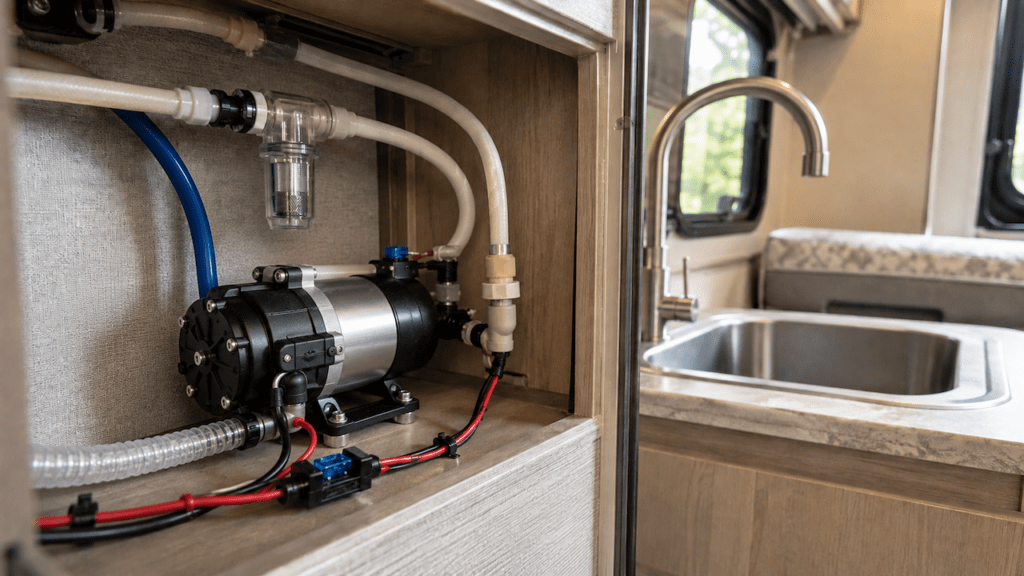
Once you open the shower, water begins moving through the hose, regulator, filter, fittings, and RV plumbing. Each component creates some resistance.
The pressure available at the fixture can then fall.
So when someone says, “My RV water pressure dropped after installing a filter,” the real problem is often insufficient flow while water is being used.
Why Does an RV Water Filter Reduce Flow?
Several things determine how restrictive an RV filter becomes. Understanding them can help you fix weak flow without immediately replacing your entire filtration setup.
Filter Media Naturally Creates Resistance
Water cannot pass through filtration media as freely as it passes through an empty hose.
A sediment filter forces water through small openings that capture particles.
A carbon filter pushes water through activated carbon designed to reduce chlorine, taste, odor, and other contaminants.
The more resistance the media creates, the more pressure is lost while water flows through it.
This is normal to a point.
The goal is to choose enough filtration without restricting the system more than necessary.
Sediment Gradually Clogs the Cartridge
Sediment buildup is one of the biggest causes of declining RV water flow.
Campground water can look perfectly clear while still carrying small amounts of rust, dirt, or mineral debris.
Your filter catches that material instead of allowing it into the RV.
That is good for your plumbing, but eventually the cartridge begins filling with contaminants.
A heavily loaded sediment filter may become brown, orange, gray, or almost black.
However, don’t judge the cartridge only by appearance.
A filter can become restrictive internally before it looks completely dirty from the outside.
Finer Filtration Can Add More Resistance
Micron ratings describe how small a particle a filter is designed to capture.
For example, a 20-micron filter catches larger particles than a 5-micron filter. A 1-micron filter targets even smaller particles.
Finer filtration often requires water to travel through smaller pathways.
That can increase resistance.
But don’t assume that every 1-micron filter will automatically flow worse than every 5-micron filter.
Other design factors matter just as much.
Filter Surface Area and Housing Size Matter
This is one detail that often gets overlooked.
Imagine pushing water through one small section of filter material. Now imagine spreading that same water across a much larger filter surface.
The larger filter gives water more pathways to travel through.
That can help maintain better flow.
This is why a larger canister system may provide stronger usable flow than a small inline filter, even when both provide relatively fine filtration.
Pleated filter cartridges can also provide additional surface area because the material is folded repeatedly inside the cartridge.
Multiple Filter Stages Add Resistance
A two-stage system might include:
- A sediment filter.
- A carbon filter.
A three-stage system could add another specialty cartridge.
Water must travel through every stage.
That means each cartridge contributes some resistance.
However, don’t assume that a multi-stage system automatically produces terrible flow.
Large cartridges with enough surface area can still deliver strong water flow.
A well-designed two-canister system may actually perform better under high demand than one small, overloaded inline filter.
What Affects RV Filter Pressure Drop the Most?
Several components can influence how much pressure reaches your fixtures. Looking at the whole water path is more useful than blaming the filter alone.
| Factor | Effect on RV Water Flow | What You Should Check |
| Dirty cartridge | Gradually reduces available flow | Inspect or replace the cartridge |
| Fine filtration media | May increase resistance | Compare micron rating and rated GPM |
| Dense carbon block | Can create additional resistance | Check cartridge flow specifications |
| Small filter surface area | Reaches its flow limit sooner | Consider a larger housing |
| Multiple stages | Adds cumulative resistance | Check every cartridge |
| Low campground supply | Leaves little pressure available | Test the spigot directly |
| Restrictive regulator | Can limit the entire system | Inspect and test the regulator |
| Kinked water hose | Reduces flow before the RV | Straighten or replace the hose |
| Dirty inlet screen | Restricts water entering the RV | Remove and clean the screen |
| Multiple fixtures running | Increases required GPM | Compare one-fixture and two-fixture flow |
How Can You Tell If the RV Water Filter Is Causing Low Pressure?
You don’t need to start buying parts immediately. A few simple tests can usually tell you whether the filter is responsible.
Check Whether Every Fixture Is Weak
Start by opening several fixtures separately.
Test:
- Kitchen faucet
- Bathroom faucet
- Shower
- Outdoor shower, if equipped
If every fixture is weak, the restriction is probably somewhere before those fixtures.
The filter becomes one possible suspect.
If only one faucet is weak, the filter probably isn’t the main problem.
Instead, inspect that fixture’s aerator, screen, valve, or showerhead.
Temporarily Bypass the Water Filter
This is one of my favorite troubleshooting tests because it gives you a useful answer quickly.
- Shut off the campground water supply.
- Open a faucet to relieve pressure.
- Disconnect or bypass the filter.
- Reconnect the water hose safely.
- Turn the water supply back on.
- Open the same fixture you tested earlier.
- Compare the water flow.
If your shower suddenly becomes dramatically stronger, something in the filter assembly is causing the restriction.
That could be the cartridge itself, but also inspect the filter housing, fittings, valves, and connections.
Compare One Fixture With Two Fixtures Running
Open the kitchen faucet and observe the stream.
Then turn on the shower.
If the kitchen faucet drops from a healthy stream to a trickle, your system may not have enough available flow for simultaneous use.
A clogged filter can cause this.
So can an undersized regulator, narrow fitting, small filter housing, or poor campground supply.
Pay Attention to When the Problem Started
Timing provides useful clues.
If flow was excellent when the cartridge was new but slowly became weaker, clogging is likely.
If flow became weak immediately after installing a new filter, look for:
- Wrong cartridge
- More restrictive filter media
- Incorrect flow direction
- Partially closed valve
- Trapped air
- Blocked fitting
- Poorly seated cartridge
That usually points toward an installation or sizing issue instead of normal filter aging.
How to Find Exactly Where the Restriction Is
The easiest way to troubleshoot weak RV water flow is to rebuild the water connection one component at a time.
- Test the campground spigot by itself.
- Add your potable-water hose.
- Test the flow again.
- Add the pressure regulator.
- Test again.
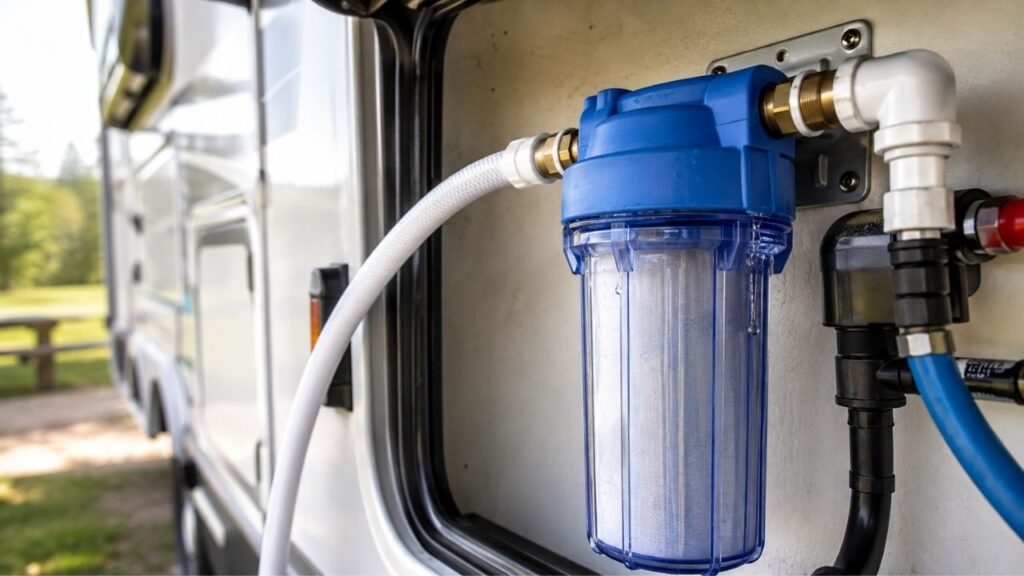
- Add the water filter.
- Compare the flow again.
- Connect everything to the RV.
- Test the same faucet each time.
Try to keep your testing conditions similar.
If water stays strong until you install one specific component, you’ve probably found your restriction.
This method can save you from replacing a perfectly good filter when the real problem is a kinked hose or clogged regulator.
How to Measure Pressure Drop Across an RV Water Filter
If you want a more accurate answer than simply judging shower strength, you can measure pressure before and after the filter.
Use Two Pressure Gauges
Install one gauge before the filter and another after it.
Your connection would look something like this:
Water source → upstream gauge → filter → downstream gauge → RV
Make sure the fittings are rated for your water system.
Then open a faucet so water is flowing.
Checking pressure while the system is actually moving water gives you far more useful information than checking static pressure alone.
Calculate the Pressure Drop
The calculation is simple:
Pressure drop = upstream pressure − downstream pressure
For example:
52 PSI upstream − 44 PSI downstream = 8 PSI pressure drop
That tells you how much pressure is being lost across the filter under those particular conditions.
Don’t treat one number as a universal pass-or-fail standard.
Different filters have different normal pressure-drop characteristics.
What the Pressure Readings Can Tell You
Your readings can help narrow the problem quickly.
- Large difference across the filter: Inspect the cartridge and filter assembly.
- Both gauges show low pressure: Look upstream at the campground supply or regulator.
- Pressure drop increases over time: The cartridge may be loading with sediment.
- Large drop with a new filter: Check sizing, cartridge design, fittings, and installation.
- Normal readings but one weak faucet: Inspect that individual fixture.
Testing under actual flow is the important part.
Does a Lower Micron RV Filter Always Reduce More Pressure?
No. A lower micron rating does not automatically mean that the filter will always cause a larger pressure drop.
Finer filters often create more resistance because they use smaller filtration pathways. However, micron rating is only one part of the design.
Pressure drop also depends on filter surface area, cartridge diameter, media type, cartridge length, pleating, housing passages, and the amount of water being requested.
For example, a large pleated fine filter could potentially maintain better flow than a small dense cartridge with a similar micron rating.
This is why I wouldn’t choose an RV water filter based only on the lowest micron number printed on the package.
Look at filtration performance and flow capacity together.
Inline vs. Canister RV Water Filters for Maintaining Flow
Both inline and canister filters can work well in an RV. The better option depends on your water demand, storage space, and how much filtration you want.
| Filter Setup | Typical Flow Characteristics | Main Advantage | Main Drawback |
| Basic inline filter | Usually fine for modest demand | Compact and simple | Limited media area |
| Single canister | Depends heavily on cartridge choice | Easy cartridge replacement | One cartridge handles all demand |
| Dual canister | Good when properly sized | Separate sediment and carbon stages | Requires more space |
| Large high-flow canister | Better suited to higher demand | More filter surface area | Larger and heavier |
| Very fine whole-RV system | Depends strongly on design | Greater contaminant reduction | Requires careful sizing |
For weekend camping with limited simultaneous water use, a simple inline filter may be completely adequate.
For full-time RVing or frequent shower and faucet use, larger cartridge systems may provide more comfortable flow.
Can a Pressure Regulator Make the Filter Problem Worse?
A pressure regulator and water filter can both contribute to total pressure loss, but they serve completely different jobs.
Think of your RV water connection as a chain:
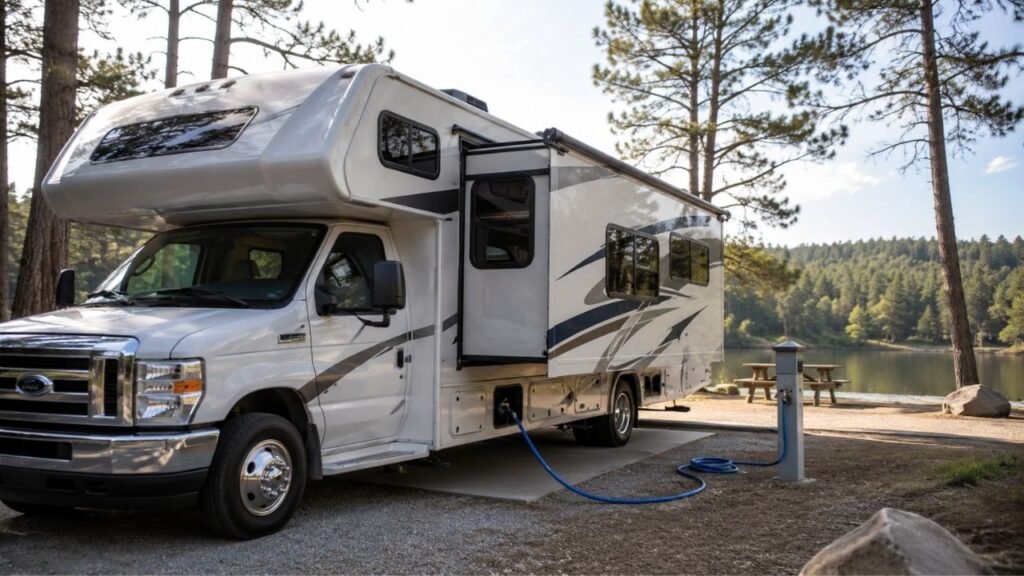
Campground spigot → regulator → hose → filter → RV inlet → plumbing → fixture
Every component creates at least some resistance.
If the regulator is already limiting available flow and the filter is also restrictive, the combined effect can become noticeable.
However, that does not mean you should permanently remove the regulator.
A water filter does not protect your RV from excessive campground water pressure.
The regulator controls pressure.
The filter treats the water.
You normally need both.
If adding the regulator causes a dramatic drop in flow, inspect its screen, setting, internal passages, and condition instead of eliminating it from your setup.
Why Did My Water Pressure Drop Right After Changing the Filter?
If water flow became weak immediately after installing a new cartridge, the filter probably hasn’t had enough time to become clogged.
Check these possibilities instead:
- The new cartridge has finer filtration media.
- The replacement cartridge has a lower rated flow.
- The cartridge isn’t seated properly.
- The filter housing is connected backward.
- Air remains trapped inside the housing.
- A valve isn’t fully open.
- Debris is blocking a fitting.
- An O-ring is incorrectly positioned.
- The filter needs its recommended initial flush.
- The new cartridge is incompatible with the housing.
I would start with the simple things first.
Confirm the flow direction, open every valve completely, purge air, and check the cartridge installation.
How to Improve RV Water Flow Without Giving Up Filtration
You usually don’t need to choose between clean water and a decent shower. Most pressure problems can be improved by finding the actual bottleneck.
Replace a Loaded Cartridge
If bypassing the filter restores strong flow, inspect the cartridge.
A heavily loaded sediment cartridge should normally be replaced.
Don’t keep forcing water through a clogged disposable cartridge just because it hasn’t reached an arbitrary calendar date.
Campground water conditions vary too much for one replacement schedule to fit every RVer.
Use a Sediment Prefilter When Appropriate
If you frequently encounter dirty campground water, a sediment stage can protect more restrictive downstream media.
The sediment filter captures larger debris before that debris reaches your carbon cartridge.
This may help the carbon stage maintain better flow for longer.
Choose Filters by Rated GPM
Don’t shop by micron rating alone.
Look for information such as:
- Rated service flow
- GPM
- Micron rating
- Initial pressure drop
- Cartridge dimensions
- Housing size
- Recommended operating pressure
A filter capable of handling your expected water demand will usually provide a better RV experience.
Increase Filter Surface Area
Larger cartridges give water more filtration area.
That can reduce how hard water must work to travel through the filter at a given flow rate.
If your small inline filter repeatedly becomes the bottleneck, a larger canister system may be worth considering.
Remove Restrictions Elsewhere
Before buying another filter system, inspect the rest of the connection.
Look for:
- Kinked hoses
- Collapsed hose sections
- Dirty regulator screens
- Dirty RV inlet screens
- Partially closed valves
- Restrictive quick-connect fittings
- Sharp hose bends
- Damaged fittings
Several small restrictions can combine into one frustrating shower.
Use the Freshwater Tank and Pump When Campground Flow Is Poor
Sometimes the campground itself simply cannot provide enough usable flow.
In that situation, filling your freshwater tank and using the onboard RV pump can provide more consistent pressure at your fixtures.
The pump delivers water from the tank rather than depending directly on campground pressure.
Keep in mind that a severely clogged external filter can still make the tank take longer to fill if water passes through that filter first.
When Should You Replace an RV Water Filter Because of Low Flow?
You don’t need to replace a cartridge simply because a certain number of months have passed.
Consider replacement when:
- Water flow has noticeably declined.
- Bypassing the filter restores strong flow.
- Pressure drop across the filter has increased.
- The cartridge is heavily loaded with sediment.
- The manufacturer’s recommended capacity has been reached.
- Taste or odor reduction has noticeably declined.
- The cartridge is swollen or deformed.
- The cartridge is cracked or otherwise damaged.
Water quality matters enormously.
One cartridge might last a long time on relatively clean municipal water but clog quickly after several stays with sediment-heavy campground supplies.
Carrying a spare cartridge is a good idea if you travel frequently.
Quick RV Water Pressure Diagnostic Table
Use this table when you want to narrow down the restriction without replacing parts at random.
| What You Notice | Most Likely Area | Quick Test | What to Do |
| Weak flow directly from spigot | Campground supply | Test spigot alone | Ask campground or try another source |
| Strong spigot but weak after hose | Hose or fitting | Remove hose temporarily | Straighten or replace hose |
| Flow drops after regulator | Pressure regulator | Compare before and after | Inspect screen and regulator |
| Flow drops after filter | Filter system | Bypass filter briefly | Inspect cartridge and housing |
| Flow gradually became weaker | Loaded cartridge | Compare with fresh cartridge | Replace clogged filter |
| Weak immediately after filter change | Installation issue | Recheck cartridge setup | Purge air and inspect installation |
| Only one faucet is weak | Fixture problem | Check another fixture | Clean aerator or showerhead |
| One fixture works, two become weak | Flow capacity issue | Open two fixtures | Find undersized restriction |
| Both gauges show low pressure | Upstream problem | Test source and regulator | Troubleshoot supply side |
| Large pressure difference across filter | Filter restriction | Perform two-gauge test | Service or resize filtration system |
What RV Water Filter Specs Matter Most for Good Pressure?
Looking beyond the marketing label can help you choose a filter that provides good filtration without making your shower miserable.
Pay attention to:
- Rated service flow: Shows how much water the cartridge is designed to handle.
- Initial pressure drop: Indicates how much resistance a clean filter creates at a stated flow.
- Micron rating: Describes the approximate filtration level.
- Filter media: Sediment, carbon block, granular carbon, and specialty media behave differently.
- Cartridge size: Larger cartridges usually provide more filtration area.
- Housing port size: Narrow passages can become a bottleneck.
- Operating pressure range: The system needs to handle your RV water setup safely.
- Rated capacity: Helps estimate when cartridge performance may decline.
If manufacturers provide both filtration and flow specifications, use both when comparing options.
Can an RV Water Filter Increase Water Pressure?
No. A passive RV water filter cannot create water pressure.
Replacing a badly clogged filter with a clean, higher-flow cartridge may make the shower feel dramatically stronger.
However, you are restoring pressure and flow that were previously being lost through restriction.
You aren’t actually generating additional pressure.
Increasing water pressure requires a pump, different water supply, or another pressure-producing system.
Should You Remove the RV Water Filter If Campground Pressure Is Low?
Temporarily bypassing the filter can be a useful diagnostic step.
If water flow becomes significantly stronger without the filter, you know the filtration system deserves attention.
However, I wouldn’t routinely remove filtration just to compensate for another problem.
Instead, determine whether the issue is:
- A clogged cartridge
- An undersized filter
- Poor campground flow
- A restrictive pressure regulator
- A kinked hose
- A dirty screen
- An undersized fitting
Fixing the actual restriction gives you stronger water flow without sacrificing filtration.
And don’t confuse removing the filter with removing the pressure regulator.
Those components serve different purposes.
A Practical Campsite Test Before Buying Anything
If I were standing beside your RV helping you troubleshoot weak water flow, this is the order I would follow.
- Open one cold-water faucet and observe the flow.
- Turn on a second fixture and watch what happens.
- Disconnect the RV and check campground water flow.
- Inspect the potable-water hose for bends and kinks.
- Inspect the pressure regulator and its screen.
- Check accessible inlet screens.
- Temporarily bypass the filter.
- Compare faucet and shower flow again.
- Reinstall the filter.
- Inspect or replace the cartridge if testing points toward it.
This takes far less time than randomly replacing hoses, regulators, and filters.
It also gives you a much better chance of finding the real problem.
Final Verdict
Yes, an RV water filter can reduce the pressure you feel at your faucets and shower because water loses some pressure while moving through filtration media. A small amount of resistance is normal. Severe or gradually worsening flow loss usually indicates a clogged cartridge, undersized filtration setup, restrictive fitting, or another supply-side problem.
I wouldn’t automatically blame the filter whenever an RV shower feels weak. Test the campground supply, hose, pressure regulator, filter, screens, and fixtures in order. Once you identify where the flow changes, the fix is usually straightforward.
Most importantly, don’t automatically choose the finest filter available. Choose filtration performance, rated flow, cartridge capacity, and system size together. That gives you cleaner water without unnecessarily sacrificing a comfortable shower.
Related FAQs
Does a New RV Water Filter Reduce Water Pressure?
Yes, a new RV water filter can cause a small pressure drop because water must pass through filtration media. However, a correctly sized clean filter should still provide comfortable water flow under its rated operating conditions.
Does a Clogged RV Water Filter Cause Low Water Pressure?
Yes. Dirt, rust, sediment, and other debris gradually block filtration pathways, increasing resistance and reducing the amount of water reaching RV faucets and showers.
Does a 1-Micron Filter Reduce More Pressure Than a 5-Micron Filter?
Not necessarily. A 1-micron filter may be more restrictive, but surface area, media construction, cartridge size, pleating, housing design, and rated flow also affect pressure drop.
Can an RV Water Filter Affect Shower Pressure?
Yes. A shower often makes filter restrictions more noticeable because it requires steady water flow. The problem may become even more obvious when another faucet is opened simultaneously.
Should the RV Water Filter Go Before or After the Pressure Regulator?
Follow the instructions for your specific equipment, but the pressure regulator is commonly placed near the campground water source so downstream hoses, filtration equipment, and RV plumbing remain protected from excessive incoming pressure.
Can an RV Water Filter Reduce Freshwater Tank Filling Speed?
Yes. If water passes through the filter before reaching your freshwater tank, a restrictive or clogged cartridge can reduce the gallons per minute entering the tank and make filling take longer.
Why Is My RV Water Pressure Fine Without the Filter?
If your water flow improves significantly after bypassing the filter, the cartridge, housing, fittings, or filtration capacity is probably creating too much resistance.
How Do I Know if My RV Water Filter Is Too Restrictive?
Compare water flow with and without the filter, check its rated GPM, run multiple fixtures, and measure pressure before and after the filter while water is flowing if you want a more accurate diagnosis.
Can a Dirty RV Water Filter Damage the Water Pump?
A restrictive filter installed where it affects pump supply can make water delivery harder and may contribute to poor pump performance. Always install filters according to the RV and filter manufacturers’ recommended configuration.
Why Does My RV Water Pressure Drop When Two Faucets Are Open?
Your available flow may be too low to supply both fixtures comfortably. A clogged filter, restrictive regulator, small hose, poor campground source, or undersized filtration system can all create this problem.

Steven Parker writes about everyday RV life, from setup tips to long-term living decisions. His content reflects a calm, experienced approach to RV ownership and travel. He focuses on comfort, reliability, and realistic expectations.