Your RV water may still feel hard because the softener resin is exhausted, regeneration was incomplete, campground water is extremely hard, or water is moving through the unit incorrectly. Iron, sediment, excessive flow, and untreated water remaining inside your RV can also cause similar symptoms.
The best approach is to test the water before changing anything. I’ll show you how to confirm the problem, find the cause, regenerate the softener correctly, and know when the resin actually needs attention.
Key Takeaways
- Test water hardness before assuming your RV softener has failed.
- Test both campground water and the softener outlet separately.
- A TDS meter cannot reliably tell whether water is softened.
- Exhausted resin often causes hard water to return suddenly.
- Very hard campground water can shorten regeneration intervals dramatically.
- Incorrect regeneration may leave the resin only partly recharged.
- High water flow can reduce effective softening in some portable units.
- Iron and sediment can reduce resin performance over time.
- Flush existing hard water from your RV after restoring the softener.
- Replace resin only after testing confirms regeneration no longer works.
First, Make Sure Your RV Water Is Actually Still Hard
Before taking your portable softener apart, confirm that hardness is really the problem. Water can feel different after softening, and that difference sometimes causes unnecessary troubleshooting.
What Hard Water Usually Looks and Feels Like
Hard water contains relatively high amounts of calcium and magnesium.
Inside an RV, you may notice several familiar signs.
These include white mineral deposits around faucets, showerheads, and sinks. Glasses and dishes may develop cloudy spots after drying.
Soap may also seem harder to lather. You can notice stubborn soap scum around your shower walls and fixtures.
Your water heater may gradually collect scale as well. Coffee makers, kettles, and other small appliances can develop chalky deposits.
These physical signs are more useful than judging hardness by touch alone.
Soft Water Can Actually Feel Slippery
This catches many RV owners by surprise.
Softened water often feels noticeably slicker when washing your hands. Soap may also seem harder to rinse away at first.
That does not necessarily mean minerals remain in your water.
Hard water reacts with soap and creates residue. Soft water allows soap to work more efficiently without creating as much mineral-based film.
If you have spent weeks using hard campground water, the difference can feel strange.
That is why I would test the water before regenerating anything.
Test the Water Before and After Your Softener
Use water-hardness test strips or a drop-style hardness test kit.
For a useful comparison, collect three samples:
- Test water directly from the campground spigot.
- Test water directly from your softener outlet.
- Test water from an RV faucet after flushing it.
The first sample tells you what the softener must handle.
The second tells you whether the softener itself is working.
The third tells you what is actually reaching your fixtures.
Hardness is commonly measured in grains per gallon, or GPG.
One grain per gallon equals roughly 17.1 parts per million of hardness expressed as calcium carbonate.
If campground water tests very hard while the softener outlet tests soft, your softener is doing its job.
The remaining problem is likely somewhere inside the RV.
Why a TDS Meter Cannot Tell You Whether the Softener Works
A TDS meter measures total dissolved solids. It does not specifically measure calcium and magnesium hardness.
That distinction matters with an ion-exchange water softener.
The softener removes calcium and magnesium ions by exchanging them for sodium or potassium ions.
Those replacement ions are still dissolved in the water.
As a result, your TDS reading may remain similar after softening.
You could therefore have properly softened water with a relatively high TDS reading.
Use a hardness-specific test instead.
RV Water Softener Test Results: What They Mean
Testing the water at different points helps isolate the problem quickly. Use this table before moving into more involved troubleshooting.
| Test Result | Most Likely Meaning | What to Do Next |
| Campground water is hard, softener outlet is soft | Softener is working normally | Flush RV plumbing |
| Campground water is hard, softener outlet is also hard | Resin may be exhausted | Regenerate the softener |
| Water is soft after regeneration but becomes hard quickly | Source water may be extremely hard | Check hardness and calculate capacity |
| Outlet stays hard immediately after regeneration | Regeneration failed or resin is fouled | Repeat proper procedure and inspect resin |
| Softener works better with lower flow | Water demand may be excessive | Reduce flow and check unit rating |
| Outlet is soft, but one fixture shows deposits | Problem may be inside the RV | Flush or inspect that fixture |
| TDS stays high while hardness tests low | Softening is probably working | Judge performance with hardness testing |
| Orange staining appears with poor softening | Iron may be affecting the resin | Investigate iron and resin cleaning |
1. The Resin Has Reached Its Hardness Capacity
Portable RV water softeners cannot remove unlimited amounts of calcium and magnesium.
Inside the tank are resin beads containing ion-exchange sites. Those sites capture hardness minerals as water passes through them.
Eventually, those available sites become saturated.
Once that happens, calcium and magnesium begin passing through the tank again.
This is often called hardness breakthrough.
The harder your campground water is, the faster breakthrough happens.
You can estimate theoretical capacity using this basic formula:
Softener grain capacity ÷ incoming hardness in GPG = approximate gallons between regenerations
Suppose you have a 16,000-grain portable softener.
At 10 GPG:
16,000 ÷ 10 = about 1,600 gallons
At 20 GPG:
16,000 ÷ 20 = about 800 gallons
At 40 GPG:
16,000 ÷ 40 = about 400 gallons
That difference is huge.
A softener that lasts several weeks at one campground may need regeneration much sooner at another.
Real-world capacity can also be lower because of flow, iron, sediment, incomplete regeneration, and resin condition.
2. You Waited Too Long Between Regenerations
A fixed regeneration schedule does not work equally well everywhere.
You might regenerate every few weeks while staying on relatively soft municipal water.
Then you move to a campground supplied by a hard groundwater well.
Suddenly, the same softener becomes exhausted within days.
Watch for these clues:
- Hardness slowly returns at the outlet.
- Soap becomes harder to lather.
- White spots start appearing again.
- Shower fixtures develop fresh deposits.
- Hardness strips begin showing increasing mineral levels.
I prefer using hardness and estimated water consumption rather than calendar days alone.
If you wait until the resin becomes heavily exhausted, one normal regeneration may not always restore its best performance immediately.
Follow your manufacturer’s procedure if a deeper regeneration becomes necessary.
3. The Softener Was Not Regenerated Correctly
Regeneration sounds simple, but small mistakes can leave part of the resin exhausted. Salt quantity, flow rate, contact time, and rinsing procedure all matter.
You Used the Wrong Amount of Salt
Portable RV softeners do not all use the same salt quantity.
A smaller unit may require considerably less than a large-capacity model.
Using more salt is not automatically better either.
Too little salt may leave the resin only partly regenerated. Excessive salt wastes material and may not improve performance.
Follow the regeneration quantity listed for your specific softener.
Do not rely on instructions from another brand or tank size.
You Rinsed the Brine Through Too Quickly
This is an easy mistake to make.
During regeneration, concentrated brine needs enough contact time with the resin.
If you immediately blast water through the tank at maximum pressure, the regeneration process may be less effective.
Many portable units require a slower initial rinse or regeneration flow.
Follow the valve position and flow instructions for your unit carefully.
If your water remains hard immediately afterward, review this step.
You Did Not Complete the Entire Regeneration Cycle
Stopping regeneration early can leave some resin sites loaded with calcium and magnesium.
The salt must dissolve properly.
The brine must move through the resin.
Then the remaining salt must be rinsed from the tank before normal use.
Skipping part of this process can leave inconsistent water quality.
You may get soft water briefly, followed by hardness sooner than expected.
The Resin May Need a More Thorough Regeneration
Severely exhausted resin sometimes needs more than a casual salt rinse.
Some manufacturers provide a special procedure for heavily exhausted units.
Follow that procedure rather than randomly adding double or triple amounts of salt.
Regeneration methods vary between portable softeners.
4. Your Campground Water Is Much Harder Than Expected
Campground water hardness can change dramatically as you travel.
One RV park may use moderately hard municipal water.
The next campground could rely on groundwater containing much more calcium and magnesium.
That difference directly affects softener capacity.
For example, consider a theoretical 16,000-grain unit.
At 5 GPG, it may theoretically process about 3,200 gallons.
At 20 GPG, that falls to roughly 800 gallons.
At 40 GPG, theoretical capacity drops to about 400 gallons.
Water consumption matters too.
Long showers, frequent dishwashing, laundry, and several travelers can exhaust the unit much faster.
That is why testing each new campground can be useful.
You do not need laboratory precision every time.
A simple hardness strip can tell you whether the new source is dramatically harder than the previous one.
5. Water Is Moving Through the Softener Too Quickly
A portable softener needs proper contact between water and resin.
Every softener also has a practical service-flow range.
If demand becomes excessive, effective ion exchange may decline.
This can happen when several fixtures operate simultaneously.
For example, you could have:
- Someone taking a shower.
- A washing machine filling.
- The kitchen faucet running.
- A toilet being flushed.
That is a lot of water passing through a compact resin tank.
Try reducing water demand temporarily.
Then test the water directly after the softener.
If hardness improves at a slower flow, compare your normal demand with the manufacturer’s rated service flow.
Also inspect your pressure regulator.
High campground pressure does not automatically mean better softening.
6. Iron or Sediment Has Fouled the Resin
Hardness minerals are not the only substances entering your portable softener. Well water can also carry iron, rust, sand, sediment, and other material that reduces performance.
Iron Can Affect the Resin
Iron can become a problem at campgrounds using groundwater.
You may notice orange staining around sinks, toilets, hoses, or fittings.
Over time, iron can accumulate on or within the resin bed.
That contamination can reduce usable ion-exchange capacity.
Common warning signs include increasingly frequent regenerations and poor softening shortly after regeneration.
If iron is suspected, use only a resin cleaner approved for your softener and resin type.
Avoid pouring random household chemicals into the tank.
Sediment Can Restrict the Resin Bed
Sand, rust, dirt, and pipe debris can enter through campground water systems.
A softener is designed primarily to exchange ions.
It should not become your main sediment filter.
Accumulated debris can restrict water distribution through the resin bed.
A suitable sediment prefilter can help reduce that load.
Inspect and replace the filter regularly when staying at sediment-heavy campgrounds.
When to Use a Resin Cleaner
Consider resin cleaner when normal regeneration no longer restores expected performance and contamination is suspected.
Read your softener instructions first.
The cleaner must be compatible with the resin and internal components.
After cleaning, rinse the system completely before returning it to drinking-water service.
7. The Softener Needs a Backflush
Regeneration and backflushing perform different jobs.
Regeneration restores the ion-exchange capacity of the resin.
Backflushing sends water through the resin bed in reverse.
That reverse flow can loosen compacted resin and remove trapped debris.
It can also help redistribute the resin inside the tank.
A softener exposed to campground sediment may benefit noticeably from periodic backflushing.
Follow your manufacturer’s backflush instructions because flow direction matters.
Do not assume adding more salt replaces this maintenance step.
If your unit has gradually developed poor flow alongside weak softening, backflushing deserves particular attention.
8. The Inlet and Outlet May Be Connected Incorrectly
Portable RV softeners usually have a specified direction of flow.
It is surprisingly easy to reverse hoses after moving campsites.
Check the markings on the tank.
Your setup will generally resemble this:
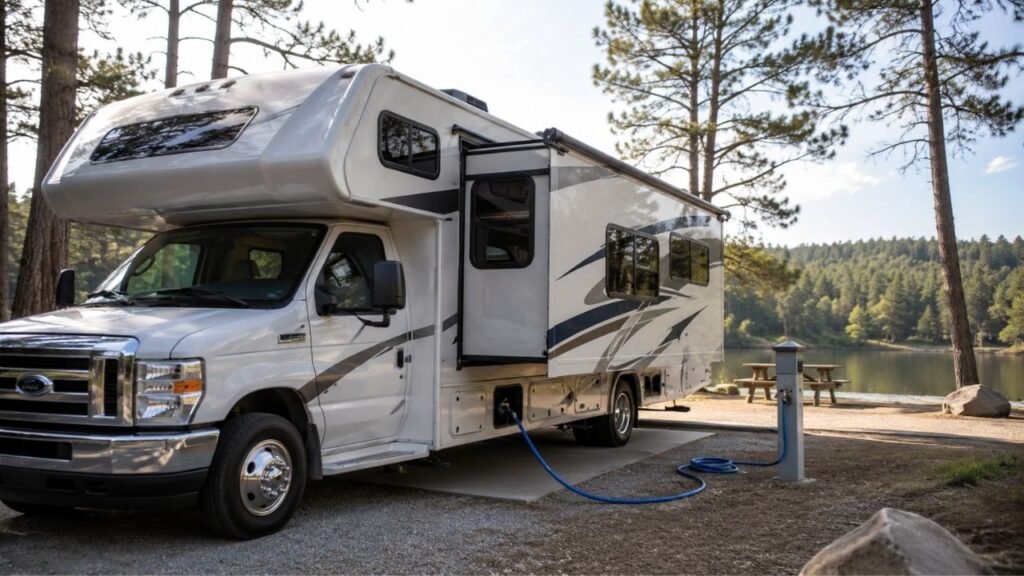
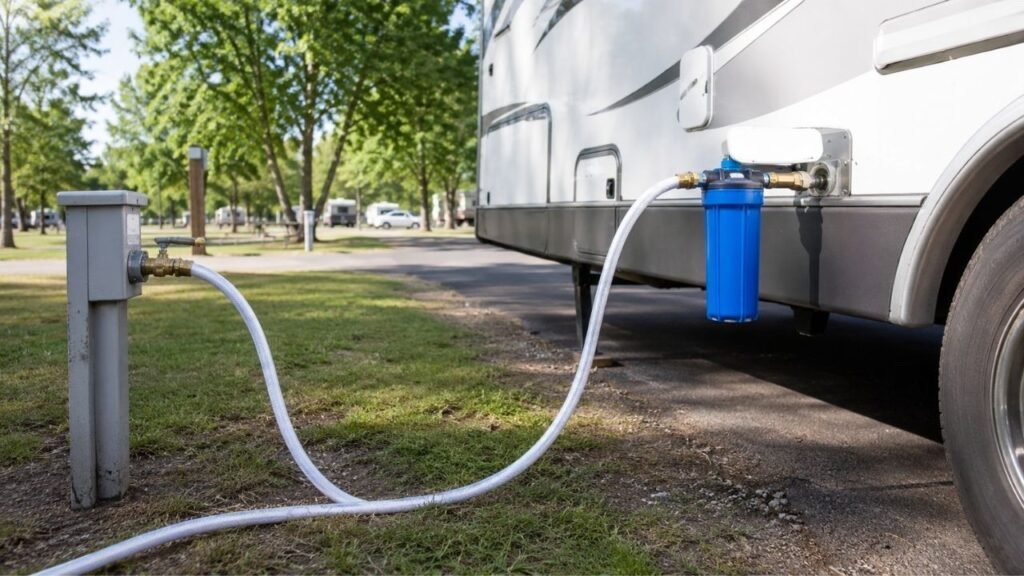
Campground spigot → prefilter → softener inlet → softener outlet → potable-water hose → RV city-water connection
Your exact filter order can differ depending on your equipment.
Follow the manufacturer’s recommended arrangement.
Also inspect any Y-connectors, quick-connect fittings, and bypass valves.
You may have accidentally created another route around the softener.
If untreated campground water can reach your RV without passing through the resin, your faucets can receive partially or completely hard water.
9. Hard Water Is Still Sitting Inside Your RV
Restoring your softener does not instantly replace every gallon already inside the RV. Stored and trapped water can make a repaired system appear unsuccessful.
Your Water Heater Still Contains Hard Water
An RV water heater can hold several gallons of water.
If it filled while your softener was exhausted, that water remains hard.
Connecting a freshly regenerated softener will not instantly replace it.
Your next hot shower could therefore contain a mixture of hard and newly softened water.
This is one reason I recommend testing directly at the softener outlet first.
If that water tests soft, give the RV system time to exchange its existing water.
Your Freshwater Tank Contains Untreated Water
This becomes particularly important when switching between city water and the onboard pump.
Your freshwater tank may contain water filled at another campground.
That stored supply can have completely different hardness.
If you test a faucet while the pump is supplying the RV, you may not even be testing water that passed through the portable softener.
Verify which water source is active.
Your Plumbing Lines Need to Flush
Water sitting inside PEX lines, faucets, shower hoses, and appliances will not disappear immediately.
Let softened water travel through the system.
Flush both hot and cold fixtures as appropriate.
Then test again.
Remember, the softener outlet remains your best isolation point.
If water there is soft, look downstream before blaming the resin.
10. The Resin Has Become Damaged or Worn Out
Resin does not automatically need replacement whenever hard water returns.
In most cases, regeneration should be your first move.
However, resin can eventually lose useful performance.
Long-term iron contamination, oxidant exposure, severe neglect, physical degradation, or repeated fouling can shorten its effective life.
A useful test is simple.
Regenerate the softener exactly as instructed.
Then test water immediately at its outlet.
If incoming water is hard and outlet water remains similarly hard, something is wrong.
Backflush and perform approved cleaning if appropriate.
If proper regeneration and cleaning still produce poor results, replacing the resin or entire softener may make sense.
How to Fix Hard RV Water After Using a Softener
The fastest troubleshooting method is to work from simple tests toward more involved repairs. This prevents unnecessary resin replacement and repeated regeneration.
Follow these steps in order:
- Test campground hardness. Find out what your softener is actually receiving.
- Test the softener outlet. This separates softener problems from RV plumbing problems.
- Check the inlet and outlet. Make sure water flows through the tank correctly.
- Look for bypass routes. Check valves, Y-connectors, and alternate hoses.
- Reduce water demand. Run one fixture and retest the softened output.
- Regenerate correctly. Follow the exact salt quantity and procedure.
- Retest immediately. Confirm whether regeneration restored soft water.
- Backflush when required. Remove sediment and redistribute the resin.
- Flush your RV plumbing. Clear untreated water from lines and appliances.
- Check for iron and sediment. Look for staining and dirty filters.
- Use approved resin cleaner when needed. Follow manufacturer instructions.
- Perform any recommended deep regeneration. Do not improvise the process.
- Consider resin replacement last. Replace it only after testing confirms failure.
How Often Should I Regenerate My RV Water Softener?
There is no single regeneration schedule that works for every campground. Incoming hardness, tank capacity, water consumption, and resin condition all affect how long a charge lasts.
Calculate Regeneration From Water Hardness
Start with your softener’s grain rating.
Then determine campground hardness in grains per gallon.
Use this basic estimate:
Softener grain capacity ÷ incoming hardness in GPG = approximate gallon capacity
Suppose your campground water tests at 20 GPG.
An 8,000-grain unit theoretically handles:
8,000 ÷ 20 = about 400 gallons
A 16,000-grain unit theoretically handles:
16,000 ÷ 20 = about 800 gallons
These numbers are estimates.
Real conditions can reduce actual usable capacity.
Example Capacity for 8,000- and 16,000-Grain RV Softeners
The table below shows why testing campground water matters so much. These figures represent theoretical capacity before real-world operating factors are considered.
| Incoming Hardness | 8,000-Grain Softener | 16,000-Grain Softener |
| 5 GPG | About 1,600 gallons | About 3,200 gallons |
| 10 GPG | About 800 gallons | About 1,600 gallons |
| 20 GPG | About 400 gallons | About 800 gallons |
| 30 GPG | About 267 gallons | About 533 gallons |
| 40 GPG | About 200 gallons | About 400 gallons |
Do not treat these figures as guaranteed regeneration intervals.
Your softener’s actual instructions take priority.
Why Regeneration Changes From Campground to Campground
Travel itself makes RV softener maintenance unpredictable.
Campgrounds use different water supplies.
Some rely on city water.
Others rely on private wells.
Water chemistry can even change seasonally.
Your consumption can change too.
A couple staying for a quiet weekend may use relatively little water. A family showering, cooking, cleaning, and doing laundry uses far more.
That is why hardness testing plus approximate gallon usage gives you a better schedule than simply regenerating every two weeks.
Should I Regenerate My RV Softener Based on Time or Gallons?
Neither measurement works perfectly by itself.
Time ignores changes in campground hardness and daily usage.
Gallons alone ignore changes in water chemistry.
A better approach combines four things:
- Incoming hardness
- Softener grain capacity
- Estimated water consumption
- Periodic outlet hardness tests
After using your softener for a while, you will learn its normal range.
You may discover it lasts much longer in certain regions.
Then one extremely hard campground suddenly cuts that interval dramatically.
That does not automatically mean your softener has failed.
Do Portable RV Water Softeners Get Salt Bridges?
Salt bridging is frequently mentioned in general water-softener troubleshooting.
However, be careful applying household-softener advice to portable RV equipment.
Traditional residential systems can have separate brine tanks that continuously hold salt.
Under certain conditions, salt can form a hard crust inside those tanks.
Many portable RV softeners work differently.
You add salt directly during regeneration instead of maintaining a large household-style brine tank.
For those designs, the traditional salt-bridge diagnosis may not apply.
Check how your particular softener regenerates before trying to break up imaginary salt clumps.
If your portable model does use a separate salt or brine reservoir, follow its instructions for dealing with bridging or clumping.
Does a Water Filter Make Hard Water Soft?
A normal RV water filter and a water softener perform different jobs.
A sediment filter primarily catches particulate material.
A carbon filter may improve chlorine, odor, taste, and certain contaminants.
Neither automatically removes calcium and magnesium hardness.
An ion-exchange water softener specifically targets hardness minerals.
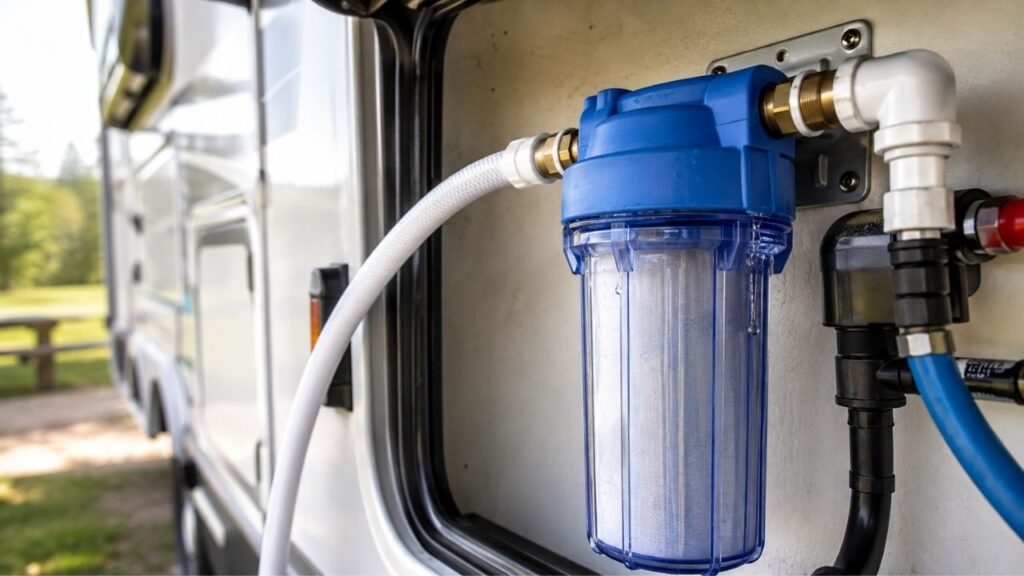
That means adding another standard blue inline RV filter usually will not solve hard-water scale.
It may still be useful before the softener for other purposes.
Just do not expect filtration and softening to produce the same result.
How to Keep Your RV Water Softener Working Properly
Portable softeners are relatively simple equipment, but consistent maintenance makes their performance much easier to predict.
- Test campground hardness when arriving at unfamiliar locations.
- Keep hardness strips near your RV water equipment.
- Track approximate water usage between regenerations.
- Regenerate before severe hardness breakthrough develops.
- Use the salt quantity specified for your exact model.
- Follow the proper regeneration flow rate and rinse time.
- Backflush according to manufacturer recommendations.
- Use suitable sediment filtration when campground water is dirty.
- Watch for orange staining that could indicate iron.
- Clean fouled resin only with compatible products.
- Protect the softener from freezing during winter storage.
- Drain and store the unit according to its instructions.
- Record campground hardness and regeneration dates while traveling.
A simple log can be surprisingly helpful.
After a few trips, you will recognize patterns before problems develop.
When Should You Replace the Resin or RV Water Softener?
Replacement should come after testing, regeneration, and basic maintenance.
Do not buy new resin simply because water feels different.
Consider replacement when:
- Correct regeneration no longer reduces outlet hardness.
- Approved deeper regeneration does not restore performance.
- Resin cleaning produces no meaningful improvement.
- Resin is visibly escaping from the softener.
- The tank or internal components are damaged.
- Water flow remains severely restricted after maintenance.
- Your softener is consistently too small for your water demand.
You may also choose a larger-capacity unit if frequent regeneration becomes inconvenient.
That is particularly useful when you regularly camp in very hard-water regions.
Final Verdict
If your RV water still feels hard after using a softener, start with a hardness test rather than guessing. Test campground water first, then test directly at the softener outlet. That simple comparison tells you whether the problem is inside the softener or somewhere in your RV.
When outlet water truly remains hard, exhausted resin is a common cause. Incorrect regeneration, extreme campground hardness, excessive flow, iron, sediment, and plumbing mistakes can also interfere with performance.
Most importantly, do not judge your portable softener entirely by time or water feel. Track actual hardness, estimate capacity, regenerate correctly, and confirm the result with another hardness test. That approach makes the problem much easier to solve.
Related FAQs
Why Is My RV Water Hard Right After Regenerating the Softener?
If the outlet water remains hard immediately after regeneration, the regeneration may have been incomplete, brine may have passed through too quickly, or the resin could be heavily fouled. Confirm the procedure for your specific unit, retest the outlet, and consider approved cleaning if normal regeneration fails.
How Do I Know When My RV Water Softener Needs Regeneration?
Test the water directly from the softener outlet with hardness strips or a hardness kit. When hardness begins returning, the resin is approaching exhaustion. You can also estimate the interval using the softener’s grain capacity, campground hardness, and approximate gallons used.
What Hardness Should Water Be After an RV Softener?
Properly softened water should show very little calcium and magnesium hardness. Some portable-softener instructions consider roughly 0–3 GPG within the soft range, but you should use the target provided by your specific manufacturer’s instructions.
Can I Use a TDS Meter to Test My RV Water Softener?
A TDS meter is not a reliable way to test softener performance because ion-exchange softeners replace calcium and magnesium with other dissolved ions. TDS can therefore remain relatively high even when the water has very little hardness.
Why Does Soft Water Feel Slippery in the Shower?
Soft water allows soap to lather and rinse differently because calcium and magnesium are no longer reacting with it as strongly. That can make your skin feel unusually slippery, especially if you have become accustomed to showering with hard campground water.
Can Very Hard Campground Water Exhaust an RV Softener Quickly?
Yes. The harder the incoming water, the faster it consumes the softener’s available grain capacity. A portable unit that lasts a long time on 5-GPG water can require regeneration much sooner when connected to water measuring 20, 30, or 40 GPG.
Does High Water Flow Make an RV Softener Less Effective?
It can. Water needs enough contact with the resin for effective ion exchange, and portable softeners have service-flow limits. If several fixtures operate simultaneously, reduce demand and test the outlet again to see whether hardness decreases.
Can Iron Ruin RV Water Softener Resin?
Iron can accumulate on resin and reduce its performance over time, especially when you frequently stay at campgrounds using iron-rich well water. Orange staining, declining capacity, and poor results after regeneration can indicate that approved resin cleaning is needed.
Should I Put a Sediment Filter Before My RV Water Softener?
A sediment prefilter can help protect the resin from sand, rust, dirt, and other particles in campground water. Follow your equipment manufacturer’s recommended filter arrangement because pressure, filtration level, and system design can affect the preferred installation order.
Can I Use Table Salt to Regenerate an RV Water Softener?
Some portable RV water softeners are specifically designed to regenerate with ordinary table salt, while others may recommend different salt products or procedures. Always follow the instructions for your exact unit instead of assuming one salt type works for every softener.
Why Is My Water Soft After Regeneration but Hard Again a Few Days Later?
The incoming campground water may be extremely hard, your household may be using more water than expected, or the softener may have limited capacity. Resin fouling or incomplete regeneration can also cause the unit to reach hardness breakthrough unusually quickly.
Do I Need to Flush My RV After Installing a Water Softener?
Yes, some flushing may be necessary because hard water can remain inside plumbing lines, the freshwater tank, water heater, faucets, and appliances. First confirm soft water directly at the softener outlet, then allow treated water to replace the older untreated water throughout the RV.

Steven Parker writes about everyday RV life, from setup tips to long-term living decisions. His content reflects a calm, experienced approach to RV ownership and travel. He focuses on comfort, reliability, and realistic expectations.