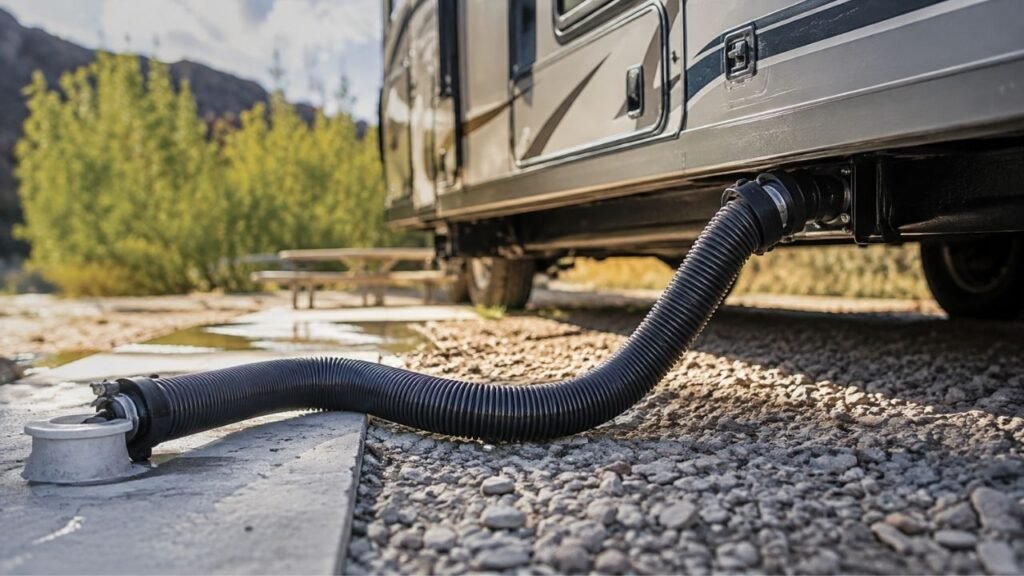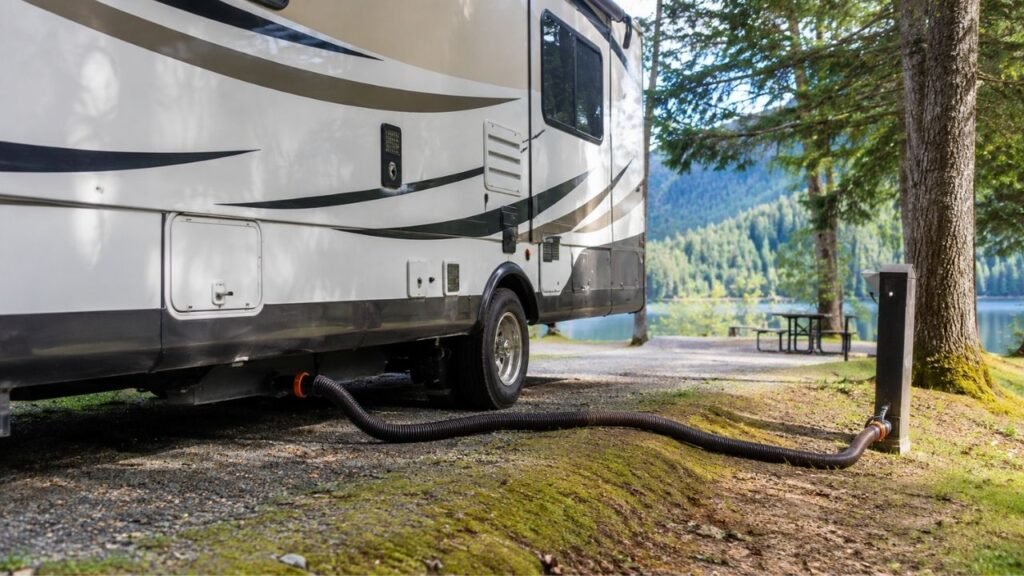
Wastewater usually remains in an RV sewer hose because the hose has a low spot, poor slope, or uphill section. These areas trap liquid because gravity cannot carry it completely into the campground sewer inlet. Excess hose length, weak dumping flow, debris, or a high sewer connection can also cause standing wastewater.
If you keep finding liquid inside your hose after dumping, I’ll help you track down the reason. We’ll also cover how to drain the hose safely, correct its slope, and prevent the problem during future campsite hookups.
Key Takeaways
- Low spots are the most common cause of trapped wastewater.
- Your sewer hose needs a continuous downhill path toward the sewer inlet.
- Small droplets inside the hose are normal after dumping.
- Visible pools of wastewater usually indicate a slope or drainage problem.
- Dump your black tank before dumping your gray tank.
- Gray water helps rinse residue from the sewer hose.
- Shorter sewer hose runs usually drain more completely.
- A hose that refills afterward may indicate a leaking gate valve.
Why Does Wastewater Stay in an RV Sewer Hose?
Your RV sewer system mainly depends on gravity to move wastewater. When part of the hose sits below the surrounding sections, liquid naturally collects there instead of reaching the sewer inlet.
The Sewer Hose Has Dips or Low Spots
This is probably the first thing I would check.
An RV sewer hose is flexible, which makes campsite setup easier. Unfortunately, that flexibility also allows the hose to sag between supports.
Imagine the hose leaving your RV, dropping toward the ground, and then rising again. That low section behaves like a small trap.
Wastewater flows into the dip but cannot climb the next section. When your holding tank finishes draining, that liquid stays behind.
You may even hear water moving inside when lifting the hose.
Uneven campsites make these low spots especially common. Grass, gravel, tree roots, and soft soil can change the hose height along its run.
The Hose Does Not Have a Continuous Downhill Slope
Your sewer hose should gradually descend from the RV toward the sewer connection.
A nearly flat hose may still move some wastewater. However, it often leaves more liquid inside its accordion folds.
A hose can also appear correctly positioned from several feet away. One small uphill section may still stop complete drainage.
Think about the entire hose as one continuous path.
The goal should look like this:
RV outlet → gradual downward run → campground sewer inlet.
You want to avoid this:
RV outlet → down → low spot → uphill section → sewer inlet.
The Campground Sewer Inlet Is Too High
Sometimes the hose itself is not the real problem.
The campground sewer fitting may sit unusually high above the ground. In some campsites, it can even be close to your RV waste outlet height.
Gravity cannot move wastewater uphill.
You may successfully empty most of your tanks because of the initial pressure. Once that flow slows down, however, wastewater can remain inside the hose.
This situation is especially frustrating because adjusting normal hose supports may not completely solve it.
Your Sewer Hose Is Longer Than Necessary
Extra hose length sounds harmless, but it creates more opportunities for wastewater to collect.
A longer hose has:
- More accordion folds
- More unsupported sections
- More chances to sag
- More opportunities for an uphill section
- More resistance during slow drainage
For example, there is little benefit in stretching 20 feet of hose when the sewer inlet is only eight feet away.
Use enough hose to reach comfortably without pulling the connections tight.
Anything beyond that can make drainage unnecessarily difficult.
The Hose Is Kinked, Crushed, or Partially Collapsed
A damaged sewer hose can also restrict wastewater movement.
Look along the entire hose for sections that were stepped on, crushed during storage, or flattened beneath heavy equipment.
A permanent kink can create a narrow passage.
Wastewater may still move through that area while the tanks are draining quickly. Once the pressure drops, however, the remaining liquid may not pass through easily.
This differs from a simple low spot.
A low spot traps wastewater because of gravity. A damaged hose physically restricts the wastewater path.
Waste or Toilet Paper Is Catching Inside the Hose
Solid material can sometimes collect inside low sections of the hose.
This becomes more likely when the black tank is dumped with very little water. Toilet paper and waste may move slowly instead of being carried out by a strong flow.
A properly functioning sewer hose should handle normal RV waste.
However, repeated low spots can allow solids to settle. Those solids may then restrict the remaining water.
If you can see debris through a clear fitting, I would correct the hose slope before assuming the holding tank itself is clogged.
There Was Not Enough Water Behind the Dump
A fuller holding tank creates stronger initial flow.
If you regularly dump the black tank when it contains very little liquid, you lose some of that flushing force.
Liquids move faster than heavier solids.
That is one reason keeping the black tank valve closed between dumps matters. It allows enough liquid to accumulate around the waste.
When you finally open the valve, the larger volume helps carry everything toward the sewer connection.
Cold Weather Has Partially Frozen the Wastewater
Freezing temperatures introduce another possible problem.
Wastewater sitting inside a low section can freeze before wastewater elsewhere in the system.
That frozen section may partially block the hose.
The next time you dump, liquid collects behind the restriction instead of flowing normally.
If your sewer hose suddenly stops draining during freezing weather, inspect the lowest sections first.
Is It Normal to Have Some Water Left in an RV Sewer Hose?
A completely dry sewer hose after every dump is unrealistic. Small droplets, moisture, or a thin film inside the accordion folds can remain even when your setup is working correctly.
What matters is how much wastewater remains.
A few drops around the hose walls usually do not indicate a problem.
A visible pool is different.
If you lift one section and suddenly hear or see several cups of liquid moving toward the sewer, your hose probably had a low spot.
I would also investigate further when you notice:
- Significant wastewater remaining after every dump
- Strong sewage odors around the hose
- Visible solids inside the hose
- Very slow drainage
- A hose section that remains full
- Wastewater returning after you already drained the hose
Small residual moisture is normal.
Standing wastewater usually means the hose setup needs attention.
Quick Diagnosis: Why Is Water Sitting in My RV Sewer Hose?
You can often identify the problem without removing anything from your RV. Start by looking at where the liquid remains and how the hose behaves during dumping.
| What You Notice | Most Likely Cause | Quick Check | Best Fix |
| Water sits in one section | Hose sag or low spot | Lift that section gently | Add or adjust hose supports |
| Entire hose drains slowly | Insufficient slope | Compare hose height along the run | Create a continuous downward path |
| Water collects near sewer end | Sewer inlet sits too high | Compare inlet and RV outlet heights | Raise the hose run or use another dumping method |
| Flow starts strong and then stops | Kink or obstruction | Inspect the hose from end to end | Straighten, rinse, or replace the hose |
| Solids remain inside | Weak flush or debris | Check tank fullness and hose dips | Improve dumping routine and rinse |
| Hose fills again later | Possible leaking waste valve | Drain hose and monitor it | Inspect the black or gray gate valve |
| Problem occurs only in freezing weather | Partial freezing | Inspect low sections | Thaw safely and improve drainage |
How Do You Get Trapped Wastewater Out of an RV Sewer Hose?
If wastewater is already sitting inside the hose, you usually do not need complicated equipment. The safest approach is to keep the sewer end connected and gradually move the trapped liquid toward it.
Follow these steps:
- Keep the campground sewer connection securely attached.
- Close both black and gray tank valves.
- Start at the RV end of the sewer hose.
- Gently lift the first section several inches.
- Allow the wastewater to move toward the sewer inlet.
- Move farther along the hose section by section.
- Continue lifting until the trapped liquid reaches the inlet.
- Straighten any dips before lowering the hose again.
- Rinse the hose when suitable facilities are available.
- Drain the remaining liquid before disconnecting everything.
RV owners often call this process “walking the hose.”
You are basically moving the low point toward the campground sewer connection.
Do it slowly.
Suddenly lifting a full section can cause fittings to move or wastewater to surge toward the sewer connection.
Wear disposable sanitation gloves while working around sewer equipment.
Also keep any hose used for sewer rinsing completely separate from your drinking-water equipment.
How Should an RV Sewer Hose Be Positioned to Drain Completely?
Proper hose positioning prevents most standing wastewater problems. Your goal is not simply getting the hose off the ground. You need a supported path that keeps getting lower as it approaches the sewer inlet.
Create One Continuous Downhill Run
Start near your RV waste outlet.
The hose should gradually move downward from that point toward the campground sewer connection.
A gentle decline usually works better than steep drops followed by flat sections.
Where campsite conditions allow, roughly 1/8 to 1/4 inch of drop per foot can provide a practical gradual slope.
Do not obsess over the exact measurement.
Removing dips and uphill sections matters more than achieving a perfect number.
Support the Entire Hose
Sewer hose supports help prevent the accordion hose from dropping between high points.
Position the tallest support near the RV.
Gradually lower each section as you move toward the campground sewer inlet.
Adjustable accordion-style supports work well because they follow uneven campground terrain.
You can also use a stable trough-style support.
Whatever you use, make sure the hose cannot slide off during dumping.
Keep the Hose as Short as Practical
Use only the length you actually need.
Your hose should comfortably reach the sewer connection without pulling against either fitting.
Avoid stretching unused hose across the campsite.
Every unnecessary foot creates another place where the line can sag.
Recheck the Hose After Wastewater Starts Flowing
This is an easy detail to overlook.
An empty sewer hose weighs very little.
Once wastewater begins flowing through it, the extra weight can make unsupported sections sag.
Watch the hose during your first dump after setting up.
If a section suddenly drops between supports, adjust it before the next dump.
Should I Dump the Black Tank or Gray Tank First?
Dump the black tank first, then dump your gray tank.
This order gives you a cleaner sewer hose at the end.
Black tank wastewater carries toilet waste and paper through the hose. After that tank finishes draining, close its valve.
Then open the gray tank valve.
The gray water from showers and sinks helps rinse remaining black tank residue through the sewer hose.
However, gray water cannot fix poor hose positioning.
If your hose contains a deep dip, the gray water may simply replace the black wastewater sitting there.
Correct the slope first.
Then let the gray tank provide the final rinse.
Can Leaving the Black Tank Valve Open Cause Wastewater Problems?
Leaving the black tank valve open can indirectly contribute to poor dumping performance.
When the valve stays open at a full-hookup campsite, liquids continually drain away.
Heavier waste may remain behind inside the black tank.
Over time, that can create buildup and reduce how effectively everything leaves during dumping.
Keeping the black valve closed allows water and waste to accumulate together.
When you eventually open the valve, the larger volume produces stronger flow.
That stronger discharge helps carry waste through the outlet and sewer hose.
So the primary problem from leaving the valve open happens inside the tank.
It is not usually the direct reason water sits inside your sewer hose.
What If the Campground Sewer Connection Is Higher Than My RV Outlet?
A high campground sewer fitting creates a different challenge because normal RV dumping depends heavily on gravity. If the wastewater must travel uphill, adjusting a basic hose support may not be enough.
Raise and Support the Hose Where Possible
Sometimes the inlet is only slightly higher than expected.
You may be able to improve the path by raising the hose near your RV and creating a gradual descent toward the sewer fitting.
Make sure this does not create another low point.
Reposition the RV if the Site Allows
Moving your RV a few feet can sometimes make a surprising difference.
A better parking position may:
- Shorten the sewer hose
- Improve outlet height
- Reduce sagging
- Create a straighter run
Obviously, only reposition when doing so remains safe and appropriate for your campsite.
Use a Macerator Pump When Gravity Cannot Work
If the campground sewer inlet truly sits above your RV waste outlet, gravity may never drain the system completely.
A macerator pump can handle this situation.
It grinds waste and pumps it through a smaller dedicated discharge hose.
I would consider this solution when correcting the hose position still leaves a genuine uphill run.
Always follow the pump manufacturer’s discharge limits and campground rules.
Why Does My Sewer Hose Fill With Wastewater Again After I Drain It?
If you completely drain the sewer hose and liquid later appears again, do not keep blaming the hose slope. Wastewater returning without using your plumbing can indicate that liquid is slowly passing through a waste valve.
A Black or Gray Gate Valve May Be Seeping
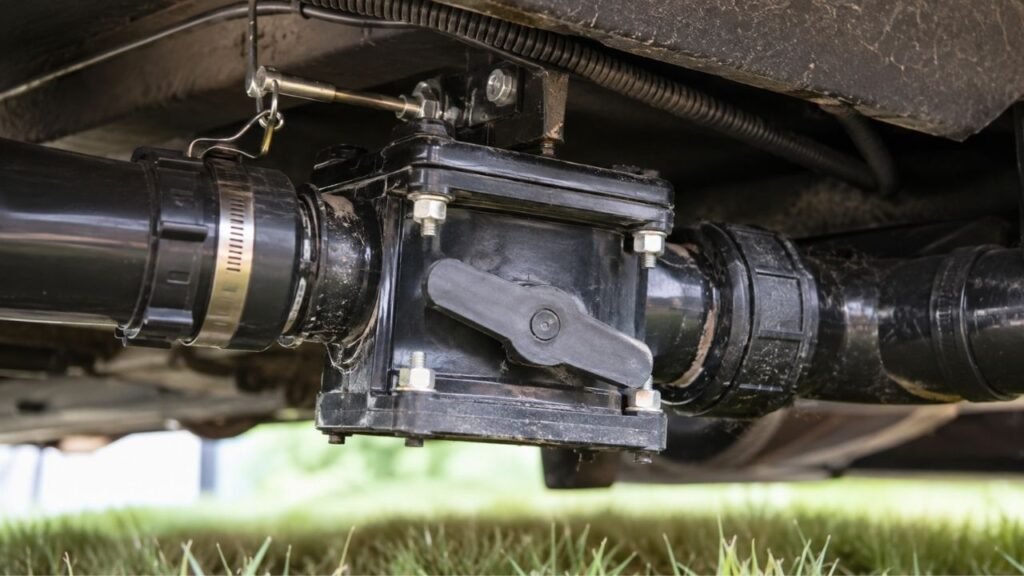
Your black and gray tanks normally use gate valves to hold wastewater inside.
Those valves contain seals.
If a seal becomes worn, damaged, or contaminated with debris, a small amount of wastewater may slowly leak past it.
That liquid then enters the common outlet and eventually reaches your sewer hose.
A Valve May Not Be Closing Fully
A gate valve can also remain slightly open.
Possible causes include:
- Debris around the valve blade
- A sticky valve mechanism
- Damaged seals
- A bent or poorly moving valve assembly
The valve may look closed from outside while still allowing a slow seep.
Confirm the Problem Before Replacing Anything
Drain your sewer hose completely.
Close both tank valves.
Leave the hose connected and correctly supported.
Then watch the clear elbow or hose connection.
If new wastewater slowly appears without anyone using the RV plumbing, inspect the waste valves.
That is a more useful clue than repeatedly changing your sewer hose slope.
When Does Trapped Wastewater Mean the Sewer Hose Is Clogged?
Standing water does not automatically mean your sewer hose is clogged.
Most cases involve hose geometry.
If lifting a low section immediately sends the wastewater toward the sewer, you probably have a slope problem rather than a blockage.
A clog becomes more likely when:
- Flow remains slow after fixing the hose slope
- Lifting the hose does not release the wastewater
- One section remains unusually swollen
- Solid material is visible inside
- The hose has a severe crushed section
- Waste drains normally through another sewer hose
Inspect the hose itself before assuming the RV tank is clogged.
Sometimes replacing a damaged hose is simpler than repeatedly flushing one with permanent internal restrictions.
Should You Rinse an RV Sewer Hose After Every Dump?
Dumping gray water after black water already provides a useful routine rinse.
For many RVers, that is enough during normal campground use.
If your dump station provides a suitable non-potable water source, you can rinse the sewer hose further before storage.
Never use your drinking-water hose for this job.
Keep freshwater and sewer equipment completely separate.
Rinsing is especially useful when you see residue remaining in the accordion folds or clear elbow.
However, rinsing cannot compensate for a poorly sloped hose.
Water will still collect wherever gravity creates a trap.
How Do You Drain an RV Sewer Hose Before Storing It?
Before putting the hose away, remove as much remaining wastewater as possible. This reduces odor, mess, and unpleasant surprises the next time you open your storage compartment.
- Leave the sewer end connected while draining.
- Close your black and gray tank valves.
- Start lifting the hose near your RV.
- Work toward the sewer inlet gradually.
- Let every low section empty completely.
- Rinse the hose when appropriate.
- Allow excess rinse water to drain.
- Disconnect carefully after the hose stops draining.
- Install the end caps if your hose has them.
- Store sewer gear away from freshwater equipment.
A few remaining droplets are not a concern.
The goal is to avoid storing a hose containing a pool of wastewater.
Common RV Sewer Hose Mistakes That Leave Wastewater Behind
Several small setup mistakes can create the same annoying result. Correcting these habits usually makes dumping cleaner and easier.
- Laying the hose directly on uneven ground: Small dips can trap more wastewater than you expect.
- Allowing the hose to sag between supports: The hose may create several small liquid traps.
- Using unnecessary hose length: Extra length introduces additional low spots and folds.
- Assuming a flat hose will drain completely: Gravity works better with a continuous decline.
- Dumping gray water before black water: You lose the convenient final rinse that gray wastewater provides.
- Disconnecting immediately after tank flow stops: Some liquid may still be traveling slowly through the hose.
- Leaving the black valve open continuously: This can reduce the strong flushing action of a fuller black tank.
- Ignoring crushed hose sections: A damaged section can restrict flow even with perfect slope.
- Overlooking a high campground sewer inlet: Sometimes campsite geometry makes complete gravity drainage impossible.
- Storing the hose before emptying low spots: Trapped wastewater can remain inside until your next setup.
How to Prevent Wastewater From Remaining in the Sewer Hose
Most wastewater pooling problems can be prevented during setup. Spend an extra minute checking the hose before dumping, and you can avoid dealing with trapped liquid afterward.
- Inspect the sewer inlet height before connecting.
- Choose the shortest practical sewer hose length.
- Create a continuous downhill path toward the sewer.
- Support sections that could sag under wastewater weight.
- Keep your black tank valve closed between dumps.
- Allow enough liquid to accumulate before dumping.
- Dump the black tank before the gray tank.
- Use gray water as the final hose rinse.
- Watch flow through a clear elbow when available.
- Inspect the hose for damaged or collapsed sections.
- Walk remaining liquid toward the sewer before disconnecting.
- Check your gate valves if wastewater returns afterward.
Final Verdict
Wastewater usually remains inside an RV sewer hose because gravity cannot move it past a low spot, flat section, or uphill stretch. Correcting the slope and supporting the hose solves most cases.
A little moisture inside the hose is completely normal. A visible pool of wastewater after every dump deserves attention.
Start with the simplest checks first.
Check the slope, remove low spots, shorten the hose, and improve your dumping routine. Then inspect the hose and gate valves if the problem continues.
If the campground sewer connection truly sits above your RV outlet, a macerator pump may be the practical solution.
Related FAQs
Why Is Water Still in My RV Sewer Hose After Dumping?
Water usually remains because part of the sewer hose sits lower than the surrounding sections. That low spot traps wastewater after tank flow stops. A nearly flat hose, uphill section, damaged hose, or high campground sewer inlet can also cause the problem.
Is It Normal for an RV Sewer Hose to Have Water in It?
A small amount of moisture or several droplets inside the hose is normal. A noticeable pool that moves when you lift the hose usually indicates a sagging section or inadequate downhill slope.
How Do I Completely Drain My RV Sewer Hose?
Keep the sewer end connected and begin lifting the hose near your RV. Slowly work toward the campground sewer inlet, allowing trapped liquid to move ahead of you. Continue until each low section has drained.
Does an RV Sewer Hose Need to Be Sloped?
Yes. A continuous downhill slope helps gravity carry wastewater toward the sewer inlet. A flat or sagging hose can still drain partially, but it is much more likely to leave wastewater behind.
How Much Slope Does an RV Sewer Hose Need?
A gentle, continuous decline is usually more important than hitting an exact measurement. Where campsite conditions allow, roughly 1/8 to 1/4 inch of drop per foot can provide a useful gravity-assisted path.
Should an RV Sewer Hose Have a P-Trap?
You generally do not need to intentionally create a water-holding P-trap in a standard RV sewer hose. A deliberate dip can trap wastewater and make the hose harder to drain before disconnecting or storing.
Why Is My RV Sewer Hose Not Draining Even With the Valve Open?
Check for low spots, insufficient slope, a kinked hose, debris, a high campground sewer inlet, or an upstream tank restriction. If correcting the hose position changes nothing, inspect the tank outlet and waste valve.
Should I Leave My Gray Tank Valve Open at Full Hookups?
Some RVers leave it open, but keeping some gray water available can be helpful before departure. You can dump that stored gray water after the black tank to rinse residue through the sewer hose.
Should I Leave My Black Tank Valve Open at Full Hookups?
No. Keeping the black valve continuously open lets liquids drain while heavier waste can remain inside the tank. Keeping it closed until dumping gives you more water volume to carry waste out effectively.
Can Toilet Paper Clog an RV Sewer Hose?
RV-friendly toilet paper should normally pass through a properly operating sewer system. Problems become more likely when there is too little water, existing waste buildup, deep hose low spots, or a damaged hose restricting flow.
What Should I Do if the Campground Sewer Inlet Is Higher Than My RV?
First shorten and support the hose and see whether repositioning your RV improves the height difference. If wastewater must genuinely travel uphill, a macerator pump can provide a more reliable solution than gravity alone.
Why Does Wastewater Come Back Into My Sewer Hose After I Empty It?
If wastewater returns without anyone using the RV plumbing, a black or gray tank gate valve may be leaking. Drain the hose, close both valves, and watch whether liquid gradually returns before replacing any parts.

Steven Parker writes about everyday RV life, from setup tips to long-term living decisions. His content reflects a calm, experienced approach to RV ownership and travel. He focuses on comfort, reliability, and realistic expectations.