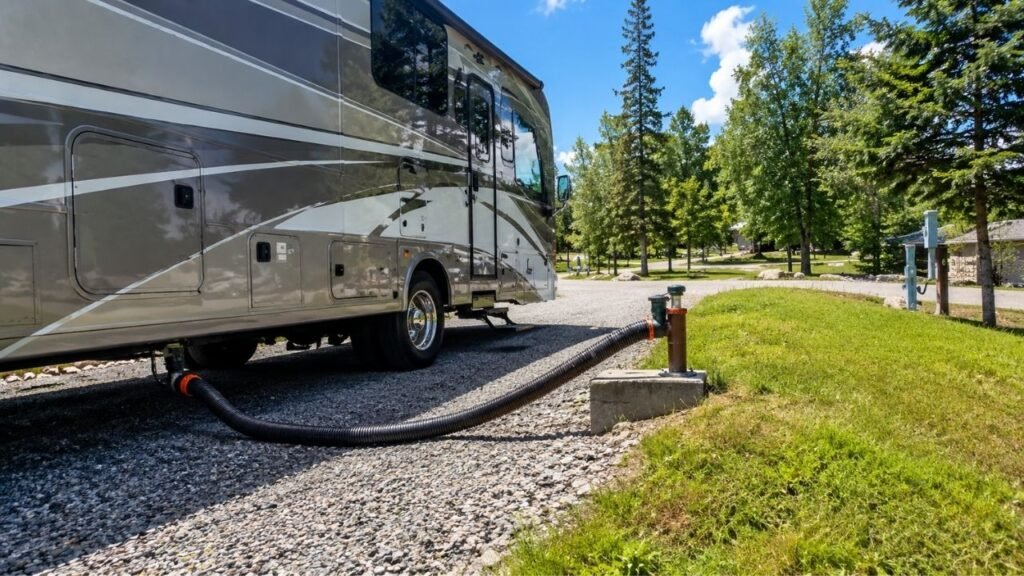
When the sewer inlet is higher than your RV outlet, gravity may not fully drain your holding tanks. For a small height difference, drain as much as possible and carefully lift the sewer hose toward the inlet. For a true uphill connection, a properly rated RV macerator pump is usually the most reliable solution.
In this guide, I’ll help you determine how serious the height difference is. Then, we’ll go through practical fixes, safe dumping steps, and mistakes you should avoid.
Key Takeaways
- A standard RV sewer hose depends mainly on gravity.
- Sewer hose supports remove dips but cannot make waste flow uphill.
- Small height differences may be manageable by manually lifting the hose.
- A macerator pump works better for a true uphill sewer connection.
- Never disconnect a sewer hose while wastewater remains trapped inside.
- Dump your black tank first and gray tank afterward.
- Do not tilt your RV excessively just to improve sewer drainage.
- An extremely high campground sewer inlet may justify changing sites.
First, Determine What Kind of Sewer Height Problem You Have
Before buying anything or changing your RV setup, look carefully at the elevation difference. Not every high-looking sewer connection actually requires a pump.
| Situation | What Is Happening | Best First Fix | Macerator Needed? |
| Sewer inlet is lower, but hose sags | Wastewater collects in low spots | Shorten and support the hose | Usually no |
| Sewer inlet is almost level | Flow slows and liquid stays inside the hose | Improve support and lift remaining hose | Usually no |
| Sewer inlet is slightly higher | Some waste drains before flow stalls | Drain normally, then walk the hose | Maybe |
| Sewer inlet is clearly higher | Waste must travel uphill | Use a macerator pump | Usually yes |
| Sewer riser is extremely high | Normal dumping becomes impractical | Request another site or use a dump station | Often better |
The key question is simple: Does the wastewater have a continuous downhill path?
If the answer is yes, your problem may only involve hose positioning.
If the answer is no, you need another way to move wastewater uphill.
Why an RV Sewer Hose Cannot Reliably Drain Uphill
A traditional RV sewer system relies on gravity rather than pressure. Understanding that basic limitation makes choosing the right solution much easier.
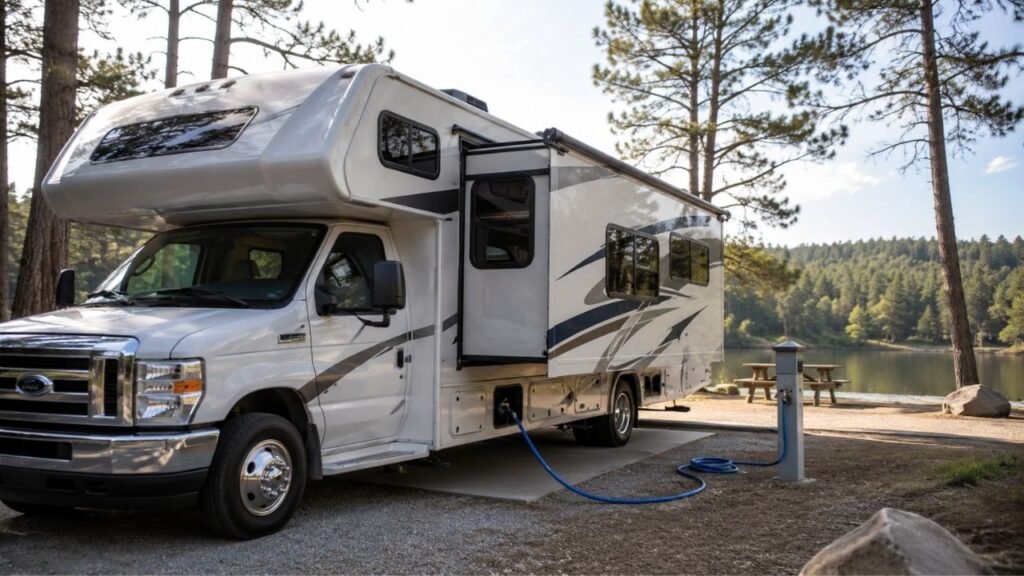
When you open your black or gray tank valve, wastewater leaves the holding tank. It then travels through the large sewer hose toward the campground connection.
For normal dumping, the campground sewer inlet should sit lower than the effective wastewater level.
Problems begin when the sewer connection is too high.
You may initially see good flow because the tank contains plenty of wastewater. The liquid level inside the tank may still sit above the campground sewer inlet.
As the tank empties, that pressure decreases.
Eventually, wastewater may stop moving. Some liquid can remain inside the tank outlet or sewer hose.
That is why an elevated sewer inlet does not always mean nothing will drain. It often means the system cannot drain completely using gravity.
What to Do If the Sewer Inlet Is Only Slightly Higher
A small height difference does not always require expensive equipment. You can often drain most of the tank normally and manage the remaining wastewater carefully.
Let the Tank Drain as Much as Possible
Connect your sewer hose securely before opening any waste valve.
Let gravity do as much work as possible.
Your holding tank may still sit high enough for most wastewater to leave normally. Keep watching the hose or clear sewer fitting if you use one.
Eventually, the flow may slow or stop.
Do not immediately disconnect anything.
There may still be wastewater sitting inside the hose.
Carefully Walk the Remaining Waste Through the Hose
You can sometimes empty the remaining hose manually when the height difference is small.
Start near your RV outlet.
Carefully lift a short section of hose without disconnecting either end. Move that raised section gradually toward the campground sewer inlet.
You are essentially pushing the trapped liquid forward using gravity.
Continue lifting and lowering sections until the remaining wastewater enters the sewer connection.
Work slowly.
Avoid suddenly raising a hose full of wastewater because pressure can increase around fittings.
Keep the campground end securely attached throughout the process.
This method works best when the elevation difference is minor. It is not a practical solution for a sewer inlet several feet higher.
Finish With Gray Water
After dumping your black tank, drain your gray tank.
Gray water contains soap and relatively cleaner wastewater from sinks and showers. Running it last helps rinse residue from the common RV outlet and sewer hose.
It does not sanitize the hose.
However, it can make cleanup much easier before disconnecting everything.
Can a Sewer Hose Support Fix a High Campground Sewer Inlet?
Sewer hose supports are extremely useful, but they are often misunderstood. They solve sagging and uneven hose runs rather than a true uphill elevation problem.
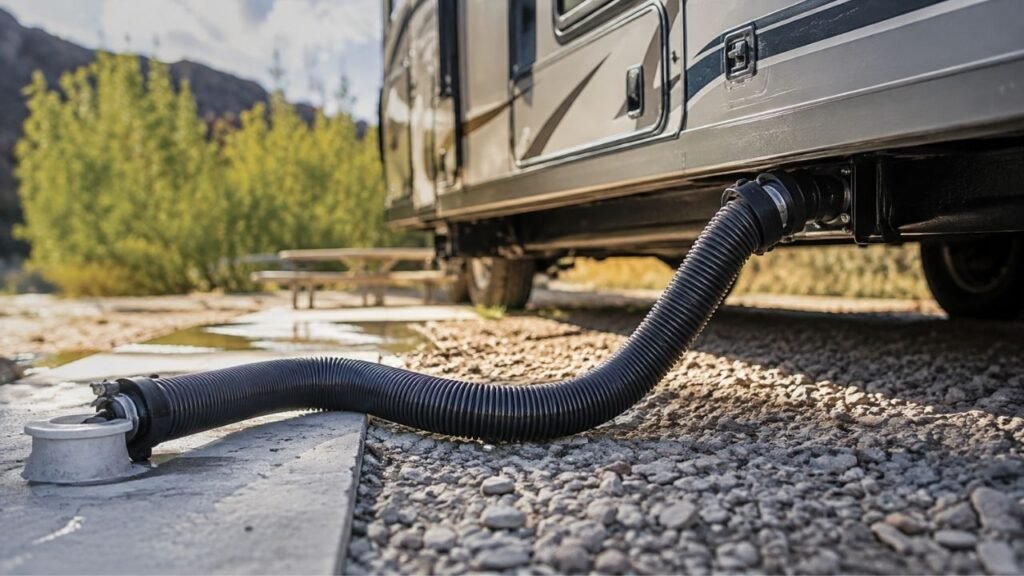
An accordion-style sewer support keeps your hose off the ground. It also prevents deep dips where wastewater can collect.
A vinyl gutter or rigid hose cradle can do something similar.
These supports work well when your RV outlet is already higher than the campground sewer inlet.
They help preserve that natural downhill path.
However, imagine your RV outlet is 12 inches above the ground. The campground sewer opening is 18 inches above the ground.
A hose support cannot change that six-inch difference.
You would still be asking wastewater to travel uphill.
In that situation, use the support to eliminate unnecessary dips. Then decide whether manual hose lifting or a pumping system is needed.
When a Macerator Pump Is the Better Solution
When wastewater truly needs to travel uphill, a macerator pump is usually the most dependable solution. Unlike a standard sewer hose, it does not rely entirely on gravity.
How an RV Macerator Pump Solves the Problem
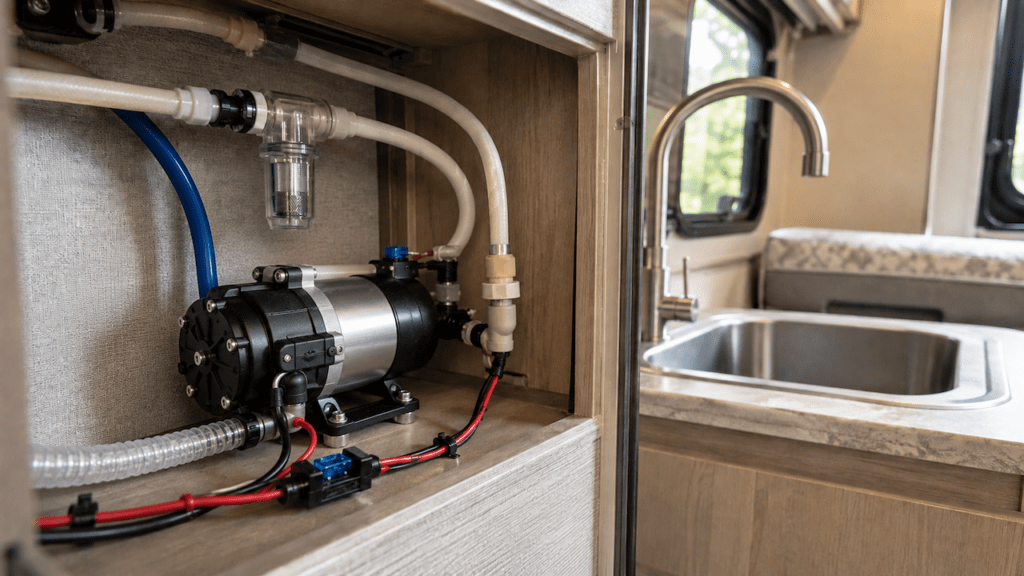
A portable RV macerator normally connects near your waste outlet.
Inside the pump, a cutting mechanism breaks down waste and toilet paper. The pump then pushes the wastewater through a smaller discharge hose.
That pressure allows waste to travel farther or higher than gravity alone permits.
This can be especially useful when:
- The campground sewer inlet is clearly above your RV outlet.
- Your RV is parked far from the sewer connection.
- The sewer route crosses uneven terrain.
- Gravity drainage repeatedly leaves wastewater trapped in the hose.
A macerator is not necessary at every campground.
But having one available can solve some of the most awkward sewer layouts.
How to Set Up a Portable Macerator for an Uphill Sewer Inlet
Follow your specific pump manufacturer’s instructions first. The general process usually looks like this:
- Close both holding tank valves.
- Connect the macerator securely to the RV waste outlet.
- Attach the dedicated discharge hose.
- Route the hose toward the campground sewer inlet.
- Secure the discharge end firmly inside the sewer connection.
- Connect the pump to its required power supply.
- Open the black tank valve.
- Turn on the macerator according to its instructions.
- Watch the flow and listen for pump changes.
- Turn the pump off when appropriate.
- Close the black tank valve.
- Drain or rinse with gray water as recommended.
- Shut down the system before disconnecting anything.
Never assume the small discharge hose is harmless.
A powered macerator pressurizes that hose. A loose connection can create a serious mess.
Check Vertical Lift, Hose Length, and Pump Limits
Not every RV macerator has the same pumping ability. Check your exact model before expecting it to handle a difficult campsite.
Important specifications include:
- Maximum recommended vertical lift
- Maximum discharge hose length
- Required hose diameter
- Electrical current requirements
- Fuse size
- Pump duty cycle
- Maximum continuous run time
- Dry-running limitations
- Restrictions caused by kinks or tight bends
Vertical lift matters especially when your sewer inlet sits higher.
A pump capable of moving waste a long horizontal distance does not automatically have the same vertical pumping capacity.
Always follow the manufacturer’s limits.
What About a Water-Powered SewerSolution?
A water-powered waste system can be another option for some RVers. However, it works differently from an electric macerator and usually has different operating limits.
These systems use pressurized water to help break up and move wastewater.
They can be convenient when electrical power for a macerator is inconvenient.
However, they also require a suitable water source.
More importantly, their uphill capability can be much more limited than some powered macerators.
Do not assume every pumping-style sewer system can overcome the same elevation.
Check the manufacturer’s rated vertical rise carefully.
If the campground sewer connection sits significantly higher than your RV, an electric macerator may be the more practical choice.
Can You Raise or Reposition the RV Instead?
Changing your RV position can sometimes improve drainage, but stability comes first. Never create an unsafe campsite setup just to gain a few inches of sewer height.
For a Travel Trailer
A small positioning change may improve the relationship between your sewer outlet and campground inlet.
For example, moving the trailer slightly within the site may place the outlet over higher ground.
Approved leveling blocks may also change the height somewhat.
However, avoid making the trailer excessively unlevel just for sewer drainage.
Your refrigerator, slide-outs, doors, comfort, and overall stability may also depend on proper leveling.
For Motorhomes and Fifth Wheels
Use only the leveling procedures approved for your RV.
Hydraulic or electric leveling systems have specific operating limits.
Do not extend jacks excessively just to raise one side of the waste outlet.
You should also never work underneath an RV that is supported only by leveling equipment.
If gaining enough sewer height requires an extreme leveling setup, choose another dumping method instead.
When Moving to Another Site Makes More Sense
Sometimes the smartest solution is not modifying your RV setup.
Consider contacting campground staff when:
- The sewer riser is unusually high.
- Your hose cannot reach safely.
- Your macerator cannot handle the vertical lift.
- The sewer route would cross a roadway.
- The connection cannot be sealed securely.
- The site requires excessive RV leveling.
- A nearby dump station offers easier access.
Campground staff may have another site with a better-positioned sewer connection.
Should You Leave the Black Tank Valve Open With a Difficult Sewer Connection?
A high sewer connection can tempt you to leave everything open and hope wastewater slowly drains. That approach can create an entirely different black tank problem.
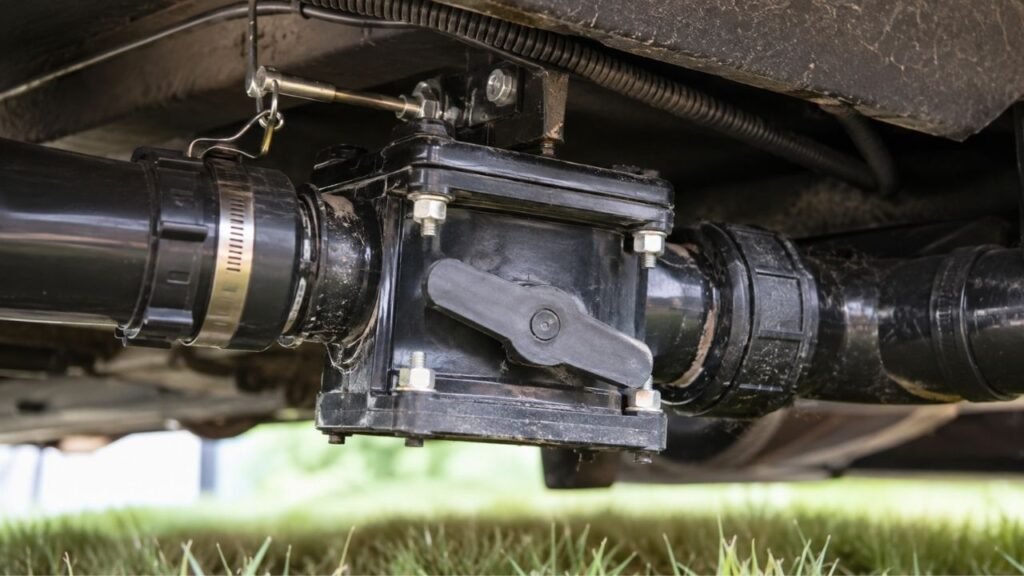
Keep your black tank valve closed during normal full-hookup camping.
You want enough liquid inside the tank to help carry solids when dumping.
If the black valve stays open, liquids may gradually drain away while heavier solids remain behind.
Those solids can accumulate inside the tank.
When you are ready to dump, open the black valve and drain it completely.
Then close it before draining your gray tank.
The gray water helps rinse the shared sewer outlet and hose afterward.
Safe Dumping Routine When the Sewer Connection Is Uphill
An awkward sewer connection increases the chance of spills, trapped wastewater, and loose fittings. A careful routine keeps the situation much easier to control.
- Put on disposable gloves before handling sewer equipment.
- Confirm that both holding tank valves are closed.
- Connect the sewer fittings securely at both ends.
- Determine whether gravity can handle the elevation difference.
- Support the hose to remove unnecessary dips.
- Open the black tank valve first.
- Let gravity drain as much wastewater as possible.
- Use your macerator if the remaining run requires pumping.
- Close the black valve after dumping.
- Perform your normal black tank rinse if equipped.
- Open the gray tank valve.
- Let gray water rinse the common discharge path.
- Close the gray valve completely.
- Clear any remaining wastewater from the sewer hose.
- Disconnect carefully without allowing the hose ends to drop.
- Rinse sewer equipment using a dedicated non-potable hose.
- Cap your RV sewer outlet.
- Store sewer equipment away from freshwater equipment.
The most important rule is simple.
Never disconnect a hose while you know wastewater remains trapped inside.
Mistakes to Avoid With a High Sewer Inlet
A difficult sewer connection can encourage improvised fixes. Some work temporarily, while others create bigger problems.
- Do not assume a sewer support makes wastewater flow uphill.
- Do not disconnect a hose filled with trapped sewage.
- Do not leave the black tank valve continuously open.
- Do not tilt your RV excessively for drainage.
- Do not exceed your macerator’s vertical lift rating.
- Do not exceed the recommended discharge hose length.
- Do not run a macerator dry beyond its rated limit.
- Do not use your drinking water hose for sewer cleanup.
- Do not allow a pump discharge hose to kink.
- Do not leave pressurized fittings unsecured.
- Do not dump wastewater onto the ground.
- Do not modify campground sewer plumbing yourself.
That last point is especially important.
If the campground installed an unusually tall sewer riser, tell management. Cutting or altering park plumbing is not your responsibility.
When You Should Stop Fighting the Campsite Sewer Connection
Most awkward sewer hookups have a workable solution. Still, there comes a point when changing sites makes more sense than improvising.
Suppose the sewer pipe sits dramatically above your RV outlet.
You could build complicated hose supports, tilt the RV, add long discharge hoses, and struggle with the setup every time you dump.
That does not necessarily make it a good solution.
Instead, contact campground management.
Ask whether another full-hookup site has a lower sewer connection.
You can also ask whether the campground has a central dump station.
For a short stay, using the dump station when leaving may be much easier than managing a difficult sewer connection all weekend.
The goal is not to prove you can make a bad hookup work.
The goal is to empty your tanks safely without damaging equipment or creating a spill.
Final Verdict
When the campground sewer inlet sits higher than your RV outlet, first determine whether you have a hose-slope problem or a true elevation problem.
If your hose simply dips along the ground, shorten and support it.
If the sewer inlet is only slightly higher, let the tanks drain naturally. Then carefully walk the remaining wastewater through the hose.
If waste genuinely needs to travel uphill, use a properly rated macerator pump.
And if the campground connection is extremely high or unsafe, ask for another site or use the dump station.
You do not need to fight gravity every time you empty your tanks. Choose the simplest solution that keeps your RV stable, your equipment protected, and the wastewater safely contained.
Related FAQs
Can an RV Sewer Hose Drain Uphill?
A standard RV sewer hose cannot continuously move wastewater uphill using gravity alone. Some waste may initially drain while the liquid inside the tank remains above the campground inlet, but flow can eventually stop before the tank and hose empty completely.
How Do You Empty an RV Sewer Hose That Has Water Stuck in It?
Keep both ends securely connected and start near your RV outlet. Slowly lift sections of the hose and work toward the campground sewer inlet, allowing trapped wastewater to move forward until the hose is empty.
How High Can an RV Macerator Pump Waste?
The maximum height depends on the specific macerator, discharge hose diameter, hose length, and vertical lift rating. Always check your pump manufacturer’s specifications instead of relying on one universal uphill distance.
Will a Sewer Hose Support Help if the Sewer Connection Is Too High?
A sewer hose support can remove dips and improve an existing downhill run, but it cannot overcome a campground sewer inlet that is physically higher than the RV outlet. A pump may be necessary for true uphill drainage.
Can I Raise My Travel Trailer to Make the Sewer Hose Drain Better?
A small manufacturer-approved leveling adjustment may improve drainage, but you should not make your trailer dangerously unlevel just to raise the sewer outlet. Use a macerator or another dump connection when significant elevation is required.
Should I Dump the Black or Gray Tank First?
Dump the black tank first and the gray tank afterward. Gray water helps rinse remaining black tank residue from the common outlet and sewer hose before you disconnect your equipment.
Should the Black Tank Be Full Before Dumping?
Your black tank does not have to be completely full, but having plenty of liquid helps carry solids through the outlet. Follow your RV manufacturer’s recommendations and avoid repeatedly dumping a nearly empty black tank.
Is a Macerator Pump Worth Carrying in an RV?
A macerator pump can be very useful if you frequently encounter high sewer connections, long discharge distances, or awkward dump locations. For normal downhill campground hookups, your standard three-inch sewer hose is usually faster and simpler.
What Should I Do if the Campground Sewer Pipe Is Extremely High?
Contact campground management and ask about another site or a central dump station. If safely reaching the sewer requires excessive RV leveling or exceeds your pump’s limits, using another connection is the better choice.

Steven Parker writes about everyday RV life, from setup tips to long-term living decisions. His content reflects a calm, experienced approach to RV ownership and travel. He focuses on comfort, reliability, and realistic expectations.