An RV waste-valve handle usually becomes hard to pull because the gate blade is dragging against dry, dirty, or worn rubber seals. Waste buildup, a binding cable, corrosion, misalignment, or freezing can also make the valve difficult to move. Avoid forcing the handle because excessive pressure can damage the rod, cable, seals, or valve body.
The good news is that many stiff RV waste valves can be fixed without replacing them. I’ll help you figure out where the resistance is coming from, what you can safely try yourself, and when the valve needs repair or replacement.
Key Takeaways
- Dry or dirty gate-valve seals commonly make RV waste valves stiff.
- Waste, toilet paper, grease, and mineral deposits can obstruct the blade.
- Cable-operated valves may bind because of kinks, corrosion, or poor routing.
- A sudden hard stop usually deserves more caution than steady resistance.
- RV-approved valve lubricant may restore smooth gate movement.
- Never use pliers, hammers, or excessive force on a stuck handle.
- Persistent stiffness or leakage can indicate damaged seals or valve parts.
Why Does an RV Waste-Valve Handle Become Hard to Pull?
Your T-handle is only the part of the waste valve you can see. The actual resistance may be happening inside the gate valve or somewhere along its cable or rod.
Dry or Gummed-Up Rubber Seals
Inside a typical RV waste valve, a sliding blade moves between rubber seals.
Those seals need to remain flexible enough for the blade to move smoothly. After months of use or storage, the rubber can become dry or sticky.
The blade then drags against the seal instead of sliding freely.
You might notice that the valve still works, but opening it requires noticeably more effort than before.
This is especially common after an RV has been sitting unused.
Waste or Toilet Paper in the Valve Track
The blade must slide through a narrow channel before the valve fully opens or closes.
Unfortunately, that channel can collect debris.
Black-tank valves may develop buildup from:
- Toilet paper
- Dried waste
- Tank sludge
- Mineral deposits
- Small pieces of debris
Gray-tank valves can develop similar problems from grease, soap residue, food particles, and mineral scale.
A small amount of buildup may create noticeable resistance.
A larger obstruction can prevent the blade from completing its travel.
A Kinked or Binding Remote Cable
Not every RV waste-valve handle connects directly to the valve.
Many motorhomes, fifth wheels, and travel trailers use cable-operated valves. The handle may be several feet away from the actual gate valve.
When you pull the handle, an inner cable moves inside an outer housing.
That cable can become difficult to operate if it develops:
- Sharp bends
- Corrosion
- Dirt contamination
- A crushed housing
- Internal wear
- Poor routing
In this situation, the gate valve itself might still be perfectly usable.
The cable is creating most of the resistance.
Dirt or Corrosion on the Valve Rod
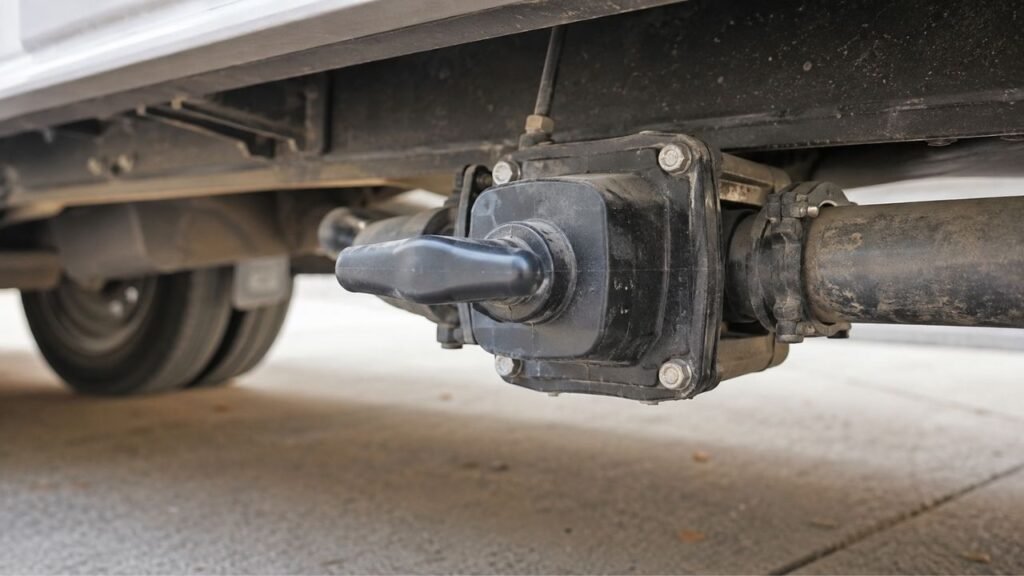
A direct-pull valve has an exposed metal shaft between the handle and valve body.
Road spray, mud, dust, salt, and moisture can collect on this shaft.
Eventually, you may notice roughness or corrosion.
The rod then has more resistance when it passes through the valve mechanism.
Cleaning the rod can help, although remember something important.
Lubricating the exposed shaft does not necessarily lubricate the internal gate seals.
Valve or Plumbing Misalignment
An RV waste valve works best when its blade moves straight through the housing.
If the surrounding plumbing shifts, the valve body may become slightly twisted.
That can place sideways pressure against the blade.
The result is a valve that suddenly feels much harder to move.
Misalignment can happen after:
- Plumbing repairs
- Road vibration
- Impact underneath the RV
- Loose pipe supports
- Valve replacement
- Underbelly damage
This problem usually requires more than simply spraying lubricant on the handle.
Cold Weather or a Frozen Valve
If the handle suddenly becomes immovable during freezing weather, stop pulling.
Water remaining around the gate valve can freeze.
The blade may then become locked inside the housing.
Trying to overpower frozen components can crack the valve body or damage its seals.
Thaw the area safely before testing the valve again.
Worn, Swollen, or Damaged Seals
Lubrication can help a dry seal.
It cannot repair a badly damaged one.
Older seals may become:
- Torn
- Distorted
- Hardened
- Swollen
- Rolled out of position
A damaged seal may create resistance while also allowing wastewater to leak past the closed gate.
If proper cleaning and lubrication do not help, the valve may need to be opened and serviced.
Bent Rod or Damaged Linkage
Pay attention to the way the handle moves.
A bent rod can make the valve feel unusually stiff because it no longer travels straight.
Other linkage problems can cause strange symptoms.
For example, the handle might move several inches before you feel the gate moving.
It could also suddenly become much easier to pull.
That does not necessarily mean the problem fixed itself.
An unusually loose handle can indicate a disconnected or damaged linkage.
What Does the Way the Handle Feel Tell You?
The way the handle resists you can provide useful clues. Before adding lubricant or buying parts, pay attention to exactly what happens during the pull.
| What You Feel | Possible Cause | What to Check First |
| Stiff during the entire pull | Dry seals, cable drag, dirty rod | Cable type and exposed shaft |
| Moves slightly, then stops suddenly | Debris, obstruction, frozen valve | Tank condition and temperature |
| Harder to push closed | Debris in valve track, displaced seal | Flush and clean valve area |
| Resistance increases during travel | Cable bend or alignment problem | Cable routing and valve position |
| Gritty or rough movement | Corrosion, dirt, contaminated cable | Rod and cable condition |
| Handle moves but tank does not drain | Broken linkage or separate tank clog | Confirm gate actually opens |
| Handle suddenly becomes very loose | Detached rod, cable, or gate | Stop and inspect linkage |
| Stiff mainly after storage | Dry seals or dried residue | Clean and condition valve |
| Completely stuck after freezing weather | Ice around valve | Thaw before operating |
A smooth but heavy pull usually points toward friction. A sudden solid stop deserves more caution because something may be physically blocking the blade.
First, Determine Whether You Have a Direct-Pull or Cable-Operated Valve
Before troubleshooting further, look at how your handle connects to the valve.
A direct-pull valve normally has a relatively straight rod leading from the T-handle into the valve body. When you pull the handle, you are directly moving the internal blade.
A cable-operated valve is different. The handle moves an inner cable that operates a valve located somewhere else underneath the RV.
This distinction matters.
If you have a direct-pull valve, the resistance is more likely coming from the rod, gate, seals, or debris.
With a cable system, the cable itself becomes another major suspect.
You can spend plenty of time treating the valve seals without solving anything if a crushed or badly routed cable is actually causing the problem.
How to Diagnose a Hard-to-Pull RV Waste Valve
You do not need to start disassembling plumbing immediately. A careful inspection can usually narrow the problem considerably.
- Identify the affected tank. Determine whether the black, gray, or both valves are becoming stiff.
- Stop using excessive force. If normal hand pressure does not move the valve, do not keep pulling harder.
- Identify the valve style. Determine whether you have a direct rod or remote cable arrangement.
- Inspect the handle and shaft. Look for bends, rust, dirt, cracking, or unusual movement.
- Inspect cable routing. If you have a cable valve, look for sharp turns, crushed sections, or corrosion.
- Think about when the problem started. Stiffness after storage may suggest dry seals. Sudden stiffness can point toward debris or mechanical damage.
- Compare opening and closing resistance. A blade that closes poorly may have debris packed in its lower track.
- Consider recent temperatures. Freezing weather can temporarily lock a valve.
- Check for leakage. A stiff valve that also leaks may have debris or damaged seals preventing complete closure.
Be especially careful when checking a black-tank valve.
If wastewater could be sitting behind the termination cap, connect your sewer hose before removing that cap whenever practical.
How Do You Fix an RV Waste-Valve Handle That Is Hard to Pull?
Start with the simplest and safest fixes first. The goal is to reduce resistance without damaging a valve that may only need cleaning or lubrication.
Step 1: Clean the Exposed Valve Rod
If your valve has an exposed metal rod, wipe it with a clean rag.
Remove visible:
- Dirt
- Dust
- Dried residue
- Light surface corrosion
Inspect the rod while cleaning.
It should travel relatively straight into the valve housing.
If it is noticeably bent, lubrication probably will not solve the underlying problem.
For an appropriate shaft lubricant, use something approved for the valve materials and manufacturer recommendations.
Avoid assuming every spray lubricant is compatible with rubber seals and RV wastewater components.
Step 2: Lubricate the Internal Valve Seals
If dry seals appear to be the problem, an RV drain-valve lubricant may help.
These products are typically added through the RV plumbing so they can reach the valve area from inside the holding tank.
For the black tank, treatment normally enters through the toilet.
For a gray tank, it can usually enter through the appropriate sink or drain.
Follow the instructions printed on your specific lubricant.
Do not assume that every product uses the same amount or soaking time.
After treatment has reached the gate, gently cycle the valve several times.
You are trying to distribute lubricant around the blade and seals, not force the blade through an obstruction.
Step 3: Flush Away Waste Buildup
If the valve feels gritty or does not close completely, buildup may be involved.
Empty the tank when possible.
Then rinse it thoroughly.
For a black tank, use the built-in tank flush if your RV has one.
You can also use an appropriate RV tank-rinsing method.
The goal is to move toilet paper, solids, and residue away from the gate area.
Gray tanks can develop their own buildup.
Soap, grease, food residue, and mineral deposits can settle near the valve.
After flushing, operate the valve gently again.
If it becomes noticeably smoother, contamination was probably contributing to the problem.
Step 4: Inspect the Remote Cable
If your RV uses a cable-operated waste valve, inspect the entire accessible cable path.
Look for tight curves.
A gentle sweeping bend is much easier for an inner cable to travel through than a sharp turn.
Also check for:
- Crushed cable housing
- Rust
- Water intrusion
- Loose mounting
- Damaged cable ends
- Binding near the handle
A useful diagnostic test can sometimes be performed during servicing.
If the gate moves smoothly directly at the valve after the cable is disconnected, but the cable remains difficult to move, the cable is likely the problem.
This type of work can expose wastewater plumbing, so make sure the tank is safely emptied first.
Step 5: Check the Valve for Misalignment
Look at how the valve sits between its plumbing connections.
The housing should not appear twisted or forced sideways.
You may also notice pipes pulling against the valve.
Misalignment can squeeze the valve body enough to increase gate resistance.
Do not start loosening wastewater fittings while a tank contains waste.
If correcting the alignment requires opening the valve assembly or moving plumbing, empty and rinse the tank first.
Step 6: Service or Replace Damaged Seals
Sometimes lubrication works for several trips.
Then the problem quickly returns.
That can happen when a seal is damaged rather than simply dry.
If the valve has been properly cleaned and lubricated but remains difficult to operate, the blade and seals may need inspection.
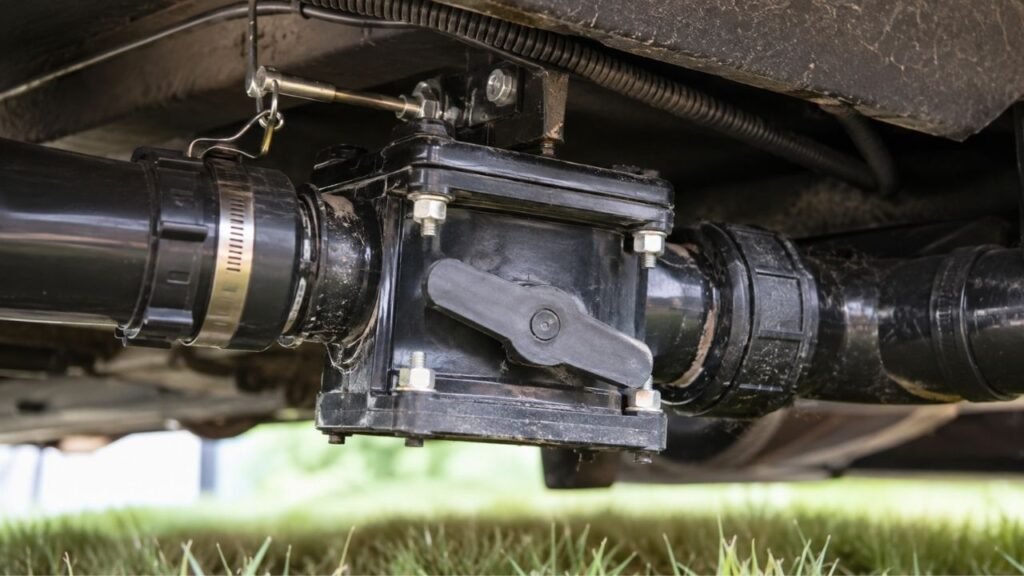
Many common RV gate valves use a four-bolt design.
Once the tank is completely emptied and cleaned, the valve can often be removed from between its flanges.
The seals can then be inspected and replaced if necessary.
If you are uncomfortable opening wastewater plumbing, this is a good job for an RV technician.
What If the Waste Valve Is Stuck Closed and the Tank Is Full?
A full tank changes the situation because opening or dismantling the wrong component could release wastewater. Keep your troubleshooting conservative until the tank can be safely emptied.
- Do not remove the valve mounting bolts.
- Do not pull the handle with pliers.
- Do not hammer the T-handle.
- Do not pry against the valve housing.
- Do not drill into an unknown valve body.
- Do not loosen wastewater plumbing connections.
- Do not pour harsh drain-cleaning chemicals into the tank.
- Try only manufacturer-compatible valve treatments.
- Keep your sewer hose ready before attempting valve movement.
- Get professional help if the tank is nearly full and remains trapped.
This is especially important with a black tank.
A simple stiff-valve repair can become a sanitation problem very quickly if the valve housing opens unexpectedly.
Should You Use Silicone Spray, RV Valve Lubricant, WD-40, or Cooking Oil?
You will find plenty of home remedies for sticky RV dump valves. Some may seem to work temporarily, but compatibility with the valve seals matters more than convenience.
| Product or Method | Typical Use | Recommendation |
| RV drain-valve lubricant | Internal blade and seal conditioning | Preferred option |
| Manufacturer-approved silicone lubricant | Exposed rod or approved mechanical parts | Good when compatible |
| Silicone or non-petroleum valve grease | Servicing accessible seals | Follow manufacturer guidance |
| General penetrating oil | Exterior metal components | Avoid on seals unless specifically approved |
| Vegetable or cooking oil | Common DIY workaround | Not my preferred long-term solution |
| Dish soap and water | Helps loosen some tank residue | Cleaning aid, not true valve lubrication |
| Petroleum grease | General mechanical lubrication | Avoid unless explicitly approved |
The simplest rule is to use a lubricant approved for your valve and seal material.
That removes the guesswork.
It also reduces the chance of using something that makes a rubber seal soften, swell, or deteriorate.
What Should You Never Do With a Stiff RV Waste Valve?
A stuck valve can be frustrating, especially when you are standing at a dump station. Still, brute force usually creates a bigger repair.
- Do not grab the T-handle with pliers.
- Do not kick or hammer the handle.
- Do not repeatedly yank against a solid stop.
- Do not force the valve closed against obvious debris.
- Do not loosen valve bolts with waste inside the tank.
- Do not drill into the valve body without approved instructions.
- Do not use harsh household drain openers.
- Do not assume lubricating the outside reaches internal seals.
- Do not ignore increasing resistance from trip to trip.
A valve that gradually becomes harder to move is giving you an early warning.
Fixing the problem now is much easier than dealing with a broken handle and full holding tank later.
How Do You Know Whether the Cable or Waste Valve Is Bad?
Cable problems usually create resistance throughout most of the handle’s movement. You may also see sharp cable bends, corrosion, damage to the outer housing, or poor movement even when the actual valve is disconnected.
A valve problem is more likely when the gate itself remains stiff during direct operation. Leakage, incomplete closing, damaged seals, and a blade that binds after cleaning also point toward the gate-valve assembly.
Do not automatically replace both components.
Finding which part actually binds can save money and unnecessary work.
When Should You Replace the RV Waste Valve?
Cleaning and lubrication can restore many stiff valves. Eventually, however, worn or damaged components need mechanical repair.
Replacement or major servicing becomes more reasonable when:
- Lubrication no longer improves movement.
- The valve repeatedly becomes stuck.
- The valve continues leaking after cleaning.
- The blade will not fully open.
- The blade will not fully close.
- A seal is torn or displaced.
- The valve housing is cracked.
- The rod or gate connection is damaged.
- The valve remains extremely stiff without its cable.
- Excessive force is required every time you operate it.
A stiff four-bolt valve does not always require complete replacement.
Sometimes fresh seals and proper reassembly restore normal operation.
Inspect what has actually failed before buying parts.
Can a Hard-to-Pull Valve Also Cause Wastewater Leaks?
Yes. The two problems can be closely connected.
A stiff blade may stop before reaching its fully closed position.
Waste, paper, or a displaced seal can also keep the blade from seating correctly.
That small opening allows liquid to move past the valve and collect behind the sewer termination cap.
If you notice wastewater every time you remove the cap, do not assume the cap itself is leaking.
One of your tank valves may not be sealing completely.
Does a Hard Black-Tank Valve Mean the Black Tank Is Clogged?
Not necessarily.
A hard-to-pull valve means the mechanism used to open the gate is resisting movement.
A clogged black tank means waste inside the tank is preventing proper drainage.
You can have a stiff valve and a perfectly clear tank.
You can also have a smooth valve while the tank itself is clogged.
Sometimes both problems occur together because heavy waste buildup can collect near the valve opening.
Diagnose the valve movement first before assuming the entire tank is blocked.
How to Prevent Your RV Waste-Valve Handle From Getting Stiff Again
A few simple habits can prevent most gate-valve problems. Good tank care also reduces the amount of residue collecting around the blade.
- Use plenty of water in your black tank.
- Keep the black valve closed between dumps.
- Dump before waste becomes excessively concentrated.
- Flush the tank thoroughly after emptying when practical.
- Do not let waste dry inside during long storage.
- Exercise the valves periodically during the camping season.
- Keep exposed rods clean.
- Inspect cable routing for tight bends.
- Address corrosion before it becomes severe.
- Lubricate according to valve and product instructions.
- Properly winterize the waste system before freezing weather.
- Investigate increasing resistance early.
You do not need to obsess over the valves every time you camp.
Simply pay attention to how they normally feel.
If a handle that previously moved smoothly begins requiring more effort, deal with it before it becomes completely stuck.
Final Words
A hard-to-pull RV waste-valve handle usually means something is creating friction somewhere between your hand and the internal gate. Dry seals are common, but debris, a dirty rod, cable binding, misalignment, damaged seals, and freezing can create very similar symptoms.
Start by identifying whether you have a direct-pull or cable-operated valve. Then pay attention to how the resistance feels. Clean accessible components, flush buildup, and use a valve-compatible lubricant before moving toward disassembly.
Most importantly, do not respond to a stiff valve by simply pulling harder. A little troubleshooting now can save you from a broken handle, damaged cable, leaking valve, or full tank you cannot empty.
Related FAQs
Why Is My RV Black-Tank Valve Harder to Pull Than the Gray-Tank Valve?
A black-tank valve is exposed to toilet paper, solid waste, and heavier residue, so buildup around the blade and seals can be more severe. Dry seals, cable friction, or corrosion can also make only one valve noticeably stiffer than the other.
Can I Spray Silicone Lubricant on an RV Waste-Valve Rod?
You can use a silicone lubricant on an exposed valve rod when the product and valve manufacturer consider it compatible. Clean the shaft first and use only a light coating. Remember that spraying the external rod does not necessarily lubricate the internal gate seals.
How Do You Lubricate an RV Waste Valve Without Removing It?
An RV drain-valve lubricant can usually be added through the toilet for a black tank or through the appropriate drain for a gray tank. The product reaches the lower tank and valve area from inside. Follow the lubricant manufacturer’s dosage and treatment directions.
Can an RV Waste-Valve Cable Be Lubricated?
Some cable assemblies can benefit from appropriate lubrication, while others are better replaced once corrosion or internal damage develops. Check the valve manufacturer’s instructions before spraying lubricant into a cable housing because cable designs and materials vary.
Why Is My RV Waste Valve Hard to Push Closed?
A valve that opens but becomes difficult to close may have toilet paper, waste, grease, or other debris packed into the blade track. A displaced seal, misaligned valve body, or binding remote cable can create the same symptom.
Why Does My RV Waste-Valve Handle Get Stiff After Storage?
Long storage periods allow seals to dry and residue around the gate to harden. Exposed rods and cables may also develop corrosion while sitting unused. Cleaning, tank flushing, and approved valve lubrication often help when storage is the main cause.
Can Freezing Temperatures Make an RV Dump Valve Hard to Pull?
Yes. Water trapped around the valve can freeze and prevent the blade from moving. Do not force the handle if freezing is possible. Safely thaw the valve and surrounding plumbing before testing it again.
Should I Replace a Waste Valve That Still Works but Is Very Stiff?
Not immediately. First inspect the rod or cable, clean the tank and valve area, and use an approved lubricant. If the valve remains very stiff, repeatedly sticks, or starts leaking, inspect the seals and gate assembly and repair or replace damaged parts.
Why Does My RV Waste-Valve Handle Move but Nothing Comes Out?
The gate may not actually be opening because the rod, cable, or linkage has disconnected. However, the valve could also be open while a separate blockage prevents tank contents from draining. Confirm that the gate is moving before diagnosing a tank clog.
Can I Use Pliers to Pull a Stuck RV Waste-Valve Handle?
You should avoid using pliers or other tools to increase pulling force. Doing so can break the plastic handle, bend the rod, damage the cable, tear the seals, or stress the surrounding plumbing. Find the cause of the resistance instead.

Steven Parker writes about everyday RV life, from setup tips to long-term living decisions. His content reflects a calm, experienced approach to RV ownership and travel. He focuses on comfort, reliability, and realistic expectations.