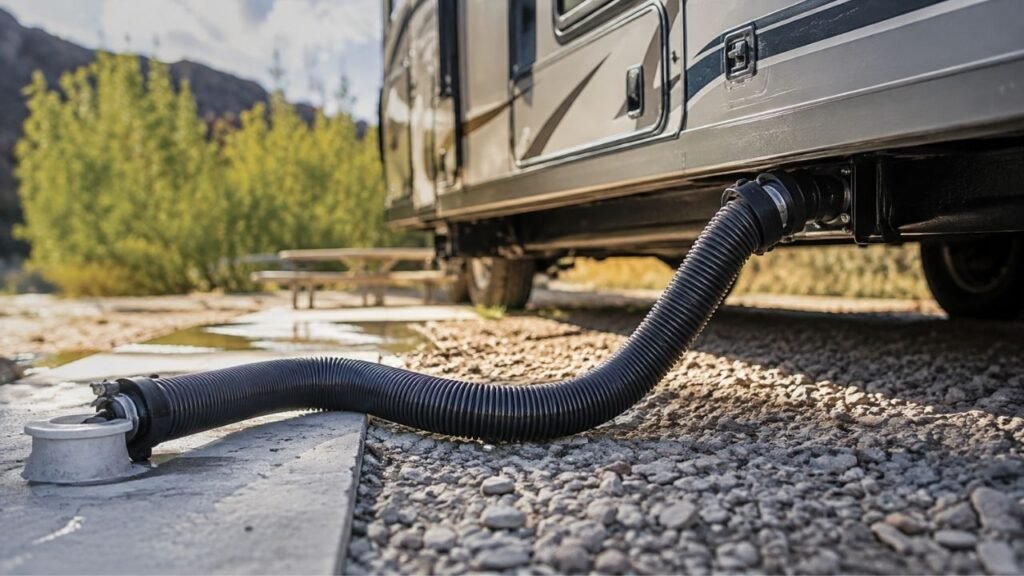
Yes, you can dump an RV without using a sewer hose support in many situations. If the sewer inlet sits lower than your RV outlet, gravity can move the waste through the hose. However, campground rules, uneven ground, and hose sagging can make a support necessary or strongly recommended.
In this guide, I’ll show you when you can safely skip the support, how to dump without one, what problems to watch for, and when using a support is the better choice.
Key Takeaways
- You can often dump without a sewer hose support at dump stations.
- Your sewer inlet should be lower than the RV waste outlet.
- Unsupported hoses can develop low spots that trap wastewater.
- You may need to manually walk remaining liquid toward the drain.
- Longer campsite stays usually benefit more from a hose support.
- Some RV parks require sewer hoses to stay elevated.
- A sewer hose support cannot make wastewater flow significantly uphill.
- Always follow the rules posted at your campground or dump station.
Can You Dump an RV Without a Sewer Hose Support?
You generally can dump your RV tanks without a sewer hose support. The support does not create the force that empties your holding tanks. Gravity does most of that work.
When you open the waste valve, liquid moves from the holding tank into the sewer hose. As long as the sewer connection is lower, the waste should continue moving toward the drain.
The main problem starts when the flexible hose rests unevenly on the ground.
Low sections can form between higher sections of hose. Wastewater collects in those dips instead of flowing completely into the sewer inlet.
For a quick dump, this usually is manageable. You can close your tank valves and carefully lift the hose afterward.
For a multi-day full-hookup campsite, however, those low areas become much more annoying. A support can maintain a smoother downhill route throughout your stay.
When Can You Skip a Sewer Hose Support?
You do not need the exact same sewer setup at every campsite. Here is a simple way to decide whether skipping the support makes sense.
| Situation | Can You Usually Skip It? | Main Concern | Better Approach |
| Quick dump-station visit | Yes | Water remains inside hose | Walk the hose toward drain |
| Short hose on smooth pavement | Usually | Minor sagging | Keep hose straight |
| Home sewer cleanout | Sometimes | Slope and local rules | Confirm safe legal connection |
| One-night full-hookup stay | Maybe | Standing wastewater | Support is helpful |
| Multi-day full-hookup stay | Not ideal | Sagging and hose wear | Use a proper support |
| Uneven grass or gravel | Not recommended | Deep low spots | Elevate the hose |
| Long sewer hose run | Not recommended | Multiple sags | Use continuous support |
| Sewer inlet higher than RV outlet | Usually no | Poor gravity flow | Consider another method |
| Campground requires support | No | Rule violation | Follow campground policy |
The easiest situations are short dump-station stops with a nearby inlet. Problems increase when the hose becomes longer, the terrain becomes rougher, or the connection must remain in place.
How Does an RV Sewer Hose Drain Without a Support?
Your holding tanks can still empty without an accordion-style support underneath the sewer hose. However, understanding what gravity is doing helps you avoid messy surprises.
Gravity Pushes Waste Toward the Sewer Inlet
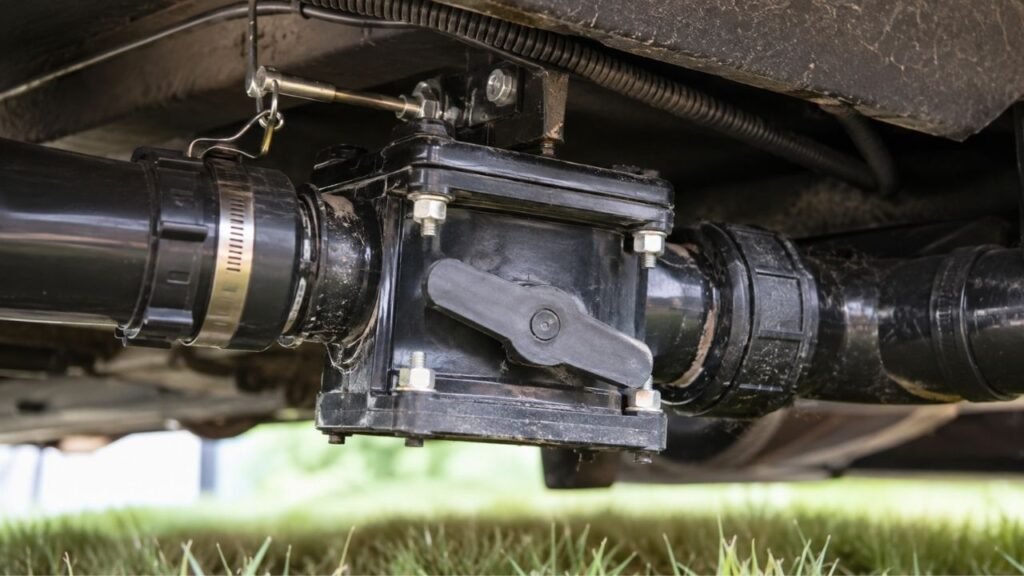
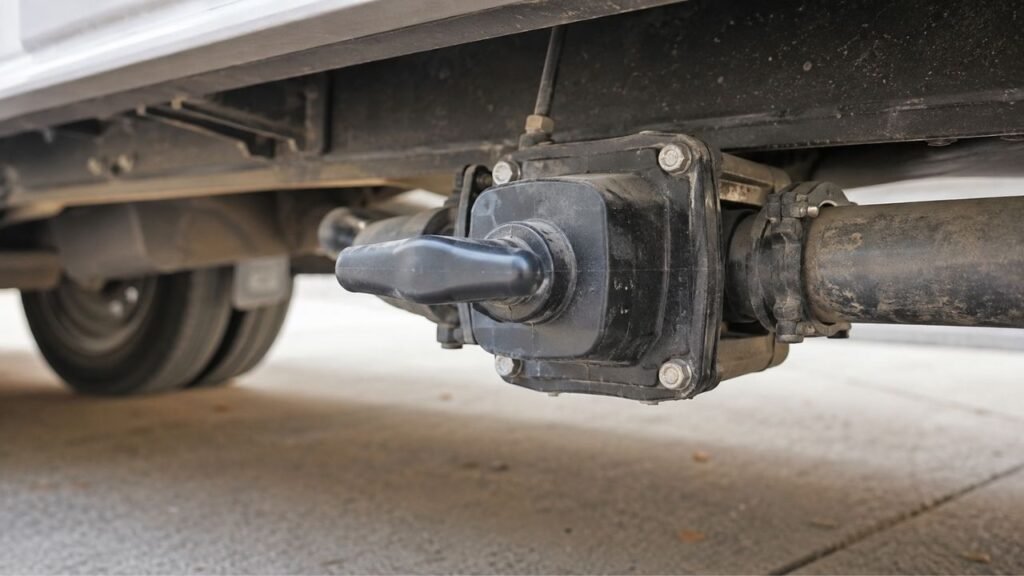
Your RV holding tanks sit above the waste outlet.
When you open a tank valve, the weight of the liquid helps move everything through the outlet and into your sewer hose.
The liquid then follows the easiest available path toward the sewer inlet.
If that path is continuously downhill, the hose can drain very well without additional support.
Low Spots Can Hold Wastewater
A flexible sewer hose rarely lies perfectly straight on the ground.
One section might rest on a rock. Another could drop into soft grass. The next section might rise slightly before reaching the drain.
That creates small valleys inside the hose.
Wastewater collects inside those valleys because gravity cannot push every drop over the next higher section.
The tank may be completely empty while wastewater still remains inside your sewer hose.
You May Need to Walk the Hose After Dumping
You can usually clear those low spots manually.
First, close the RV tank valve. Then start near the RV connection and gently raise the hose.
Move toward the sewer inlet one section at a time.
Think of it as slowly pushing a wave through the hose. The remaining liquid moves downhill toward the sewer connection.
Do not yank or sharply bend the hose. Sewer hoses can crack, separate, or come loose when handled roughly.
How to Dump RV Tanks Without Using a Sewer Hose Support
Dumping without a support is not complicated when conditions are suitable. The key is setting up the hose carefully before opening any valves.
1. Check the Campground or Dump-Station Rules
Before connecting anything, check the posted sewer rules.
Some campgrounds allow the hose to rest on the ground during dumping. Others require hoses to stay elevated whenever connected.
Rules can change from one RV park to another.
If the campground requires a sewer support, use one even if your hose would drain without it.
2. Check the Sewer Inlet Height
Stand beside your RV and look toward the sewer inlet.
Ideally, your RV waste outlet should be noticeably higher than the sewer opening.
You want gravity working with you.
If the sewer inlet is higher than your RV outlet, normal gravity dumping becomes much more difficult.
3. Use the Shortest Practical Hose
More hose is not always better.
If the sewer inlet is eight feet away, avoid stretching twenty feet of hose across the campsite unless necessary.
Extra hose creates additional bends and low spots.
Use enough length to make a comfortable connection without pulling the hose tight.
4. Secure Both Ends of the Hose
Connect the sewer hose securely to your RV waste outlet.
Then connect the other end to the campground sewer inlet using the correct adapter.
Check both fittings before opening a valve.
A poorly secured connection can turn a simple tank dump into a cleanup job very quickly.
5. Dump the Black Tank First
Open the black tank valve completely.
Let the tank empty before doing anything with the hose.
Avoid lifting or rearranging a sewer hose while black tank waste is moving through it.
Watch and listen for the flow to slow down.
Once the tank has finished draining, close the black tank valve.
6. Dump the Gray Tank Second
Open your gray tank valve after the black tank finishes.
Gray water can help rinse some leftover black tank residue from the sewer hose.
Let the gray tank drain completely before closing its valve.
7. Close Every Valve Before Moving the Hose
This step matters even more without a hose support.
Make sure both waste valves are completely closed before lifting any section of sewer hose.
You do not want another rush of wastewater entering the hose while you are moving it.
8. Walk Remaining Wastewater Toward the Drain
Start at the RV end of the hose.
Gently lift that section and move toward the sewer connection.
Continue raising each section so the trapped wastewater moves downhill.
Take your time around dips containing visible liquid.
You should eventually feel the hose becoming much lighter.
9. Disconnect and Store the Hose
Disconnect the RV end carefully after the hose finishes draining.
Then remove the sewer inlet connection according to the campground’s procedures.
Rinse your equipment where permitted.
Inspect the hose for cracks, worn fittings, or damaged sections before storing it.
Always wash your hands thoroughly afterward, even when you wore disposable gloves.
What Problems Can Happen Without a Sewer Hose Support?
Most problems come from poor hose positioning rather than the simple absence of a support. Watch for these common issues:
- Wastewater collecting inside low sections of hose
- Slower drainage near the end of a dump
- Black tank residue remaining inside the hose
- Odors developing from standing wastewater
- Extra handling after each tank dump
- Hose abrasion from gravel or rough pavement
- Small punctures caused by sharp rocks
- Hose movement around the sewer connection
- Deep sagging across uneven campsites
- Difficulty maintaining a consistent downhill path
- Campground rule violations
- More strain on older or damaged sewer hoses
A sewer hose support reduces many of these problems by giving the hose a controlled route.
That does not mean dumping without one is automatically unsafe. It simply means you need to pay closer attention to hose placement.
Why Do Some Campgrounds Require Sewer Hose Supports?
Campground sewer rules vary across the United States. Some facilities simply require secure connections, while others want the entire hose elevated.
They Help Maintain Better Drainage
A proper support creates a gradual path toward the sewer inlet.
That reduces deep dips where wastewater can collect.
It also makes drainage more predictable during longer stays.
They Keep Sewer Hoses Away From the Ground
Campground grass and gravel can be rough on thin sewer hoses.
Keeping the hose elevated reduces contact with stones, sticks, mud, standing water, and other debris.
It can also make campsite maintenance easier.
They Can Reduce Hose Damage and Leakage
A sewer hose lying across rough gravel may move every time you handle it.
Repeated rubbing can eventually create thin areas or small holes.
Supporting the hose limits some of that contact.
Local Rules Can Be Different
There is no good reason to assume every campground follows the same sewer-hose policy.
One campground may allow a hose on the ground. Another might require an elevated hose throughout your stay.
Always check the campground’s current rules when you arrive.
Following their policy is easier than finding out about the requirement after your sewer system is already connected.
Can an RV Sewer Hose Lie Directly on the Ground?
Yes, an RV sewer hose can sometimes lie directly on the ground during a short dumping session.
The important factors are the surface, slope, hose condition, and campground rules.
A hose resting on smooth pavement for several minutes at a dump station presents a very different situation from one sitting on gravel for an entire week.
Long-term ground contact creates more opportunities for abrasion, sagging, movement, mud, and accidental damage.
If you only need a few minutes to empty your tanks, ground placement may work perfectly well.
If the hose will remain connected, I prefer giving it proper support.
Do You Need a Sewer Hose Support at an RV Dump Station?
You usually do not need a sewer hose support for a normal dump-station visit.
Most dump stations are designed for RVers to pull in, connect their sewer hose, empty their tanks, clean up, and leave.
Since the hose remains connected for only a short time, you can usually manage minor low spots manually.
Once both tank valves are closed, gently walk the remaining liquid through the hose.
However, bring your support if the dump station has uneven ground or an awkwardly positioned drain.
It can also help when your sewer hose must cover an unusually long distance.
Is a Sewer Hose Support More Important at Full-Hookup Campsites?
Yes, a sewer hose support becomes more useful at full-hookup campsites.
You may stay connected for several days or even weeks. During that time, you probably do not want to manually reposition the sewer hose every time you dump.
A support creates a more stable sewer setup.
It keeps the hose organized, reduces unnecessary ground contact, and helps wastewater move toward the sewer connection.
Remember that having full hookups does not mean your black tank valve should remain open continuously.
Keep the black valve closed between dumps. This allows enough liquid to collect inside the tank and carry solids out when you finally empty it.
What If the Campground Sewer Inlet Is Higher Than Your RV Outlet?
A high sewer inlet creates a different problem. A standard hose support can improve hose positioning, but it cannot overcome a major uphill rise.
A Sewer Hose Support Cannot Make Waste Flow Uphill
Gravity wants wastewater to move downward.
If the sewer inlet sits significantly higher than your RV outlet, simply raising different parts of the hose will not create normal gravity drainage.
You may empty some of the holding tank while still leaving substantial wastewater inside the hose.
A Small Height Difference May Be Manageable
Sometimes only the final sewer fitting sits slightly higher.
The majority of your hose may still run downhill.
In that case, you might be able to finish dumping, close the valves, and carefully walk the remaining liquid through the final raised section.
Do not rely on this method for a major elevation difference.
A Macerator Pump May Be Better for Uphill Dumping
A macerator changes the situation because it actively pumps wastewater instead of relying entirely on gravity.
That can be useful when the disposal point sits uphill or farther from your RV.
It is a different dumping setup, though, and requires power plus the correct discharge hose.
Does a Sewer Hose Support Make Dumping Faster?
Sometimes, but the better description is that it can make drainage more consistent.
A support removes many low spots that interrupt the natural path of wastewater.
That may reduce the amount of liquid left inside the hose after dumping.
However, your tank drainage speed depends on several other factors, including tank level, outlet size, hose length, restrictions, and elevation.
A hose support will not fix a blocked tank outlet or badly positioned sewer connection.
Its job is mainly to give wastewater a cleaner downhill route after it enters the hose.
Is an RV Sewer Hose Support Worth Carrying?
Even if you do not use one during every tank dump, I think a compact sewer hose support is worth carrying for most RVers.
It becomes useful when:
- A campground requires the sewer hose to be elevated.
- The campsite has uneven ground.
- The sewer connection sits farther from your RV.
- Your sewer hose develops several deep sags.
- The ground contains rough gravel or sharp rocks.
- You plan to stay connected for several days.
- You want less manual hose handling after dumping.
If you mainly use dedicated dump stations, you may rarely need it.
For regular full-hookup camping, however, having one available makes your sewer setup much easier to adapt.
Final Verdict
You can dump an RV without using a sewer hose support when the conditions are right. A short hose, lower sewer inlet, smooth ground, and quick dumping session can make a support unnecessary.
The biggest downside is that an unsupported hose can sag. Those low sections may hold wastewater after your tanks finish draining. Closing the valves and carefully walking the hose toward the sewer inlet usually clears the remaining liquid.
For longer campground stays, uneven terrain, rough ground, or long sewer runs, a support becomes much more useful. And if the campground requires one, that decision has already been made for you.
I recommend keeping a sewer hose support in your RV even if you do not use it every time. It takes care of awkward campsites and gives you another option when gravity alone does not produce a clean hose layout.
Related FAQs
Do You Have to Use a Sewer Hose Support at Every Campground?
No. Sewer hose requirements vary between campgrounds and RV parks. Some allow hoses directly on the ground, while others require elevated or supported sewer lines. Check the campground rules before setting up your connection.
Can an RV Sewer Hose Sit on Concrete?
Yes, an RV sewer hose can usually sit on smooth concrete during a short dump if the facility allows it. For longer stays, supporting the hose can reduce sagging, abrasion, and standing wastewater.
How Much Slope Does an RV Sewer Hose Need?
An RV sewer hose should have enough continuous downhill slope for wastewater to move toward the sewer inlet without collecting in deep low spots. There is no single slope requirement that applies to every campground, so also check local rules.
Can I Use Leveling Blocks Under My Sewer Hose?
You can sometimes use stable leveling blocks to raise problem sections if campground rules allow it. However, a purpose-built sewer hose support usually provides better continuous support across the entire hose.
Can I Dump My Black Tank Without a Sewer Hose Support?
Yes. You can dump a black tank without a sewer hose support when the sewer inlet is lower and the hose has a workable drainage path. Close the valve before manually lifting or walking wastewater through the hose.
Why Is Water Still Inside My Sewer Hose After Dumping?
Water usually remains because the hose has a low spot, sag, kink, or uphill section. Close your tank valves, then carefully raise the hose from the RV end and walk the remaining liquid toward the sewer inlet.
Does a Sewer Hose Support Help With a High Sewer Connection?
A support can improve the hose’s route, but it cannot make wastewater flow significantly uphill. If the sewer inlet is higher than your RV outlet, a macerator pump or another approved dumping method may work better.
Should I Leave My Black Tank Valve Open With Full Hookups?
No. Keep the black tank valve closed between dumps so liquid can accumulate with the solids. Opening the valve only when the tank is ready to dump helps carry waste through the outlet and sewer hose.

Steven Parker writes about everyday RV life, from setup tips to long-term living decisions. His content reflects a calm, experienced approach to RV ownership and travel. He focuses on comfort, reliability, and realistic expectations.