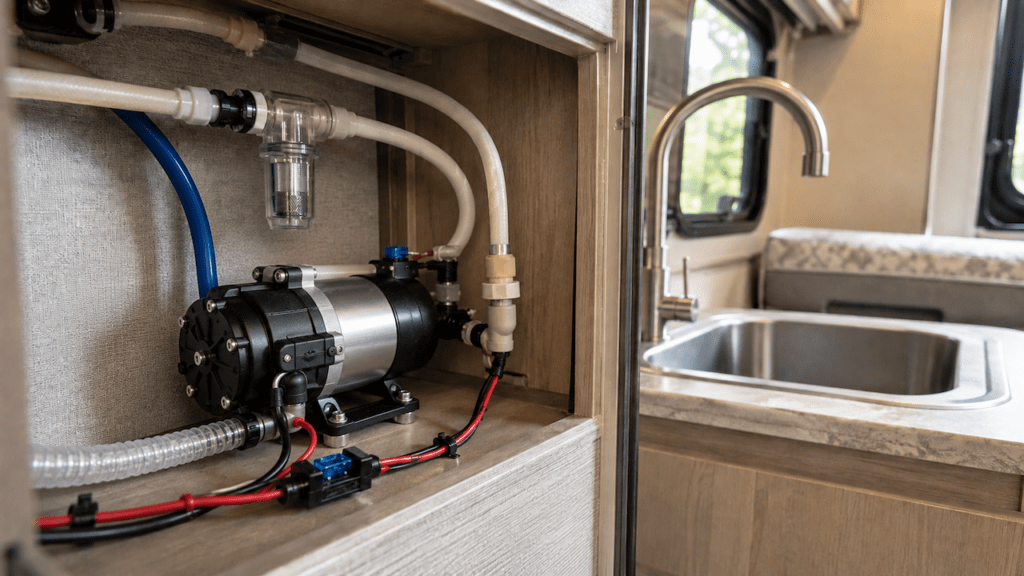
Your RV water heater pressure relief valve usually drips because heated water expands inside the tank. If the tank’s built-in air pocket becomes too small, pressure rises and the T&P valve releases a little water. However, constant dripping can also indicate excessive water pressure, mineral buildup, overheating, or a worn relief valve.
Below, I’ll help you figure out whether the dripping is normal. We’ll also go through the safest fixes, pressure checks, valve problems, and signs that replacement is necessary.
Key Takeaways
- A few drops while the water heater heats can be normal.
- A lost air pocket is a common cause of repeated dripping.
- Constant dripping while cold usually needs further troubleshooting.
- High campground water pressure can contribute to valve discharge.
- Sediment or mineral deposits may stop the valve from sealing.
- Never cap, plug, or disable a dripping pressure relief valve.
- A damaged T&P valve should be replaced with the correct model.
Is It Normal for an RV Water Heater Pressure Relief Valve to Drip?
A small amount of dripping can be normal while a tank-style RV water heater is heating. Water expands as its temperature increases, and that expansion raises pressure inside the plumbing system.
Your water heater normally has a small air pocket near the top. That pocket compresses as the water expands and helps absorb pressure changes.
Over time, water can gradually take up that space. The tank then has less room to accommodate expansion.
When pressure increases enough, the temperature and pressure relief valve may release several drops of water.
That does not necessarily mean the valve has failed.
I would become more concerned if the valve drips continuously, releases a steady stream, leaks when the tank is cold, or keeps reopening during every heating cycle.
Those symptoms deserve a closer look.
What Does the Pressure Relief Valve on an RV Water Heater Do?
The pressure relief valve is one of your water heater’s most important safety components. You may also see it called a T&P, TPR, P&T, or temperature and pressure relief valve.
Its job is simple. It opens if pressure or temperature inside the tank becomes dangerously high.
Many RV water heater relief valves are designed around ratings near 150 PSI and 210°F. However, the exact specifications depend on your heater and valve.
Always use the ratings listed for your specific water heater.
The valve is not there simply to stop leaks. It protects the water heater from excessive internal pressure.
That is why you should never plug or disable it just because it drips.
Why Does My RV Water Heater Pressure Relief Valve Keep Dripping?
Several problems can make a T&P valve release water. The dripping pattern usually gives you useful clues about the actual cause.
The Air Pocket Inside the Tank Has Been Lost
This is one of the first things I would check.
Tank-style RV water heaters normally keep a small pocket of air above the water. That air acts like a cushion.
Air can compress when the heated water expands. Water cannot compress nearly as easily.
As the air pocket becomes smaller, the tank has less room for normal thermal expansion.
Pressure rises during heating. Eventually, the relief valve may open slightly and release water.
You may notice a few drops around the valve every time the burner or electric element heats the tank.
Restoring the air pocket often stops this type of dripping.
Normal Thermal Expansion Is Raising Tank Pressure
Even when everything works properly, heated water expands.
The effect becomes more noticeable inside an RV because the plumbing often behaves like a closed system.
Check valves can prevent expanding water from pushing backward through the campground water connection. Your water pump can create a similar closed condition.
The expanding water must therefore go somewhere.
Normally, the water heater’s air pocket absorbs the change.
If there is not enough air space remaining, pressure can briefly rise until the T&P valve releases it.
That is why a valve may remain dry when cold but drip after the heater runs.
Campground Water Pressure Is Too High
Sometimes the water heater is not creating the entire pressure problem.
The campground supply may already be feeding your RV at excessive pressure.
If you connect directly without a suitable regulator, high inlet pressure can place additional stress on your plumbing system.
Now add thermal expansion from your water heater.
The combined pressure may become high enough to make the relief valve drip.
A failed or poorly adjusted water pressure regulator can cause the same problem.
I recommend checking pressure with an RV-compatible pressure gauge if the dripping mainly happens while connected to city water.
Follow your RV manufacturer’s recommended plumbing pressure rather than relying on one universal setting.
Mineral Scale or Debris Is Preventing the Valve From Sealing
Hard water creates another common problem.
Calcium, magnesium, rust, and sediment can accumulate inside your water heater. Small particles may eventually reach the relief valve.
If debris becomes trapped on the valve seat, the valve may not close completely.
You might then see a slow drip even after the pressure returns to normal.
Mineral buildup around the valve opening is another clue.
Flushing the water heater tank can help remove loose sediment. However, do not disassemble or rebuild a safety valve unless its manufacturer specifically allows that procedure.
When a valve cannot seal reliably, replacement is often the safer option.
The T&P Valve Is Worn or Corroded
Relief valves do not last forever.
Repeated heat cycles, minerals, corrosion, and age can damage the internal spring or sealing surfaces.
A worn valve may begin dripping even when system pressure remains normal.
You may also notice corrosion around the body or lever.
If restoring the air pocket and checking pressure do not solve the problem, the valve itself becomes a stronger suspect.
A safety valve that no longer seals consistently should normally be replaced.
The Water Heater Is Overheating
Dripping becomes more concerning when the water is unusually hot.
An overheating tank can create excessive pressure and trigger the T&P valve.
Possible causes include a thermostat problem, control failure, or another heating-system fault.
Do not repeatedly reset the air pocket if the heater is producing abnormally hot water.
Turn the heater off and investigate the temperature-control problem.
A relief valve releasing a significant amount of very hot water is doing an important safety job.
The Leak Is Coming From the Valve Threads
Not every leak near the relief valve is actually passing through the valve.
Look closely at where the water begins.
If water comes from the discharge opening, the valve is releasing or leaking internally.
If water forms around the threaded connection where the valve enters the tank, you may have a sealing problem instead.
Possible causes include damaged threads, corrosion, incorrect installation, or poor thread sealing.
That distinction matters because restoring the air pocket will not repair a leaking threaded connection.
What Your Dripping Pattern Can Tell You
Before replacing anything, spend a few minutes watching when the leak occurs. The pattern can quickly narrow your troubleshooting.
| What You Notice | Possible Cause | What I Would Check First |
| A few drops only while heating | Thermal expansion or reduced air pocket | Restore the air pocket |
| Drips during every heating cycle | Small air pocket or pressure problem | Air pocket and water pressure |
| Drips when the tank is cold | Debris or worn valve | Valve condition |
| Steady stream while heating | Excessive pressure or temperature | Shut heater off and investigate |
| Water feels unusually hot | Heating control problem | Thermostat and controls |
| Water appears around valve threads | Thread or sealing leak | Valve connection |
| Leak appears below the valve | Another water heater leak | Drain plug, fittings, or tank |
| Only leaks on campground water | High inlet pressure | Pressure regulator and gauge |
The key is not simply whether you see water.
Pay attention to when it appears, where it starts, and how much comes out.
How Do You Restore the Air Pocket in an RV Water Heater?
If the valve only drips while heating, restoring the tank’s air pocket is a good first step. The process is fairly simple, but you must avoid working around hot pressurized water.
- Turn off the propane water heater.
- Turn off the electric heating mode as well.
- Give the tank enough time to cool.
- Shut off the campground water connection.
- Turn off the RV’s water pump.
- Open a hot-water faucet inside your RV.
- Let the plumbing pressure drop completely.
- Carefully operate the T&P valve according to your heater instructions.
- Allow water to discharge until the flow stops.
- Release the valve lever and let it close fully.
- Close the hot-water faucet.
- Restore your water supply.
- Turn the water heater back on after the tank refills.
- Watch the relief valve during the next heating cycle.
Be cautious during this process.
Hot water under pressure can cause serious burns. Do not operate the valve while the tank is still extremely hot.
After restoring the air space, the valve may remain dry during normal heating.
If it continues dripping, move on to the next checks.
What If the Relief Valve Still Drips After Restoring the Air Pocket?
If recreating the air pocket does not help, don’t immediately replace the valve. Check pressure, sediment, temperature, and the valve itself before deciding what failed.
Check Your Incoming Water Pressure
Connect a pressure gauge to your campground water source or RV connection.
See whether the incoming pressure matches what your RV plumbing system can safely handle.
If pressure is excessive, inspect your regulator.
A regulator can fail, become inaccurate, or simply be unsuitable for your setup.
If the relief valve only drips on campground water but stays dry while using the onboard pump, inlet pressure becomes an especially strong suspect.
Flush Sediment From the Water Heater Tank
Sediment gradually collects in many tank-style water heaters.
Hard campground water can accelerate that buildup.
Follow your water heater manufacturer’s draining and flushing instructions.
Make sure the heater is turned off and cooled first.
Flushing the tank can remove loose scale and sediment that might affect water flow, heat transfer, or the relief valve.
If you have a Suburban heater with an anode rod, this is also a good time to inspect the rod.
Inspect the Valve for Corrosion or Damage
Look closely at the relief valve.
Check for visible rust, heavy mineral crust, corrosion, or damage around the lever.
A badly corroded valve deserves attention even if it only leaks slowly.
You also want to see whether the water is coming through the valve or from its threaded base.
Persistent leakage through the outlet after pressure problems are eliminated often points toward a worn valve.
Check for Excessive Water Temperature
Notice how hot the water feels.
RV water heaters normally produce hot water, but extremely hot or steaming water is different.
If the valve repeatedly releases water while temperatures seem excessive, shut the water heater off.
Do not treat that situation as a simple air-pocket issue.
The temperature-control system needs inspection before normal operation continues.
Replace the Valve if It Is Faulty
Once you have ruled out the air pocket, high inlet pressure, and overheating, the T&P valve itself may be failing.
Replacement is usually the better choice for a worn safety valve.
Do not permanently modify, plug, rebuild, or disable the valve to stop a drip.
Its ability to open correctly is essential for safe water heater operation.
When Should You Replace an RV Water Heater Pressure Relief Valve?
A dripping valve does not always need replacement. However, certain symptoms make replacement much more reasonable.
Consider replacing the valve when:
- It leaks continuously while the water is cold.
- Restoring the air pocket does not change anything.
- Water pressure is normal but the valve keeps leaking.
- Heavy corrosion is visible around the valve.
- Mineral damage prevents the valve from sealing.
- The release lever is damaged.
- The valve does not close properly.
- The spring mechanism appears faulty.
- Water constantly passes through the discharge opening.
- Your heater manufacturer recommends replacement after failed testing.
A T&P valve is a safety component.
If you cannot trust it to open and close properly, replacing it is usually safer than trying to repair its internal mechanism.
How Do You Choose the Correct Replacement T&P Valve?
Do not buy a replacement solely because its threads appear to fit. Relief valves have specific temperature, pressure, capacity, and installation requirements.
Match the replacement valve using:
- Your water heater manufacturer
- Exact water heater model
- Required thread size
- Probe length
- Pressure rating
- Temperature rating
- Required relief capacity
- Manufacturer-approved specifications
Many RV water heater valves are rated near 150 PSI and 210°F, but that does not mean every valve with those numbers fits every heater.
Check the label, owner’s manual, parts diagram, or manufacturer information for your exact model.
Using the wrong safety valve can create a serious problem.
How Can You Tell Whether the T&P Valve Is Actually the Leak?
Water has a habit of running along fittings and tank surfaces before dripping somewhere else. Before blaming the relief valve, trace the water back to its actual starting point.
Pressure Relief Valve Outlet
If water comes directly from the valve’s discharge opening, the T&P valve is either releasing pressure or failing to seal.
Watch whether the discharge happens only during heating or continuously.
That timing helps identify the cause.
Pressure Relief Valve Threads
Water around the base of the valve points toward the threaded connection.
The valve may be loose, improperly sealed, corroded, or incorrectly installed.
Do not confuse this with water coming through the relief opening.
Drain Plug or Anode Rod
The drain plug sits lower on the water heater tank.
Many Suburban tank-style heaters use an anode rod in this location.
A loose plug, damaged threads, worn sealing material, or corroded anode connection can leak.
Water can then spread across the heater compartment and make the source difficult to identify.
Hot or Cold Water Fittings
Check the plumbing connections at the back of the water heater.
Loose fittings, cracked plastic components, check valves, or damaged seals can release water.
That water may travel along the tank before becoming visible outside.
Heating Element or Gasket
Electric-capable tank heaters can sometimes leak around a heating element or its gasket.
The leak may only become obvious after the tank fills.
Inspection may require access behind the heater, depending on the installation.
Cracked or Corroded Water Heater Tank
A leaking tank is more serious.
Freeze damage, corrosion, or age can eventually create cracks or holes.
If water seems to come directly from the tank instead of a removable fitting, professional inspection is a good idea.
A damaged tank often requires water heater replacement.
Does the Air-Pocket Fix Apply to Tankless RV Water Heaters?
The classic air-pocket procedure mainly applies to tank-style RV water heaters. Those heaters store several gallons of water and intentionally maintain expansion space above it.
Tankless water heaters work differently.
They heat water as it passes through instead of storing a full hot-water tank.
Therefore, you should not automatically use the tank-style air-pocket procedure on a tankless unit.
Tankless systems can still experience pressure-related issues. Their plumbing may also include relief valves and check valves.
Follow the troubleshooting procedure for your exact tankless model if its relief valve drips.
What Should You Never Do With a Dripping T&P Valve?
The T&P valve protects your water heater from dangerous pressure and temperature conditions. Treat it as a safety device, not an annoying leak you need to block.
Never:
- Plug the relief valve opening.
- Cap the discharge outlet.
- Install a shutoff valve over the relief path.
- Disable the valve lever.
- Operate it while standing in front of hot discharge.
- Work on a hot pressurized tank.
- Install a random replacement valve.
- Ignore repeated heavy water discharge.
- Assume every relief valve can be rebuilt.
- Continue heating water that is abnormally hot.
A few drops on the ground are frustrating.
A disabled safety valve is a much bigger problem.
How Can You Prevent the Pressure Relief Valve From Dripping Again?
You cannot prevent every occasional drip, but good water-system maintenance can reduce unnecessary T&P valve problems.
- Maintain the water heater’s designed air pocket when needed.
- Use a suitable regulator with campground water connections.
- Check campground pressure when it seems unusually strong.
- Flush your tank-style water heater regularly.
- Address hard-water scale before deposits become severe.
- Inspect the T&P valve for corrosion during routine maintenance.
- Check the drain plug, anode rod, and fittings for leaks.
- Follow your manufacturer’s relief-valve inspection instructions.
- Replace damaged safety components with approved parts.
- Investigate unusually hot water instead of ignoring it.
I also recommend taking a quick look inside the water heater compartment during routine RV inspections.
Small leaks are much easier to solve before corrosion spreads.
Final Words
A dripping RV water heater pressure relief valve does not automatically mean something has failed. If you only see a few drops during heating, normal thermal expansion and a reduced air pocket may be responsible.
Start by identifying when the valve drips. Restore the air pocket if appropriate, then check water pressure, temperature, sediment, and the valve itself. If the valve continues leaking after those checks, replacement may be the safest solution.
Most importantly, never stop the leak by plugging the valve. It is there to protect your water heater and your RV.
Related FAQs
Here are a few common questions RV owners ask when dealing with a dripping water heater relief valve.
Is It Normal for an RV Water Heater Pressure Relief Valve to Drip?
A few drops while a tank-style water heater heats can be normal because heated water expands. Persistent dripping, dripping while cold, or heavy discharge should be investigated.
Why Does My RV Water Heater Relief Valve Drip Only When Heating?
Dripping only during heating usually points toward thermal expansion. The tank’s air pocket may have become too small to absorb the expanding water, causing pressure to rise temporarily.
Why Does My RV Water Heater Pressure Relief Valve Leak When the Heater Is Off?
A valve that continues leaking after the tank cools may have debris on its seat, internal wear, excessive system pressure, corrosion, or a damaged sealing surface.
How Do I Restore the Air Gap in My RV Water Heater?
Turn the heater off and let it cool. Shut off the water supply and pump, open a hot faucet to relieve pressure, then operate the T&P valve according to your heater manufacturer’s instructions before restoring water pressure.
Can High Campground Water Pressure Make the Relief Valve Leak?
Yes. Excessive campground pressure can increase pressure throughout your RV plumbing. Heating the water raises pressure further, which can cause the T&P valve to release water.
Can Hard Water Make an RV T&P Valve Drip?
Yes. Hard water can leave calcium and mineral deposits inside the heater and around the relief valve. Deposits trapped on the valve seat may keep it from closing completely.
Should I Replace a Dripping RV Water Heater Relief Valve?
Not immediately. First check the air pocket, incoming water pressure, water temperature, and sediment. Replace the valve if it remains unreliable, damaged, corroded, or unable to seal properly.
Can I Tighten an RV Water Heater Pressure Relief Valve?
You may need to address the threaded connection if water leaks around the valve’s base. However, don’t simply tighten the valve without confirming the proper installation procedure for your specific heater.
Can I Plug a Leaking RV Water Heater Pressure Relief Valve?
No. Never plug, cap, or disable a T&P valve. It is designed to release dangerous temperature or pressure and is a critical safety component of your water heater.
Does a Tankless RV Water Heater Need an Air Pocket?
Tankless RV water heaters do not use the same stored-water air pocket found in traditional tank heaters. If a tankless relief valve leaks, follow the troubleshooting procedure for that specific model.

Steven Parker writes about everyday RV life, from setup tips to long-term living decisions. His content reflects a calm, experienced approach to RV ownership and travel. He focuses on comfort, reliability, and realistic expectations.