An RV tankless water heater usually shuts off at low flow because its flow sensor no longer detects enough water moving through the unit. Once flow drops below the heater’s minimum operating threshold, the burner shuts down. Low faucet flow, cold-water mixing, clogged filters, weak pump output, or mineral buildup can all cause this problem.
Below, I’ll help you identify where that flow is being lost. We’ll also check pressure, filters, showerheads, your RV water pump, and the heater itself.
Key Takeaways
- RV tankless heaters require a minimum water flow to stay running.
- Minimum flow requirements vary between heater models.
- Water pressure and water flow are related but different.
- Mixing too much cold water can reduce hot-side flow.
- Dirty filters, aerators, and inlet screens commonly restrict water.
- Pump cycling can cause brief flow drops and heater shutdowns.
- Good measured flow with repeated shutdowns may indicate a sensor problem.
Why an RV Tankless Water Heater Shuts Off When Flow Gets Too Low
Your tankless heater constantly checks how much water moves through it. When you open a hot faucet, an internal flow sensor detects that movement.
Once enough water is flowing, the control board allows the burner to ignite. The heater then transfers heat into the moving water.
If that water flow becomes too low, the heater shuts the burner down.
That behavior is normally intentional.
A tankless heater creates a lot of heat inside a small heat exchanger. The manufacturer designs the unit to operate within a specific water-flow range. Running below that range can prevent normal temperature control.
So, when your heater stops after you reduce the faucet, it may not actually be broken. It may simply be reacting to insufficient flow.
The real question is why your RV cannot maintain enough flow.
That is what we need to find next.
How Much Water Flow Does an RV Tankless Heater Need?
There is no single minimum flow rate that applies to every RV heater. Each manufacturer sets its own activation and operating requirements, so checking your exact model manual matters.
| RV Tankless Heater Example | Approximate Minimum Flow | What Low Flow May Cause |
| Furrion FWH09A | Around 0.32 GPM | Burner may shut down |
| Truma AquaGo | Around 0.4 GPM | Burner may not activate |
| Fogatti InstaShower models | Around 0.5 GPM | Heater may stop heating |
| Girard GSWH-2 | Around 0.60 GPM | Heater may lose activation |
| RecPro tankless models | Around 0.67–0.70 GPM | Burner may not stay active |
These numbers are examples, not universal specifications. Model revisions can also change operating requirements.
Always check the manual for your exact heater.
You should also avoid confusing maximum output with minimum activation flow.
For example, a heater advertised as producing 2.4 GPM does not need 2.4 GPM before it starts. That number usually describes its maximum rated delivery under certain conditions.
The minimum activation flow may be much lower.
7 Reasons Your RV Tankless Water Heater Loses Enough Flow to Shut Off
Low-flow shutdowns usually come from something restricting water before, inside, or after the heater. I recommend starting with the easiest possibilities before assuming the heater has failed.
1. You Are Running the Hot Faucet Too Slowly
This is probably the simplest cause.
Tankless heaters do not store already-heated water. They need water actively moving through them before heating begins.
If you barely open the faucet, flow may remain below the heater’s threshold.
You may notice this while:
- Washing your hands
- Rinsing dishes
- Shaving
- Taking a low-flow shower
- Trying to conserve freshwater while boondocking
Try opening the hot faucet farther.
If the burner stays running when flow increases, you have already learned something important. The heater can operate, but your previous flow was too low.
2. Mixing Cold Water Reduces Hot-Side Flow
This issue catches many RV owners by surprise.
Imagine your showerhead is delivering plenty of total water. You might assume the heater should stay running.
However, the heater only sees water passing through the hot line.
When you add more cold water at the shower valve, less water may travel through the heater.
For example, your showerhead might deliver 1.2 GPM overall. But only part of that water could be coming from the hot side.
That smaller hot-water portion may fall below the heater’s minimum requirement.
Some RV tankless heaters work best when you set a comfortable temperature at the heater controller and use more hot-side flow.
Other systems are designed differently.
Follow the operating method recommended for your particular heater rather than assuming one method works for every model.
3. The Showerhead or Faucet Aerator Is Restricting Flow
If the heater shuts down at only one fixture, inspect that fixture first.
A showerhead or faucet aerator can become restricted by:
- Calcium deposits
- Sediment
- Sand
- Small plastic debris
- Rust particles
- Water-saving inserts
The restriction may seem minor from the outside.
However, tankless heaters can be sensitive when the flow is already close to their minimum operating point.
Remove the aerator or showerhead and test the hot water briefly.
If the heater suddenly stays running, you have probably found the restriction.
Clean the fixture before replacing anything expensive.
4. The Water Heater Inlet Screen Is Dirty
Many RV tankless heaters have a small screen near their cold-water inlet.
Its job is simple.
It catches sediment before debris enters the heater.
Unfortunately, that screen can eventually become a restriction itself.
Campground water systems sometimes carry sand, scale, rust, or other particles. Over time, debris collects across the mesh.
The result is reduced flow through every hot-water fixture.
If all your hot fixtures suddenly feel weaker than before, checking the heater inlet screen makes sense.
Turn off the water supply and RV pump first. Then relieve system pressure before removing any screen or fitting.
Follow your heater manual for the correct cleaning procedure.
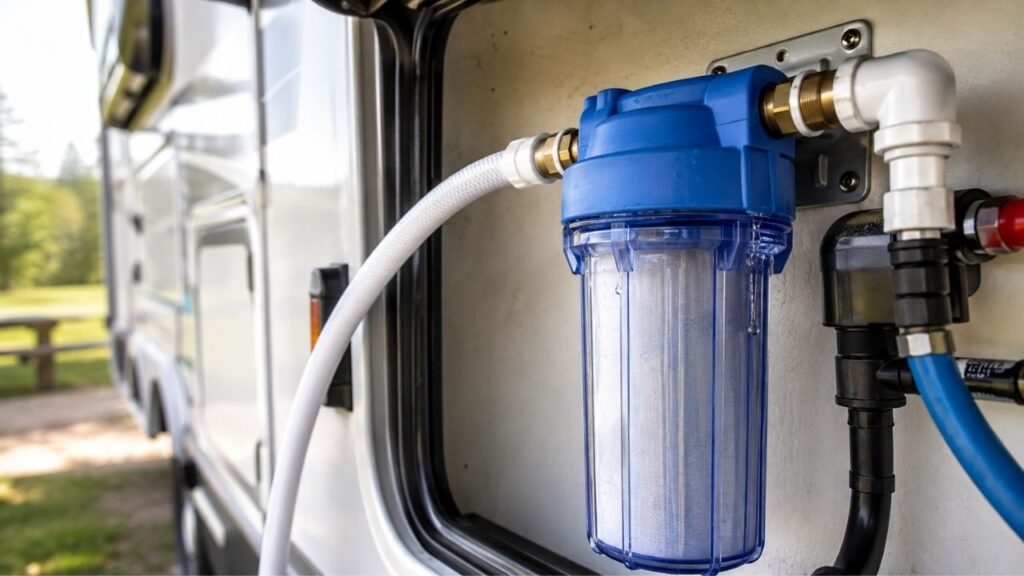
5. Your RV Water Filter Is Clogged or Too Restrictive
Your external RV water filter can also create a low-flow problem.
A new filter usually allows plenty of water through. As the cartridge collects sediment, resistance gradually increases.
You may barely notice the change.
Eventually, however, the flow reaching your heater can drop enough to cause cycling.
Very fine filters can also reduce flow more than expected.
Problems become more noticeable when you use:
- Multiple filters in series
- Small sediment cartridges
- Very low-micron filters
- Old carbon cartridges
- Filters exposed to dirty campground water
Temporarily bypassing the filter can help with diagnosis.
If your hot-water flow improves immediately, inspect or replace the filter.
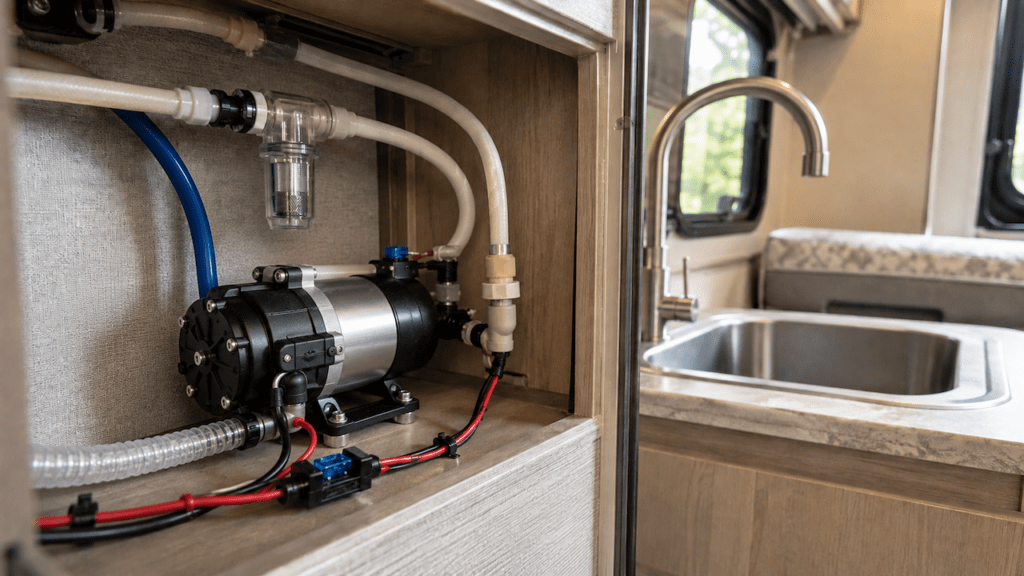
6. The Water Pump or City-Water Supply Is Unstable
Your heater needs steady flow, not just decent flow for a second.
That matters when you use your RV freshwater pump.
A diaphragm pump naturally cycles while maintaining system pressure. If the pressure swings are large enough, water flow through your tankless heater can also rise and fall.
The heater may shut off during those brief low-flow periods.
Check for:
- Rapid pump cycling
- Pulsating faucets
- A clogged pump strainer
- Air entering the suction line
- Weak pump performance
- A very low freshwater level
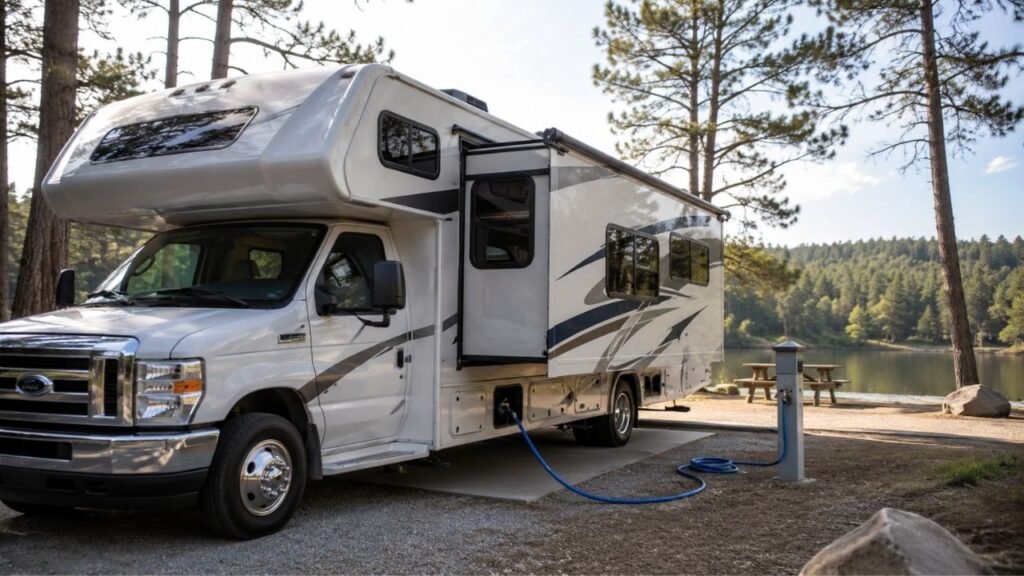
City-water connections can create similar symptoms.
Campground pressure changes throughout the day. Your regulator, filter, hose, and campground supply can all affect usable flow.
Do not assume high PSI automatically means good flow.
We will look at that difference next.
7. Scale or a Faulty Flow Sensor Is Affecting the Heater
If the easy checks do not solve the issue, move closer to the heater.
Mineral scale can slowly narrow internal water passages.
Hard water makes this more likely.
As those passages narrow, your heater receives less effective flow even though the faucet still appears usable.
A dirty or failing flow sensor can create another problem.
The heater may have enough water moving through it, yet the sensor reports otherwise.
That can cause:
- Random burner shutdowns
- Cycling at normal faucet flow
- Failure to ignite
- Low-flow error codes
- Inconsistent operation between uses
Do not replace the flow sensor based on symptoms alone.
First confirm your actual GPM and eliminate external restrictions.
Water Pressure vs. Flow Rate: Which One Is Causing the Shutdown?
Pressure and flow affect each other, but they are not the same measurement. Understanding this difference can save you from adjusting the wrong part of your RV water system.
Water Pressure Is Measured in PSI
PSI tells you how much pressure exists inside the plumbing.
Higher pressure can help push water through hoses, fittings, filters, and fixtures.
However, pressure alone does not tell you how much water reaches the heater.
Water Flow Is Measured in GPM
GPM means gallons per minute.
This tells you the actual volume of water moving through the system.
Your tankless heater cares greatly about this measurement because its flow sensor needs enough water movement to stay activated.
Why Good PSI Does Not Guarantee Good GPM
Think about a garden hose with a partially blocked nozzle.
You can still have pressure behind the blockage.
But not much water gets through.
Your RV can behave the same way.
A clogged filter, kinked hose, dirty aerator, or restricted inlet screen can reduce GPM even when pressure looks acceptable.
Signs You Have a Pressure Problem
- Both hot and cold water feel weak.
- Water output changes when the pump cycles.
- Campground water pressure changes noticeably.
- Several fixtures become weak together.
- Pressure drops badly when another faucet opens.
Signs You Have a Flow Restriction
- Cold water is strong while hot water feels weak.
- Only one faucet causes heater shutdowns.
- Removing an aerator improves operation.
- The inlet screen contains visible debris.
- The heater works only with the faucet fully open.
- A dirty filter noticeably reduces water output.
How to Measure Your RV’s Hot-Water Flow Rate
You do not need specialized equipment to check your actual flow. A container, timer, and simple calculation can tell you whether your heater is receiving enough water.
- Find your heater’s minimum operating flow specification.
- Turn off every other water fixture.
- Set the problem faucet as you normally use it.
- Catch the hot water in a measured container.
- Time how long the container takes to fill.
- Convert that measurement into gallons per minute.
- Repeat the test with the faucet fully open.
Use this formula:
GPM = gallons collected ÷ seconds × 60
Here are some easy examples:
- 1 gallon in 60 seconds equals 1.0 GPM.
- 1 gallon in 90 seconds equals about 0.67 GPM.
- 1 gallon in 120 seconds equals 0.5 GPM.
- 1 gallon in 180 seconds equals about 0.33 GPM.
Suppose your heater requires approximately 0.6 GPM.
If your shower only produces 0.45 GPM through the hot line, shutdowns make sense.
You now have a measurable problem instead of a guessing problem.
How to Fix an RV Tankless Water Heater That Shuts Off at Low Flow
Start with the simplest corrections before touching the heater itself. Many low-flow problems come from ordinary plumbing restrictions rather than expensive internal failures.
1. Open the Hot Faucet Farther
Start here.
Run one hot faucet and open it farther than usual.
If the heater remains on, you have confirmed that flow is involved.
You can then look for the reason your normal setting delivers too little hot water.
2. Lower the Heater Temperature When Your Model Supports This Approach
Some RV tankless systems let you select the desired output temperature at a wall controller.
If you set the heater extremely hot, you may need lots of cold water at the faucet.
That reduces hot-side flow.
A lower heater setting may let you open the hot side farther while still getting comfortable water.
Use this approach only when it matches your heater’s operating instructions.
3. Clean the Faucet Aerator and Showerhead
A quick fixture cleaning can solve the entire problem.
- Turn off the faucet.
- Remove the aerator or showerhead.
- Inspect the screen and flow passages.
- Remove sediment and mineral deposits.
- Rinse everything thoroughly.
- Reassemble the fixture.
- Test hot-water flow again.
If removing the fixture dramatically improves flow, you have identified the restriction.
4. Clean the Water Heater Inlet Screen
Turn off city water and the freshwater pump first.
Open a faucet to relieve pressure.
Then locate the heater’s inlet screen using your manual.
Remove and rinse the screen carefully.
Do not force fittings or disturb gas components while doing this work.
Reinstall everything correctly before restoring water pressure.
5. Check the RV Water Filter and Pump Strainer
Next, inspect the water-delivery system.
Look for:
- A dirty external filter
- A clogged pump strainer
- Kinked drinking-water hoses
- Partially closed valves
- Collapsed hoses
- Excessive filtration restrictions
Test one change at a time.
That makes it much easier to identify which component caused the problem.
6. Check Your City-Water Regulator
A pressure regulator protects your RV plumbing from excessive campground pressure.
But a restrictive or incorrectly adjusted regulator can also limit usable flow.
Do not simply increase pressure until the heater works.
Your RV plumbing, regulator, hoses, and heater each have operating limits.
Stay within the specifications for your particular setup.
If the regulator is old or inconsistent, testing another known-good regulator can be useful.
7. Test the Fresh-Water Pump
If the problem happens only while using your freshwater tank, focus on the pump system.
Watch the water stream while the heater operates.
Does the stream pulse?
Does the pump repeatedly start and stop?
Does the heater shut off at the same moment?
Inspect the pump strainer and listen for unusual pump behavior.
Also check for air entering the suction side.
A healthy pump should provide reasonably stable water delivery during normal use.
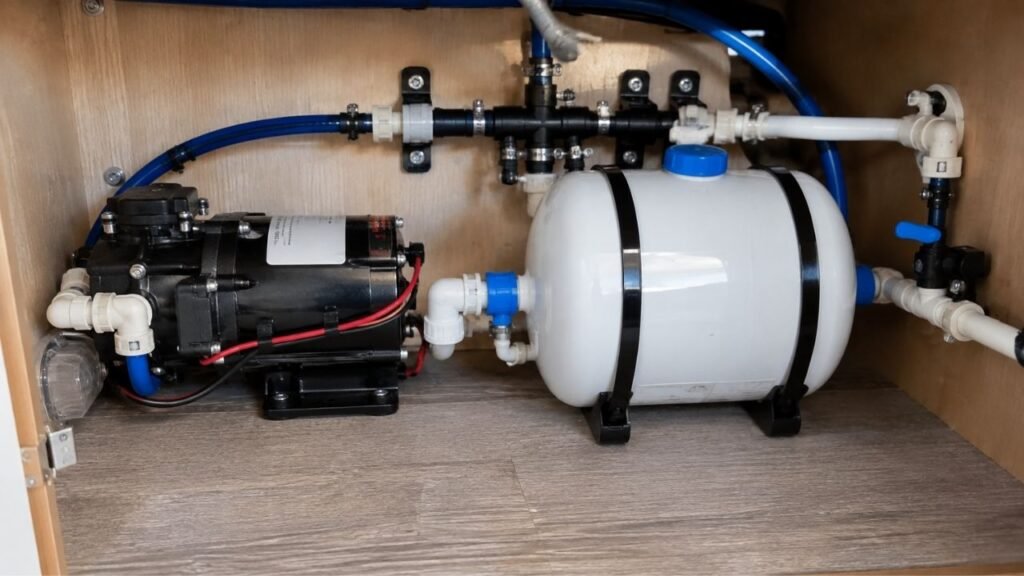
8. Consider an Accumulator Tank if Pump Cycling Matches Heater Cycling
An accumulator tank can help smooth pressure fluctuations in some RV water systems.
It stores a small amount of pressurized water between pump cycles.
That can reduce rapid changes in water delivery.
An accumulator makes the most sense when your heater cycling closely matches your water pump cycling.
It is not a cure for every low-flow problem.
A clogged filter or undersized fixture still needs to be fixed directly.
9. Descale the Heater if Your Manufacturer Recommends It
Mineral buildup can restrict internal passages over time.
This is especially common when traveling through hard-water areas.
However, do not assume every tankless heater uses the same descaling procedure.
Manufacturers may specify different:
- Cleaning solutions
- Flush times
- Service connections
- Maintenance intervals
- Winterization procedures
Follow the instructions for your exact heater.
Avoid improvising with chemicals that the manufacturer does not approve.
10. Have the Flow Sensor Checked
Once you have confirmed adequate GPM, a flow-sensor problem becomes more plausible.
The sensor may be dirty, sticking, damaged, or electrically faulty.
Internal sensor testing usually requires more technical diagnosis.
If your heater still reports low flow despite strong measured water flow, this is a good point to involve an RV technician.
Use This Quick Diagnostic Test Before Replacing Anything
You can often narrow the problem down by watching exactly when the heater fails. Use the pattern below before spending money on replacement parts.
| What You Notice | Check This First |
| Heater works with faucet fully open | Minimum flow or plumbing restriction |
| Only shower causes shutdown | Showerhead or flow restrictor |
| Only one faucet causes shutdown | Aerator or fixture restriction |
| Every hot faucet feels weak | Heater inlet, filter, or internal restriction |
| Hot and cold are both weak | Supply, regulator, pump, hose, or filter |
| Heater cycles when pump cycles | Pump stability or accumulator setup |
| Heater stops after adding cold water | Hot-side flow may be too low |
| Good GPM but heater shows low flow | Flow sensor or internal fault |
| Heater shows an error code | Follow the exact model diagnostic procedure |
Why Does the Heater Work With Full Flow but Shut Off When I Turn the Faucet Down?
This is one of the clearest signs of a minimum-flow problem.
With the faucet fully open, enough water moves through the heater. When you reduce the faucet, flow drops below the operating threshold.
The burner then shuts down.
However, pay attention if this behavior is new.
If the heater previously worked at the same low faucet setting, something may have changed.
A clogged aerator, dirty inlet screen, restrictive filter, mineral buildup, or weakening pump can gradually reduce water flow.
That means the minimum-flow requirement stayed the same.
Your RV simply stopped delivering as much water as before.
Why Does Adding Cold Water Make My RV Tankless Heater Shut Off?
Adding cold water can reduce the amount of water moving through the hot side.
Your showerhead may still feel strong because total water flow remains reasonable.
The heater, however, only measures water passing through its own plumbing path.
If hot-side flow drops below its required minimum, the burner can shut down.
Try adjusting your heater temperature closer to your preferred shower temperature when your model supports that method.
Then use more hot-side flow.
If your manufacturer recommends normal hot-and-cold mixing, follow that guidance instead.
The key is maintaining enough water through the heater.
Why Does My RV Tankless Heater Shut Off Only When Using the Water Pump?
If your heater behaves normally on city water but struggles on the freshwater tank, the pump system becomes the main suspect.
Pump Cycling Causes Flow Dips
Your pump may briefly reduce water delivery while cycling.
If those dips cross the heater’s minimum threshold, the burner shuts down.
A Dirty Pump Strainer Reduces Output
The pump strainer catches debris before it reaches the pump.
A clogged strainer makes the pump work harder while reducing usable flow.
Clean it according to the pump manufacturer’s instructions.
Air Entering the Suction Side Can Cause Pulsation
Loose fittings or air leaks before the pump may create unstable water delivery.
You may hear the pump sound different or see sputtering at faucets.
Fixing the air leak can restore steadier flow.
An Accumulator May Help Some Pump Systems
An accumulator can smooth pressure changes between pump cycles.
This may help when the heater repeatedly shuts down at the same time the pump cycles.
Why Does It Work on City Water but Not the Fresh-Water Tank?
This usually points toward your freshwater delivery system.
City water bypasses the RV water pump.
So, if city water operates the heater normally, inspect the:
- Freshwater pump
- Pump strainer
- Suction line
- Tank outlet
- Pump pressure behavior
The opposite situation is also useful.
If the heater works from the freshwater tank but fails on campground water, inspect the city-water side.
Check your regulator, external filter, hose, and campground supply.
Troubleshooting becomes much easier when you compare both water sources.
Can a Low-Flow Showerhead Cause an RV Tankless Heater to Shut Off?
Yes, a very restrictive showerhead can cause heater shutdowns.
The risk becomes higher when other restrictions already exist.
For example, you might have a low-flow showerhead combined with a dirty water filter and weak campground pressure.
Individually, each restriction may seem minor.
Together, they can drop hot-water flow below the heater’s minimum requirement.
You do not necessarily need to abandon water-saving fixtures.
Instead, test the heater temporarily with the showerhead restriction removed.
If operation becomes stable, choose a showerhead whose flow works better with your heater.
When Low Flow Is Not Actually the Problem
Not every heater shutdown comes from water flow. If increasing flow does nothing, another system may be interrupting operation.
Possible causes include:
- Propane supply interruption
- Ignition failure
- Low 12-volt DC power
- Loose electrical connections
- Blocked exterior air intake
- Blocked exhaust outlet
- Overtemperature protection
- Temperature sensor failure
- Fan or blower problems
- Control-board faults
- Model-specific safety shutdowns
Pay attention to error codes.
Write down the complete code before resetting the heater.
Also record the exact model number.
Error codes can mean different things across manufacturers and even between models from the same brand.
Avoid repeatedly resetting a fault that keeps returning.
The heater may be trying to tell you something important.
When Should You Stop Troubleshooting and Call an RV Technician?
Many flow restrictions are easy to correct yourself. Internal gas, combustion, and electrical problems deserve more caution.
Call a qualified technician if:
- You smell propane around the heater.
- You see soot near the exhaust.
- The heater repeatedly fails to ignite.
- A safety code keeps returning.
- Adequate GPM reaches the heater but it still shuts down.
- The flow sensor appears faulty.
- Internal wiring needs diagnosis.
- Gas pressure must be tested or adjusted.
- The heat exchanger needs internal repair.
- Troubleshooting requires opening sealed gas components.
If you smell propane, stop using the heater immediately.
Turn off the propane supply when safe and leave the RV if necessary.
Do not continue testing an appliance with a suspected gas leak.
How to Prevent Low-Flow Shutdowns From Coming Back
Most recurring low-flow problems can be prevented with simple water-system maintenance. A few quick checks can keep your heater operating much more consistently.
- Clean faucet aerators when flow begins dropping.
- Remove mineral buildup from your showerhead.
- Replace clogged RV water-filter cartridges.
- Inspect the heater inlet screen periodically.
- Keep the water pump strainer clean.
- Watch for unusually rapid pump cycling.
- Check hoses for kinks before connecting city water.
- Maintain your heater using its approved descaling procedure.
- Avoid overly restrictive water-saving fixtures.
- Keep your regulator within recommended pressure limits.
- Know your heater’s minimum flow specification.
- Record recurring error codes and maintenance dates.
You do not need to obsess over the heater every trip.
Just pay attention when water flow changes.
A noticeable reduction often gives you an early warning before the heater begins cycling.
Final Verdict
An RV tankless water heater usually shuts off at low flow because the heater no longer detects enough water moving through it. The burner stops once flow falls below the minimum operating point programmed for that model.
Start by opening the hot faucet farther and measuring actual GPM. Then inspect the showerhead, aerator, water filter, inlet screen, regulator, and RV water pump.
If your measured flow clearly meets the manufacturer’s requirement but the heater still shuts down, the problem may be inside the heater. At that point, a faulty flow sensor or another internal fault deserves professional diagnosis.
Related FAQs
What Is the Minimum Flow Rate for an RV Tankless Water Heater?
The minimum flow rate depends on the specific heater. Some RV tankless models operate around 0.3 to 0.4 GPM, while others may require roughly 0.6 to 0.7 GPM. Check your exact model manual because there is no universal minimum.
Why Does My RV Tankless Water Heater Only Work With the Faucet Fully Open?
Your heater probably receives enough water when the faucet is fully open but falls below its minimum flow threshold when you reduce it. A clogged fixture, filter, inlet screen, or weak water supply can make the problem worse.
Can Low Water Pressure Make a Tankless RV Water Heater Shut Off?
Yes. Low pressure can reduce water flow enough to cause shutdowns. However, pressure and flow are different measurements. You can also have acceptable PSI while a clogged filter or fixture restricts actual GPM.
Why Does My RV Tankless Water Heater Shut Off When I Add Cold Water?
Adding cold water can reduce how much water travels through the hot side. If hot-side flow falls below the heater’s minimum operating requirement, the burner may shut off even though total shower flow still feels strong.
Can a Clogged RV Water Filter Make a Tankless Heater Stop Working?
Yes. A dirty or restrictive water filter can reduce flow throughout your RV plumbing. If the heater is already operating near its minimum flow point, that additional restriction can cause ignition problems or repeated shutdowns.
Can a Low-Flow Showerhead Cause Tankless Water Heater Cycling?
Yes. A very restrictive showerhead can reduce hot-water demand enough to cross the heater’s minimum flow threshold. Testing briefly without the restriction can help determine whether the showerhead is contributing to the problem.
How Do I Know If My RV Water Heater Flow Sensor Is Bad?
A faulty flow sensor becomes more likely when you measure adequate water flow but the heater still reports low flow, refuses to ignite, or shuts down unpredictably. External plumbing restrictions should be ruled out before replacing the sensor.
Will an Accumulator Tank Stop My Tankless Water Heater From Cycling?
An accumulator tank may help when heater cycling matches fluctuations from your RV water pump. It can smooth water delivery between pump cycles, but it will not fix clogged filters, restricted fixtures, or a failing heater component.
Why Does My Tankless Heater Work on City Water but Not the RV Pump?
This usually points toward the freshwater system. Check the RV water pump, pump strainer, suction line, tank outlet, and pump cycling behavior. City water bypasses the pump, making the comparison useful for troubleshooting.
Does Hard Water Cause Low Flow Through an RV Tankless Water Heater?
Yes. Hard water can leave mineral deposits inside filters, fixtures, and heater passages. Over time, those deposits may reduce flow and contribute to cycling. Follow your heater manufacturer’s approved maintenance and descaling procedure.
Should I Increase My RV Water Pressure to Stop the Heater From Shutting Off?
Not automatically. First check actual flow and look for restrictions. Raising pressure beyond your RV plumbing or heater limits can create leaks or damage. Keep pressure within the specifications recommended for your equipment.
Is It Normal for a Tankless RV Water Heater to Shut Off at Very Low Flow?
Yes. Tankless heaters are designed to stop heating when water flow falls below their minimum operating threshold. If the heater stays on at normal flow but shuts down at a trickle, it may be operating exactly as designed.

Steven Parker writes about everyday RV life, from setup tips to long-term living decisions. His content reflects a calm, experienced approach to RV ownership and travel. He focuses on comfort, reliability, and realistic expectations.