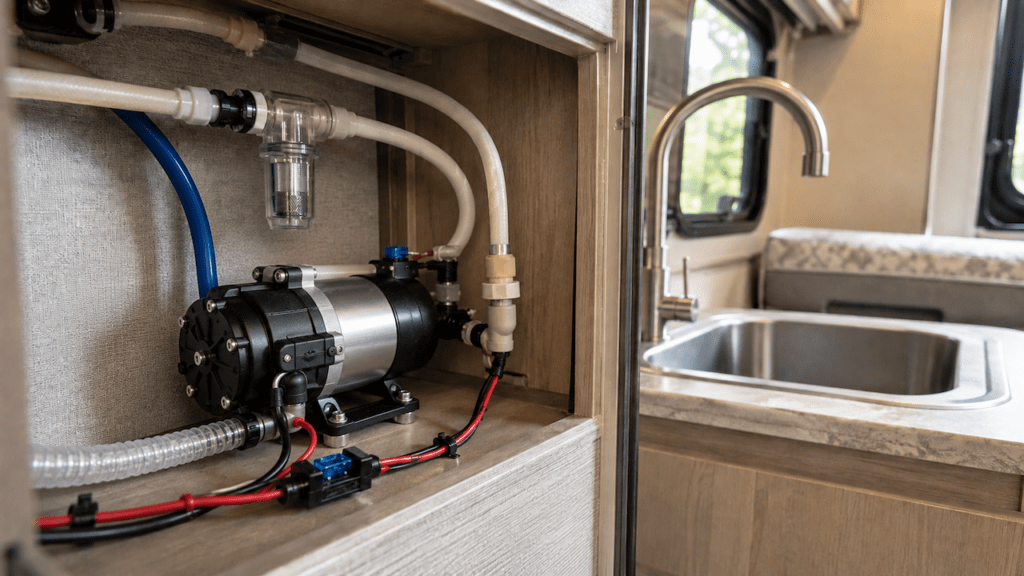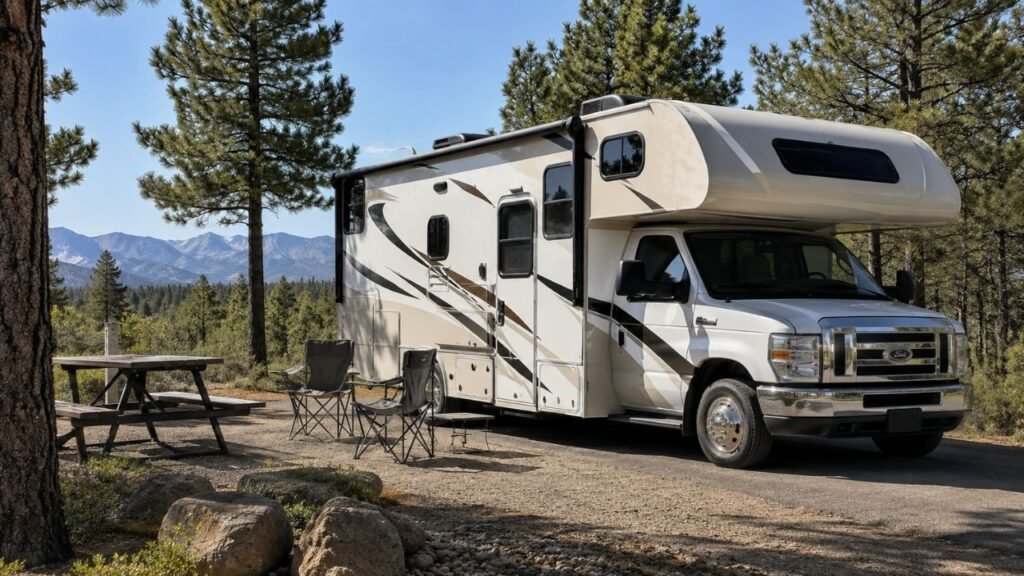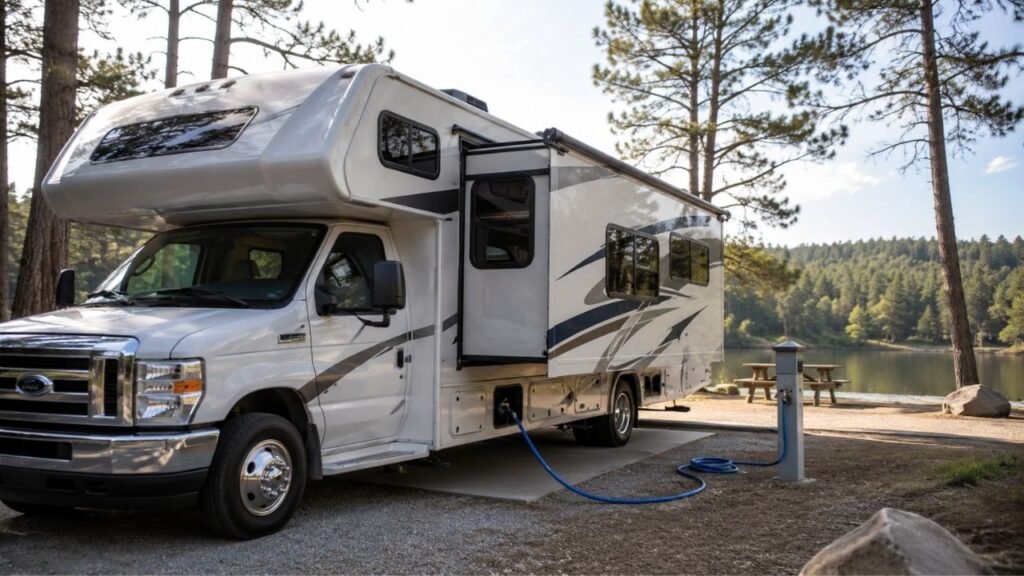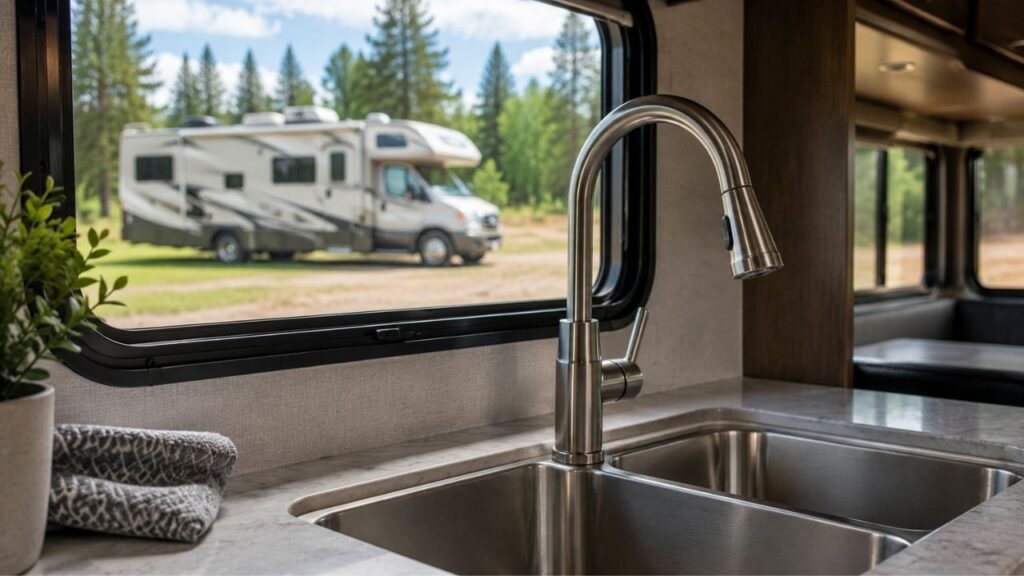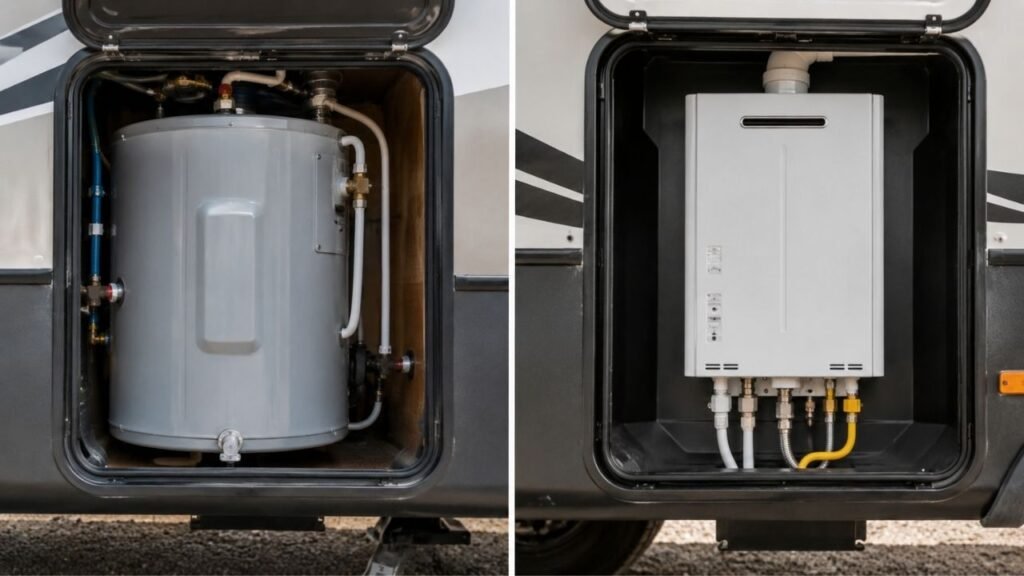
A traditional tank RV water heater usually makes it easier to use less freshwater than a tankless model, especially while boondocking. Tank heaters work well with low-flow faucets and short navy showers, while some tankless heaters need steady water flow and may waste water while the burner starts and the temperature stabilizes.
That does not mean tankless water heaters are inefficient. They can use propane efficiently and provide continuous hot water. In this guide, I’ll compare actual water consumption, warm-up waste, shower habits, flow requirements, and the best choice for different camping styles.
Key Takeaways
- Tank RV water heaters usually make strict water conservation easier.
- Tankless heaters provide continuous hot water but may encourage longer showers.
- Some tankless units need minimum water flow to stay operating.
- Tank heaters usually work better for navy showers and very low flow.
- Both systems can waste water while cooled water leaves the plumbing lines.
- Tankless heaters can save propane without necessarily saving freshwater.
- Newer low-flow and hybrid tankless models reduce many traditional drawbacks.
- Tank heaters generally suit boondocking better when water is limited.
- Tankless heaters become more attractive at full-hookup RV sites.
Tankless vs Tank RV Water Heater: Which Actually Uses Less Water?
The water heater itself does not consume water like an appliance consumes electricity. What matters is how much water must flow before you get usable hot water and how much you continue using afterward.
| Water-Use Factor | Tank RV Water Heater | Tankless RV Water Heater |
| Hot water availability | Stored and already heated | Heated as water flows |
| Minimum faucet flow | Usually not an issue | Depends on the model |
| Low-flow shower use | Very good | Can be sensitive |
| Warm-up water waste | Usually lower at the heater | Can be higher during activation |
| Navy shower use | Excellent | Can cause restart delays |
| Hot water duration | Limited by tank capacity | Continuous while water and fuel remain |
| Boondocking water conservation | Usually better | Depends heavily on habits |
| Long showers | Naturally limited | Easy to extend |
| Propane standby use | Can have standby losses | Usually lower |
| Best overall use | Water-conscious camping | Comfort and continuous hot water |
If your main concern is stretching a limited freshwater tank, I would usually give the advantage to a traditional tank heater.
If you spend most of your time connected to campground water and sewer, the water difference becomes much less important.
Why a Tank RV Water Heater Can Use Less Freshwater
A tank heater keeps several gallons of water heated and ready for use. More importantly for conservation, you can normally reduce faucet flow without worrying about shutting down the heating process.
Hot Water Is Already Heated and Ready
Traditional RV heaters commonly store around 6 or 10 gallons of hot water.
When you open a faucet, heated water leaves the tank and travels through your RV plumbing. The heater does not have to detect a specific faucet flow before it can start heating that particular stream of water.
You may still have to wait briefly for hot water.
Water sitting inside the hot-water line can cool between uses. That cooled water must leave the pipe before freshly heated water reaches you.
However, there is usually no additional minimum-flow requirement at the faucet.
You Can Reduce Water Flow More Easily
This is where tank heaters become especially useful for water-conscious RVers.
You can turn your shower down to a small stream while rinsing without worrying about whether the heater will remain activated.
That gives you more control over every gallon leaving your freshwater tank.
A good low-flow RV showerhead can make an even bigger difference.
Instead of running 2 gallons per minute, you may be able to shower comfortably at a much lower rate.
Tank Capacity Naturally Limits Long Showers
A limited hot-water supply can actually help with conservation.
With a 6-gallon tank, you know you cannot stand under an endlessly hot shower. Eventually, incoming cold water will lower the available temperature.
That naturally encourages shorter showers.
A tankless heater removes that limitation.
It may be more comfortable, but that comfort can lead to much greater total water consumption.
Tank Heaters Work Well With Navy Showers
A navy shower is one of the best ways to save RV freshwater.
The basic routine is simple:
- Turn the shower on and get wet.
- Shut the water off.
- Soap and shampoo.
- Turn the water back on.
- Rinse quickly.
A tank heater handles this routine very well.
You can repeatedly stop and restart the shower without depending on a burner flow sensor every time.
That makes tank heaters especially useful while dry camping.
Why a Tankless RV Water Heater May Use More Water
Tankless heaters do not automatically waste water. However, their operating design can make conservation more difficult in certain RVs, especially when very low water flow is important.
Water Runs While the Heater Activates
When you open a hot faucet, several things happen.
Water starts moving through the plumbing. The heater senses the flow. The burner activates. Water begins heating inside the heat exchanger.
Meanwhile, water is already moving toward the faucet.
You may therefore send some cooler water down the drain before the temperature becomes comfortable.
How much water is involved depends on your specific system.
A heater located near the shower may deliver warm water quickly. A distant fixture can take noticeably longer.
Minimum Flow Rate Can Limit Water-Saving Techniques
Many tankless RV water heaters need a minimum flow rate before they activate.
For example, imagine your heater requires roughly 0.5 to 0.6 gallons per minute.
If you reduce your shower below that level, the burner may shut down.
You then increase the flow because the water becomes cold. The heater restarts and needs time to stabilize again.
You may end up using more water than if you had maintained a slightly higher continuous flow.
This is why you should always check the minimum operating flow before buying a tankless heater.
Starting and Stopping Can Cause Temperature Changes
Some tankless RV owners notice a brief cold-water period after turning the shower off and restarting it.
The problem is especially noticeable during navy showers.
You stop the water while soaping.
When you restart it, the flow sensor activates again. Water in the lines and heat exchanger begins moving. The temperature may take a few moments to stabilize.
You may stand there waiting for comfortable water again.
That extra running time adds to freshwater use.
Modern tankless systems have improved considerably, but the behavior still varies between models.
Endless Hot Water Can Encourage Longer Showers
This is probably the most overlooked difference.
Imagine two people using the same 1.5 GPM RV showerhead.
One takes a four-minute shower with a tank heater.
The other enjoys a twelve-minute shower because the tankless unit never runs cold.
The tankless heater may be more energy-efficient, but the second person used much more freshwater.
The heater did not directly waste that water.
The unlimited hot-water supply changed the person’s behavior.
That distinction matters when comparing real-world RV water use.
How Much Water Can a Tankless Heater Waste While Warming Up?
There is no universal number because every RV plumbing system is different. However, you can estimate your own warm-up water use with a simple calculation.
Water used while waiting = Flow rate × Waiting time ÷ 60
Here is what that looks like at several common flow rates.
| Water Flow | 5-Second Wait | 10-Second Wait | 20-Second Wait | 30-Second Wait |
| 0.5 GPM | 0.04 gal | 0.08 gal | 0.17 gal | 0.25 gal |
| 1.0 GPM | 0.08 gal | 0.17 gal | 0.33 gal | 0.50 gal |
| 1.5 GPM | 0.13 gal | 0.25 gal | 0.50 gal | 0.75 gal |
| 2.0 GPM | 0.17 gal | 0.33 gal | 0.67 gal | 1.00 gal |
For example, suppose your shower flows at 1.5 GPM.
If you wait 20 seconds for stable hot water, about half a gallon passes through the shower.
Repeat that several times during the day, and the amount becomes noticeable.
Keep in mind that this table measures water flowing while you wait.
It does not mean every tankless water heater inherently wastes that amount.
The Distance From Your Water Heater to the Faucet Matters Too
The heater type is only part of the story.
Water sitting inside your hot-water plumbing cools after the faucet has been closed for a while.
When you open the faucet again, that cooled water must leave before newly heated water reaches you.
This happens with both tank and tankless heaters.
Suppose your RV shower sits only a few feet from the water heater. Hot water may reach it quickly.
Your kitchen sink might be on the opposite side of the RV. It may require much more water to clear the cooled plumbing line.
Several things affect the delay:
- Hot-water pipe length
- PEX tubing diameter
- Outdoor temperature
- Temperature inside the RV
- Faucet flow rate
- Water heater location
So, if one faucet takes much longer than another, do not immediately blame the water heater.
The plumbing layout may be the bigger reason.
Does a Tankless RV Water Heater Always Waste More Water?
No. Modern RV tankless systems vary greatly. Some newer models operate at lower flow rates and manage temperature changes much better than older designs.
Low-Flow Tankless Heaters Reduce the Difference
Minimum activation flow is one of the most important specifications to check.
One tankless heater may need a relatively strong stream to operate.
Another may continue heating at much lower flow.
A lower activation threshold can make a major difference when you want to conserve freshwater.
It lets you reduce shower flow without constantly causing the heater to stop.
Hybrid Tankless Designs Improve Temperature Stability
Not every modern tankless system works exactly the same way.
Some designs include a small mixing chamber or temperature-stabilizing reservoir.
That small amount of stored water can smooth temperature changes and reduce the cold-water effect between burner cycles.
These systems still provide the continuous-hot-water benefits people expect from tankless units.
However, they behave differently from a basic flow-through heater.
Recirculation Can Reduce Water Going Down the Drain
Some advanced RV hot-water systems circulate water through the plumbing rather than immediately sending cooler water down the drain.
The goal is simple.
Bring usable hot water closer to the faucet before you begin using it normally.
A well-designed recirculation setup can dramatically reduce warm-up water waste.
However, it adds equipment, cost, installation requirements, and sometimes electrical consumption.
Which Uses Less Water While Boondocking?
Boondocking changes the comparison dramatically because every gallon matters. You are limited by both the amount of freshwater you carry and the amount of wastewater your gray tank can hold.
Why Tank Heaters Usually Have the Advantage
A tank heater gives you several conservation advantages while dry camping.
You can:
- Run the shower at very low flow.
- Shut water off while soaping.
- Restart the shower without worrying about burner activation.
- Take shorter showers because hot water is limited.
- Use low-flow faucets more easily.
These habits can make a meaningful difference over several days.
Suppose you have a 40-gallon freshwater tank.
Saving only two gallons per person each day can significantly extend your stay.
Why Tankless Can Shorten Your Boondocking Time
Tankless systems can affect both sides of your water storage.
Every extra gallon you use:
Leaves your freshwater tank and enters your gray tank.
That means you may reach two limits sooner.
You could run out of clean water.
Or your gray tank could fill first.
Long tankless showers can become especially problematic.
Continuous hot water feels wonderful, but your holding tanks do not become unlimited just because your heater does.
When Tankless Still Works Well Off-Grid
I would not rule out tankless completely for boondocking.
It can still work well when your RV has:
- A large freshwater tank
- Generous gray-tank capacity
- A low-flow-compatible tankless heater
- Short hot-water plumbing runs
- A water recirculation system
- Efficient showerheads
- Disciplined shower habits
If you understand your tank capacities and monitor water carefully, tankless can still be practical.
Which Is Better When You Have Full Hookups?
Tankless becomes much more attractive when you’re staying at a full-hookup campground.
You are no longer depending entirely on a limited freshwater tank. A sewer hookup also removes much of the concern about filling your gray tank.
That changes the priorities.
Instead of stretching every gallon, you may care more about comfort.
A tankless heater can provide back-to-back showers without waiting for another 6 or 10 gallons of water to reheat.
Families often appreciate this difference.
One person can shower, followed by another, without planning around recovery time.
You should still avoid unnecessary water use, but the limitations are far less restrictive than they are while boondocking.
Tankless vs Tank Water Use for Common RV Activities
Different camping activities favor different heater designs. Looking at everyday situations can make the choice easier than comparing specifications alone.
| RV Activity | Better for Minimum Water Use | Why |
| Quick hand washing | Tank | Works easily at low flow |
| Short dish rinsing | Tank | No activation-flow concern |
| Navy shower | Tank | Handles frequent stops well |
| Long continuous shower | Depends | Tankless allows unlimited hot water |
| Back-to-back showers | Tankless for comfort | No tank recovery wait |
| Boondocking | Usually tank | Easier to ration freshwater |
| Full-hookup camping | Tankless often wins | Water limits matter less |
| Very-low-flow fixtures | Tank or compatible tankless | Minimum activation flow matters |
Neither system wins every category.
The best choice depends on how you actually camp.
Water Efficiency vs Propane Efficiency: Do Not Confuse Them
This is where many RV water heater comparisons become misleading.
Water efficiency and energy efficiency are not the same thing.
Water efficiency describes how much freshwater leaves your RV supply.
Energy efficiency describes how much propane or electricity is required to heat that water.
A tankless heater can perform very well from an energy perspective.
It does not need to keep several gallons of water hot throughout the day. The burner normally operates only when you request hot water.
A traditional tank heater can lose some heat while hot water sits inside the tank.
The burner may cycle periodically to maintain temperature.
That makes tankless attractive for propane conservation.
However, you could still use more freshwater if you take longer showers or repeatedly run water while waiting for the temperature to stabilize.
So when someone says, “Tankless is more efficient,” ask:
Efficient with what?
Propane and freshwater are two different resources inside an RV.
What Determines How Much Water Your RV Water Heater Really Uses?
Many factors influence your actual water consumption, so heater style should never be considered alone.
Important factors include:
- Tank or tankless heater design
- Tankless minimum activation flow
- Showerhead flow rate
- Faucet flow rate
- Distance from heater to fixture
- Hot-water PEX diameter
- Incoming water temperature
- Desired shower temperature
- Campground water pressure
- RV water pump performance
- Outdoor temperature
- Number of faucet starts and stops
- Shower length
- Number of people in the RV
- Freshwater tank capacity
- Gray-tank capacity
- Recirculation systems
- Personal water-use habits
In many RVs, your habits will affect water consumption more than the heater itself.
How to Reduce Water Waste With a Tankless RV Water Heater
You do not need to give up tankless comfort to become more water-conscious. A few changes can significantly reduce unnecessary water use.
Set the Heater Near Your Desired Water Temperature
Many tankless systems work best when the heater is set close to the temperature you actually want at the faucet.
For example, suppose you want a comfortable shower around 105°F.
Setting the heater extremely hot and then mixing large amounts of cold water may reduce the hot-side flow through certain systems.
That can sometimes affect temperature stability.
Always follow the operating instructions for your specific heater.
Avoid Repeatedly Starting and Stopping the Water
If your heater experiences noticeable restart delays, constantly stopping and restarting the shower may actually waste water.
Instead, try using a lower continuous flow that remains above the heater’s minimum activation level.
Test different settings before your next boondocking trip.
Find the lowest comfortable flow that keeps the heater operating reliably.
Capture Warm-Up Water
You do not have to send warm-up water straight into the gray tank.
Place a small container beneath the faucet while waiting.
You can reuse that water for tasks such as:
- Flushing the toilet
- Cleaning surfaces
- Rinsing dishes before washing
- General campsite cleanup
This simple habit can recover several gallons during a longer trip.
Consider a Water Recirculation System
A recirculation or water-return system can redirect cooler water instead of wasting it.
This approach is especially helpful when your water heater sits far from the shower or kitchen.
It may not be practical in every RV.
Installation complexity, electrical requirements, and plumbing access should all be considered.
Check Minimum Flow Before Buying a Low-Flow Showerhead
Do not automatically install the lowest-flow showerhead you can find.
First, check the minimum operating flow of your tankless heater.
If your showerhead delivers less water than the heater requires, you could create temperature problems.
A slightly higher-flow showerhead that keeps the heater operating steadily may actually waste less water overall.
How to Use Less Water With a Traditional Tank Heater
Traditional tank heaters already work well with conservation techniques, but your habits still matter.
Try these simple practices:
- Take navy showers while boondocking.
- Install an efficient RV showerhead.
- Reduce faucet flow while washing dishes.
- Repair dripping faucets quickly.
- Avoid leaving hot water running unnecessarily.
- Capture cooled water while waiting for distant faucets.
- Insulate accessible hot-water pipes where practical.
- Monitor fresh and gray tank levels regularly.
- Use an appropriate RV water-pressure regulator at campgrounds.
- Heat only the amount of water you realistically need.
Even a few small changes can extend your freshwater supply noticeably.
Should You Switch From a Tank Heater to Tankless Just to Save Water?
If saving freshwater is your main goal, I would not switch from a functioning tank heater to tankless for that reason alone.
A tankless heater offers several attractive benefits.
You get continuous hot water.
You may reduce standby propane use.
You can take back-to-back showers without waiting for a tank to recover.
You may also gain better temperature controls.
But none of those benefits automatically mean lower freshwater consumption.
For someone who spends most trips boondocking, a traditional tank heater may actually support better conservation habits.
For someone who stays primarily at full-hookup campgrounds, tankless convenience may matter much more.
Tank or Tankless: Which Is Better for Your Camping Style?
There is no single winner for every RVer. Your camping style should guide the decision more than marketing claims about efficiency.
Choose a Tank Heater If…
A traditional tank model probably makes more sense when:
- You frequently boondock.
- Freshwater capacity is limited.
- Your gray tank is relatively small.
- You regularly take navy showers.
- You prefer very-low-flow faucets.
- You want simple operation.
- You do not mind shorter showers.
- Your current heater works reliably.
For strict water conservation, this remains a very practical setup.
Choose a Tankless Heater If…
Tankless may be the better choice when:
- You primarily use full-hookup campgrounds.
- Several people need showers.
- You want back-to-back hot-water use.
- Long showers are important to you.
- Propane standby losses concern you.
- You want digital temperature control.
- Your RV plumbing provides reliable flow and pressure.
In these situations, comfort may matter more than squeezing every possible gallon from the freshwater tank.
Consider a Low-Flow or Hybrid Tankless System If…
A modern low-flow or hybrid system can provide a useful middle ground.
Consider one when:
- You want continuous hot water.
- You still boondock occasionally.
- Low-flow operation matters.
- You want better temperature stability.
- Warm-up water waste concerns you.
- Your budget allows a more advanced system.
Just compare operating flow specifications carefully before buying.
Final Verdict: Which RV Water Heater Uses Less Water?
For most RVers who are focused strictly on freshwater conservation, a traditional tank RV water heater has the advantage.
It works comfortably at low flow, handles navy showers well, and naturally discourages extremely long showers because stored hot water is limited.
That makes it especially useful while boondocking.
A tankless heater can still be an excellent choice.
Modern models provide continuous hot water, better temperature control, and potentially lower standby propane use.
Some newer units also perform much better at low flow than older designs.
The best choice therefore depends on where you camp.
For boondocking and strict water conservation, I would usually choose a tank heater.
For full-hookup camping and maximum shower comfort, tankless is often more appealing.
And if propane savings are your priority, remember that energy efficiency and freshwater efficiency are two separate comparisons.
Related FAQs
Does a Tankless RV Water Heater Save Water?
Not automatically. A tankless heater may save propane by heating only when needed, but freshwater use depends on minimum flow, warm-up time, plumbing length, shower duration, and how often you start and stop the water.
How Much Water Does a Tankless RV Water Heater Waste Before Getting Hot?
There is no fixed amount. For example, a 1.5 GPM shower running for 20 seconds uses about half a gallon while you wait. Your actual amount depends on flow rate, plumbing length, heater design, and incoming water temperature.
Do Tankless RV Water Heaters Use More Water?
They can use more water in real-world RV use, especially if the heater needs steady flow or encourages longer showers. However, a modern low-flow tankless system operated carefully may use very little additional water.
Are Tankless RV Water Heaters Good for Boondocking?
Yes, but they require more careful water management. Check the heater’s minimum flow rate, fresh-tank capacity, gray-tank size, plumbing layout, and your normal shower habits before relying on one for extended dry camping.
Why Does My Tankless RV Water Heater Need High Water Flow?
Tankless heaters use a flow sensor to determine when hot water is needed. If the flow drops below the heater’s operating threshold, the burner may shut down and the water can quickly become cooler.
Can I Take a Navy Shower With a Tankless RV Water Heater?
Yes, although some models handle repeated starts and stops better than others. If your heater creates a cold-water delay after every restart, a low continuous flow may conserve more water than repeatedly switching the shower off.
Can I Use a Low-Flow Showerhead With a Tankless RV Water Heater?
Usually, yes, but check your heater’s minimum operating flow first. A showerhead with extremely low output can fall below the activation threshold and cause the heater to shut down or produce unstable temperatures.
Does a 6-Gallon RV Water Heater Only Give Six Gallons of Shower Water?
No. The hot water leaving the tank mixes with cold water at the shower valve, so your usable shower volume can exceed six gallons. The exact amount depends on tank temperature, incoming cold-water temperature, and your preferred shower temperature.
Does Tankless Use Less Propane Than a Tank RV Water Heater?
Tankless heaters can reduce standby propane use because they normally fire only when hot water is requested. Actual propane consumption still depends on incoming water temperature, temperature setting, shower length, heater efficiency, and usage habits.
Does Distance From the Water Heater Affect Water Waste?
Yes. Longer hot-water lines contain more cooled water between uses. That water must leave the pipe before freshly heated water reaches the faucet, so distant showers and sinks may require a longer wait with either heater type.

Steven Parker writes about everyday RV life, from setup tips to long-term living decisions. His content reflects a calm, experienced approach to RV ownership and travel. He focuses on comfort, reliability, and realistic expectations.