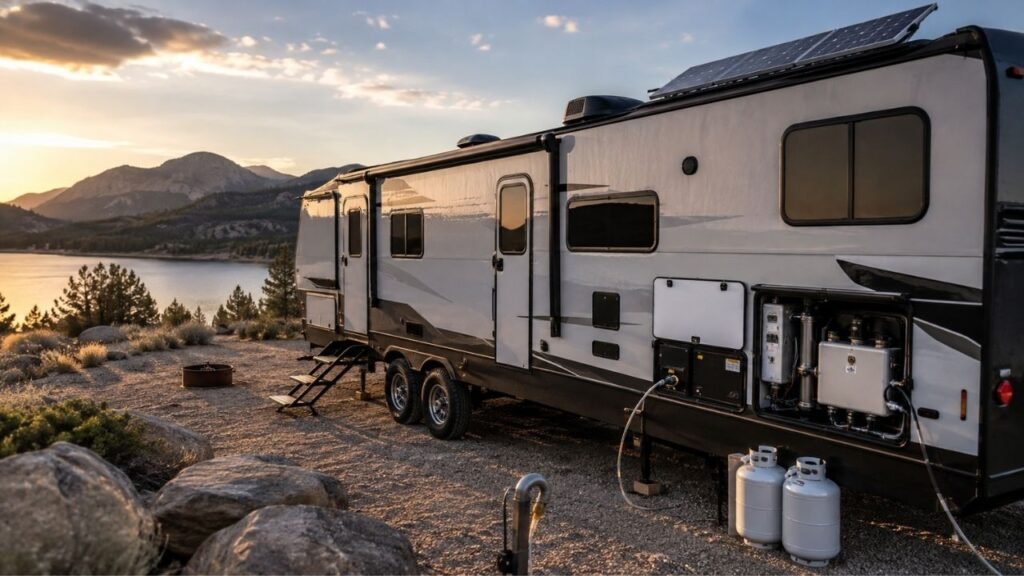
Yes, most propane RV tankless water heaters can run without shore power. Propane provides the heat, while your RV’s 12-volt house battery powers the control board, ignition, sensors, gas valve, and blower fan. You still need enough battery voltage, propane, water pressure, and water flow.
If you’re planning to boondock, this setup can work very well. Below, I’ll explain exactly what powers your heater, how much battery it may use, what can stop it from working, and how to keep hot water flowing when your RV is unplugged.
Key Takeaways
- Most propane RV tankless heaters do not need 120V shore power.
- They normally need a working 12V RV house battery.
- Propane provides the energy that actually heats your water.
- The 12V system operates the ignition, electronics, sensors, and blower.
- You usually do not need an inverter for a 12V propane model.
- Your water pump also uses battery power when boondocking.
- Low voltage or weak water flow can prevent heater ignition.
- Electric-only tankless heaters have very different power requirements.
Can an RV Tankless Water Heater Work When the RV Is Unplugged?
Yes, a typical propane RV tankless water heater can continue working after you unplug your RV from shore power. The important thing is keeping your 12V house electrical system operational.
This is where many RV owners get confused.
No shore power does not mean no electricity.
Your RV battery continues supplying 12V electricity after disconnecting the campground pedestal. That power keeps many important systems working.
Your tankless heater may use that 12V supply for its electronics. Meanwhile, propane creates the heat needed to warm your water.
So, if you unplug your RV and everything is working correctly, you should still have hot water.
The exception is an electric-only tankless heater. Those units can have much greater AC power requirements and cannot automatically run from a standard RV battery.
Always check the voltage requirements listed for your specific heater.
What Powers an RV Tankless Water Heater Without Shore Power?
Several systems work together whenever you request hot water. Knowing what each one does makes off-grid troubleshooting much easier.
Propane Provides the Heat
Your propane supply handles the energy-intensive part of the process.
When you open a hot water faucet, the heater detects flowing water. The propane burner then fires beneath or around the heat exchanger.
Cold water moves through that heat exchanger and absorbs heat quickly. Heated water then travels toward your faucet or shower.
Because propane creates the heat, your battery does not need to electrically heat several gallons of water.
That makes propane tankless heaters particularly practical for off-grid RV camping.
However, having a full propane cylinder is not enough by itself. Modern tankless units still require electrical power for several components.
The 12V Battery Powers the Controls and Ignition
Your RV house battery usually provides the heater’s electrical power.
Depending on the model, 12V DC power may operate the:
- Electronic control board
- Automatic ignition system
- Gas valve controls
- Blower motor
- Flow sensors
- Temperature sensors
- Flame detection system
- Digital thermostat or wall controller
These components do not normally consume huge amounts of power individually. However, adequate voltage is still necessary.
A severely discharged battery can therefore leave you without hot water.
The Water Pump May Also Use Your Battery
Your water source matters when you’re operating without campground hookups.
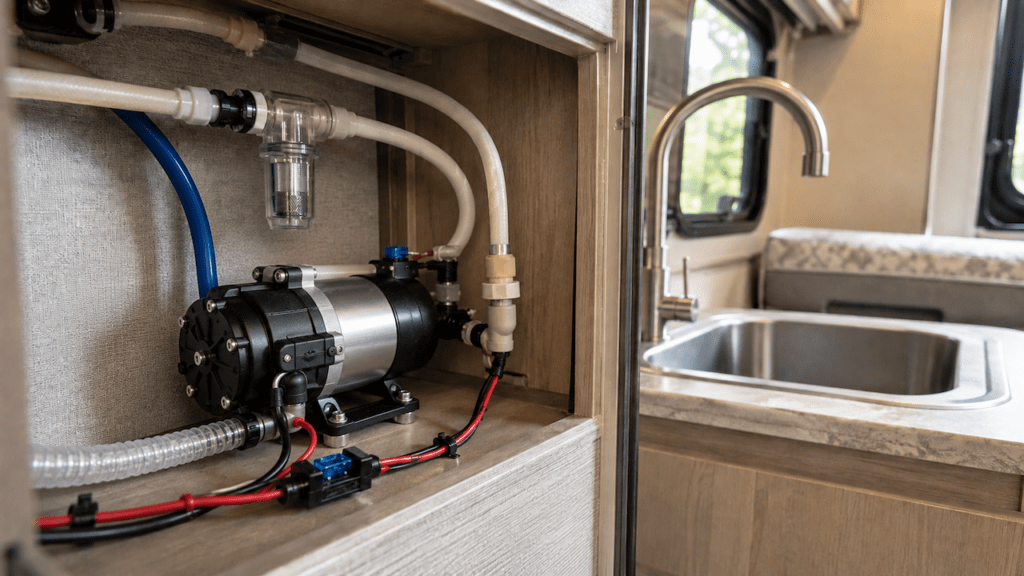
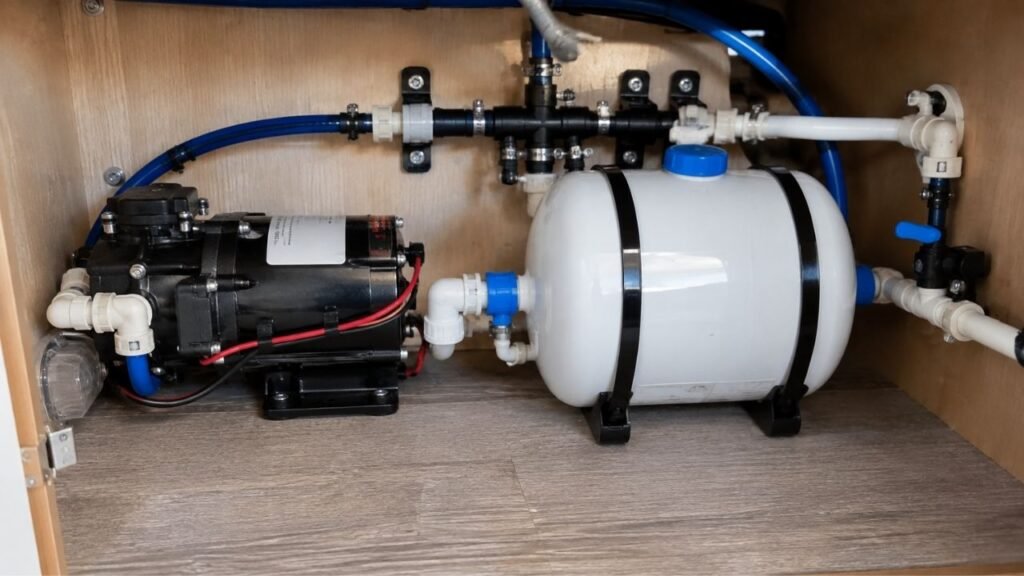
When using your RV’s freshwater tank, the onboard water pump usually provides water pressure. That pump also runs from your 12V electrical system.
Your battery may therefore power both the heater electronics and water pump.
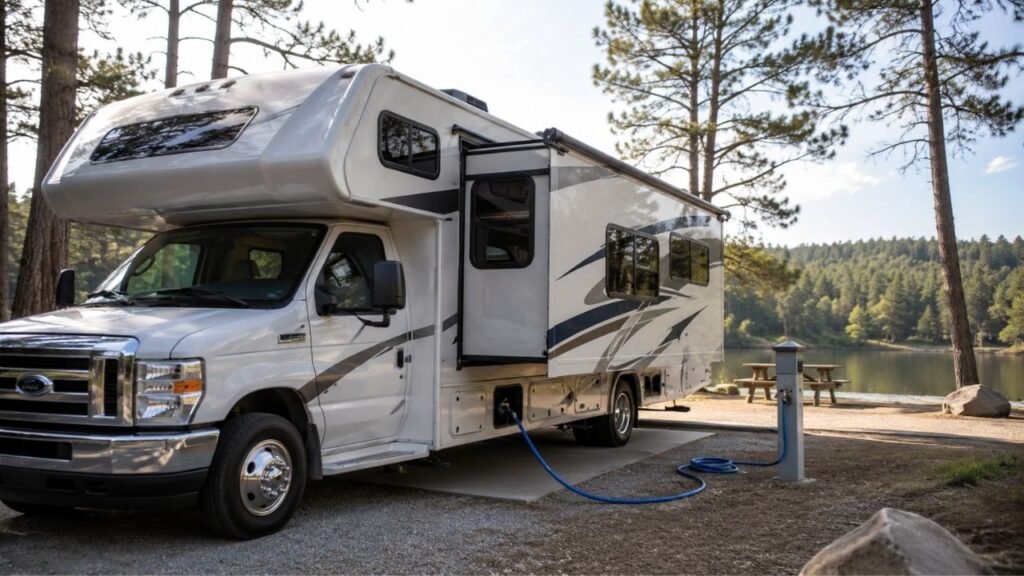
When connected directly to campground city water, things work differently. External water pressure normally pushes water through your plumbing.
In that situation, you generally leave the RV water pump turned off.
RV Tankless Water Heater Power Requirements at a Glance
| Component | Typical Power Source | Needed Without Shore Power? |
| Burner | Propane | Yes |
| Control board | 12V battery | Yes |
| Electronic igniter | 12V battery | Yes |
| Blower fan | 12V battery | Yes |
| Sensors and controller | 12V battery | Yes |
| RV water pump | 12V battery | Yes, when using freshwater tank |
| 120V shore connection | Campground pedestal | Usually no |
| Inverter | RV battery | Usually no |
| Generator | Gas, propane, or diesel | Usually no |
This basic arrangement explains why many RV tankless heaters work so well during boondocking.
Do You Need an Inverter to Run an RV Tankless Water Heater?
Usually, you do not need an inverter for a propane tankless RV water heater designed for direct 12V operation.
An inverter changes battery-supplied DC electricity into 120V AC electricity. That conversion is unnecessary when an appliance accepts 12V DC directly.
For example, your heater may receive 12V power through the RV’s existing electrical wiring. The battery can provide that power without passing through an inverter first.
That also avoids some unnecessary conversion losses.
However, never assume every tankless heater uses the same electrical design.
Some heaters or related accessories may require 120V AC power. An electric-only tankless heater can require considerably more power.
Before boondocking, check the heater’s data plate or owner’s manual.
Look specifically for its required input voltage.
If it says 12V DC, an inverter usually isn’t necessary for the heater itself.
Do You Need a Generator Without Shore Power?
You normally do not need a generator just to operate a propane RV tankless water heater.
A charged house battery can usually supply the modest 12V electrical load needed for ignition, control functions, and the blower.
Your propane system takes care of heating the water.
A generator becomes useful when your batteries need recharging. It may also help when you need larger 120V appliances.
For example, you might run a generator for:
- Air conditioning
- Microwave use
- Battery charging
- Certain residential refrigerators
- High-powered electrical appliances
The generator is not usually necessary simply because you want a hot shower.
If your water heater only works while your generator runs, investigate your 12V battery system. You may have weak batteries, bad connections, or another low-voltage problem.
How Much Battery Power Does an RV Tankless Water Heater Use?
Battery consumption varies between heater models. However, propane RV tankless heaters generally use relatively modest 12V power because electricity is not providing the primary heat.
Typical Tankless Water Heater Battery Draw
Several RV tankless heaters operate in roughly the low-single-digit amp range while running.
For example, some models draw around 2.5 to 3 amps during operation. Your exact heater may use more or less.
Always use your manufacturer’s electrical specifications when planning battery capacity.
The heater does not necessarily draw its maximum current continuously throughout the entire day. It mainly operates when hot water is requested.
Simple Battery-Use Example
Suppose your heater draws approximately 3 amps while operating.
If it runs for ten minutes:
3 amps × 10/60 hour = approximately 0.5 amp-hour
That means ten minutes of operation would use roughly 0.5 Ah from the battery for the heater itself.
This is only a simplified example.
Your actual battery usage can change with:
- Heater model
- Blower operation
- Water temperature
- Hot water duration
- Controller usage
- Battery voltage
- Other active RV appliances
Your water pump also adds additional demand when using freshwater.
What Really Drains Your Battery While Boondocking?
The water heater is only one part of your RV’s electrical load.
Other equipment may include:
- Furnace blower
- Water pump
- Interior lighting
- Ventilation fans
- Refrigerator
- Inverter
- Television
- USB chargers
- Phones and laptops
- Control boards for other appliances
This is why I recommend looking at total daily battery consumption rather than focusing only on your water heater.
A healthy battery bank should handle short showers easily when other loads remain reasonable.
What Do You Need to Run a Tankless Water Heater Off-Grid?
Your tankless heater needs more than propane when you’re away from campground hookups.
Before relying on it while boondocking, check these essentials:
- Adequate propane supply: Your burner needs consistent LP gas pressure.
- Charged 12V house battery: Electronics need reliable DC voltage.
- Freshwater supply: You need water available for the heater.
- Working water pump: This provides pressure from your freshwater tank.
- Adequate water flow: The flow sensor must detect sufficient movement.
- Proper water pressure: Extremely low pressure can affect operation.
- Clear intake and exhaust: Combustion air must move properly.
- Correct temperature settings: Use the manufacturer’s recommended settings.
- Suitable operating conditions: Temperature and altitude limits vary by heater.
If those systems are healthy, shore power usually isn’t necessary.
How to Use an RV Tankless Water Heater Without Shore Power
Running your heater off-grid is normally straightforward.
Follow this general sequence:
- Check your house battery. Make sure it has adequate charge.
- Open your propane supply. Confirm the tank valve is open.
- Check your freshwater level. Make sure enough water remains.
- Turn on your water pump. Do this when using the freshwater tank.
- Turn on the tankless heater. Use its controller or switch.
- Choose your temperature. Set the outlet temperature you prefer.
- Open the hot faucet properly. Provide enough flow for activation.
- Allow the burner to ignite. Hot water should arrive shortly.
- Monitor your resources. Watch battery, propane, freshwater, and gray tank levels.
Your exact startup procedure may differ slightly.
Always follow your heater manufacturer’s instructions when they conflict with general RV advice.
Why Won’t My Tankless Water Heater Work Without Shore Power?
If your heater stops working after disconnecting shore power, don’t immediately assume it needs 120V electricity. Several common 12V, propane, and plumbing problems can cause the same symptom.
The RV Battery Voltage Is Too Low
Your battery may have enough power for small lights but still be too weak for reliable heater operation.
Electronic control boards need stable voltage.
Low voltage can cause:
- Failed ignition
- Blower problems
- Error codes
- Intermittent shutdowns
- Controller problems
Check your battery’s state of charge first.
Then inspect battery terminals, fuses, wiring, and ground connections.
A loose or corroded connection can create significant voltage drop.
This problem sometimes becomes more noticeable after disconnecting shore power. Your converter stops supporting the 12V system, exposing a weak battery.
There Is Not Enough Water Flow
Tankless heaters usually need a minimum flow rate before firing.
If you barely open the faucet, the flow sensor may not activate.
You might experience:
- No ignition
- Hot and cold cycling
- Burner shutdowns
- Inconsistent temperatures
A clogged faucet aerator can also reduce flow.
The same applies to clogged showerheads or excessively restrictive fixtures.
Try opening the hot water faucet more fully.
If the heater starts, low water flow may be your problem.
The Water Pump Cannot Maintain Enough Pressure
A weak water pump can cause similar problems while boondocking.
Possible causes include:
- Low battery voltage
- Clogged pump strainer
- Dirty water filter
- Air entering the plumbing
- Nearly empty freshwater tank
- Kinked water line
- Partially closed valve
- Failing water pump
Check whether cold-water flow also feels unusually weak.
If it does, investigate the water supply before blaming your heater.
Propane Is Low or Gas Pressure Is Inadequate
Your burner needs a reliable propane supply.
Check whether the propane tank has enough fuel. Also confirm the tank valve is fully open.
Air trapped inside propane lines can sometimes delay ignition after storage.
Other propane appliances may help reveal a broader supply problem.
However, avoid adjusting propane regulators or combustion components without proper knowledge.
LP gas work carries serious fire and carbon monoxide risks. Have a qualified RV technician diagnose uncertain propane problems.
The Heater Has an Ignition or Control Fault
Sometimes the problem is inside the heater itself.
Possible faults include:
- Dirty burner
- Failed igniter
- Flame-sensing problem
- Blower malfunction
- Damaged controller
- Bad temperature sensor
- Wiring problem
- Blocked intake or exhaust
Check your heater’s display for an error code.
The owner’s manual should explain what that specific code means.
Can You Take a Hot Shower While Boondocking?
Yes, you can take hot showers while boondocking with a properly operating propane tankless heater. However, your hot water isn’t truly unlimited when you’re camping without hookups.
Your heater may be capable of heating continuously.
Moreover, your RV’s resources are the real limitation.
Your Off-Grid Shower Is Really Limited By:
- Freshwater tank capacity
- Gray tank capacity
- Propane supply
- House battery charge
- Water pump performance
- Incoming water temperature
- Desired shower temperature
- Available water flow
This matters because a tankless system can make long showers tempting.
At home, that may not matter much.
In an RV with a 40-gallon freshwater tank, it matters quickly.
A long shower can empty your freshwater tank and fill your gray tank surprisingly fast.
So, enjoy the hot water, but keep your overall water budget in mind.
Does a Tankless RV Water Heater Use More Propane Off-Grid?
Being off-grid does not automatically make your tankless heater consume more propane.
A propane tankless heater generally burns fuel when hot water is flowing. It doesn’t need to keep a storage tank hot throughout the day.
That can reduce standby energy losses.
However, your actual propane consumption depends heavily on your habits.
Longer showers can use more propane simply because the burner operates longer.
Cold incoming water also requires greater temperature rise. That can make the burner work harder.
Your propane use can depend on:
- Water flow rate
- Incoming water temperature
- Desired outlet temperature
- Shower length
- Heater efficiency
- Burner output
Therefore, don’t assume tankless always means dramatically lower propane consumption.
Your usage pattern matters just as much as heater design.
Does Altitude Affect a Tankless RV Water Heater Without Shore Power?
Yes, higher elevations can affect propane combustion, but there is no universal altitude where every RV tankless heater suddenly stops working.
As altitude increases, air becomes less dense.
Propane burners therefore have less oxygen available for combustion.
Depending on your heater, this can cause:
- Difficult ignition
- Reduced heating performance
- Flame instability
- Error codes
- Automatic shutdown
However, altitude capability varies significantly between models.
Some newer tankless heaters are designed for operation at elevations well beyond 4,500 feet.
Others may have lower limitations.
For that reason, don’t rely on a single generic altitude number.
Check your manufacturer’s maximum operating elevation instead.
If your heater provides a high-altitude mode, use it exactly as instructed.
Will an RV Tankless Water Heater Work in Cold Weather Off-Grid?
Many tankless RV heaters can operate during cold-weather camping. However, colder water and freezing temperatures create additional challenges that you should plan around.
Colder Incoming Water Requires More Heating
Your heater can only add a certain amount of heat while water passes through.
Suppose summer campground water enters your RV fairly warm. Your heater has less work to reach your chosen shower temperature.
Winter water can enter much colder.
That creates a larger required temperature rise.
You may notice reduced maximum hot-water flow during very cold weather.
Lowering the flow slightly can sometimes help the heater achieve the desired temperature.
Freeze Protection May Need 12V Power
Some tankless heaters include automatic freeze-protection features.
Those systems may depend on:
- 12V electrical power
- Propane
- Internal temperature sensors
- Water circulation
- Specific operating conditions
Do not assume freeze protection works with a dead battery.
More importantly, freeze protection does not replace proper winterization.
If your RV is stored or left exposed to freezing conditions, follow the manufacturer’s winterization instructions.
Frozen water inside a heat exchanger can cause expensive damage.
Are All RV Tankless Water Heaters Able to Run Without Shore Power?
No. The answer depends on the type of tankless heater you own. Most built-in propane RV models work well from propane and 12V power, but other designs can have different requirements.
Built-In Propane RV Tankless Heaters
These are the units most RV owners mean when discussing tankless water heaters.
They normally use:
Propane + 12V DC electricity
The propane heats the water.
The battery operates the electronics and related components.
This arrangement is common because it works well both at campgrounds and while boondocking.
Portable Propane Tankless Heaters
Portable camping water heaters can use completely different electrical systems.
Depending on the model, ignition may operate from:
- D-cell batteries
- Rechargeable batteries
- 12V adapters
- Other low-voltage power supplies
These units shouldn’t automatically be treated as replacements for permanently installed RV heaters.
Installation, ventilation, plumbing, and safety requirements can differ significantly.
Electric Tankless Water Heaters
Electric-only tankless water heaters are the major exception.
Instead of using propane, electricity provides the actual heating energy.
Heating moving water instantly requires considerable power.
A household-style electric tankless heater can require far more electricity than an ordinary RV battery setup can easily provide.
Therefore, never assume every tankless heater works off-grid.
Check the appliance’s voltage and wattage requirements before purchasing or installing one.
Shore Power vs Battery Power for an RV Tankless Water Heater
Your heater may behave almost identically whether you’re plugged in or boondocking. The main difference is where your RV’s 12V system gets its energy.
| Camping Situation | Can Heater Usually Run? | Main Power Arrangement |
| 30A or 50A shore power connected | Yes | Converter/12V system plus propane |
| Shore power disconnected | Yes | Charged 12V battery plus propane |
| Generator running | Yes | Generator/converter plus propane |
| Solar charging batteries | Yes | Battery system plus propane |
| House battery discharged | Usually no | Insufficient 12V power |
| Propane empty | No | Burner has no fuel |
| No adequate water flow | No | Flow sensor may not activate |
| Electric-only tankless heater | Depends | Requires specified AC power |
Solar deserves one extra clarification.
Your solar panels usually don’t directly power the propane burner.
Instead, solar helps recharge the battery supplying the heater’s 12V components.
That can make solar very useful during extended boondocking.
Is a Tankless Water Heater Good for Boondocking?
A propane tankless water heater can be an excellent boondocking appliance. It avoids depending on continuous shore power while still providing comfortable hot water.
However, tankless doesn’t eliminate resource management.
Advantages for Boondocking
- Usually operates without 120V shore power
- Uses propane for high-energy water heating
- Places relatively modest demand on batteries
- Provides continuous heating while resources remain available
- Avoids maintaining a tank of hot water
- Works with common 12V RV electrical systems
Drawbacks for Boondocking
- Long showers consume freshwater quickly
- Gray tanks can fill faster
- Water pump operation adds battery demand
- Electronics still depend on battery voltage
- Proper flow is required for ignition
- Cold inlet water can reduce maximum flow
- Propane remains necessary for burner operation
For most boondockers, the biggest limitation isn’t hot-water production.
It’s usually freshwater and wastewater capacity.
Tips for Using a Tankless Water Heater Longer Off-Grid
A few habits can make your off-grid hot-water system much easier to manage.
- Start each trip with fully charged house batteries.
- Check propane levels before leaving developed campgrounds.
- Keep your freshwater tank appropriately filled.
- Monitor your gray tank during longer stays.
- Fix leaking faucets before they waste valuable water.
- Keep faucet aerators and showerheads clean.
- Clean water filters before flow becomes restricted.
- Avoid showerheads below your heater’s minimum activation flow.
- Use shorter showers when freshwater is limited.
- Keep battery terminals clean and secure.
- Recharge batteries using solar, generator, or alternator charging.
- Check altitude specifications before mountain camping.
- Follow proper winterization procedures in freezing weather.
I would also test the heater before leaving for a remote campsite.
Disconnect shore power while you’re still somewhere convenient.
Then run the heater from your battery, propane, and freshwater tank.
If everything works there, you’ll have much more confidence when you’re miles from hookups.
Final Verdict
Yes, you can run most propane RV tankless water heaters without shore power. Your propane supply creates the heat, while your 12V house battery powers the ignition, electronics, sensors, and blower.
You usually don’t need an inverter or generator simply to make hot water. However, you still need adequate battery voltage, propane, water pressure, and sufficient flow.
If your heater suddenly stops working after unplugging your RV, check the 12V system first. Don’t immediately assume your tankless heater requires shore power.
A weak battery can look exactly like a shore-power dependency problem.
Once your propane, battery, pump, and water supply are working together, a tankless heater can provide dependable hot water during boondocking.
Related FAQs
Does an RV Tankless Water Heater Need Electricity?
Yes. Most propane RV tankless water heaters still need 12V DC electricity for the control board, ignition, sensors, gas valve, and blower, even though they don’t normally require 120V shore power.
Can I Run My RV Water Heater From a Battery?
You can run the electrical components of many propane tankless RV heaters from the house battery. The battery controls the heater, while propane supplies most of the actual heating energy.
Will an RV Tankless Water Heater Work While Boondocking?
Yes. A propane tankless heater can work while boondocking when you have sufficient propane, 12V battery power, freshwater, water pressure, and enough flow to activate the heater.
Can Solar Panels Run an RV Tankless Water Heater?
Solar panels can help keep the RV battery charged, which supports the heater’s 12V electronics. The propane burner still provides the heat on a typical propane tankless model.
Do I Need My RV Water Pump On for the Water Heater?
Turn the water pump on when you’re drawing water from your freshwater tank. When connected to an adequate pressurized city-water source, the onboard pump normally stays off.
Can I Use a Tankless RV Water Heater With a Dead Battery?
Usually not. Most built-in propane tankless RV heaters need 12V electricity for ignition and electronic controls, so a dead house battery can prevent the heater from starting.
Does a Tankless Water Heater Work on Propane Alone?
Most modern built-in RV tankless heaters do not operate on propane alone. They generally need both propane for heating and 12V electricity for ignition, controls, sensors, and the blower.
Does an RV Tankless Water Heater Need an Inverter?
Usually not. A propane RV tankless heater designed for direct 12V DC operation can use battery power without an inverter. Check your specific heater’s electrical requirements to confirm.
How Long Will an RV Battery Run a Tankless Water Heater?
Runtime depends on battery capacity, heater amperage, water-pump usage, battery condition, and other RV loads. Because propane provides the heat, the heater’s electrical demand is generally much smaller than an electric water heater.
Will My Tankless Water Heater Work at High Altitude?
It depends on your specific model. Higher elevations affect propane combustion, but altitude ratings vary considerably between heaters. Check the manufacturer’s maximum operating elevation instead of relying on one universal limit.
Can I Take a Long Shower Without Shore Power?
You can take a long hot shower if the heater keeps receiving propane, battery power, and water. However, freshwater capacity and gray-tank space usually become the biggest limitations while boondocking.
Why Does My Water Heater Work on Shore Power but Not on Battery?
A weak house battery, blown fuse, loose connection, poor ground, or excessive voltage drop may be responsible. Shore power can hide battery problems because the converter supports the RV’s 12V system while you’re plugged in.

Steven Parker writes about everyday RV life, from setup tips to long-term living decisions. His content reflects a calm, experienced approach to RV ownership and travel. He focuses on comfort, reliability, and realistic expectations.