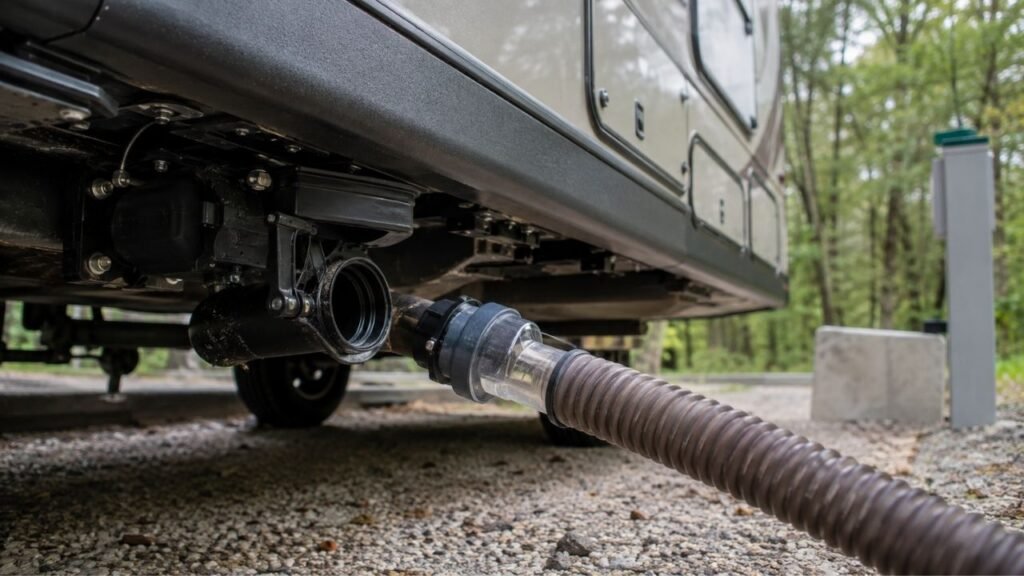
If your RV black tank valve opens but nothing drains, the most likely causes are a clogged tank outlet, hardened waste, a poop pyramid, or a gate valve that is not actually opening. A blocked vent, frozen waste, sewer hose problem, or inaccurate tank sensor can also create similar symptoms.
The good news is that you can usually narrow down the problem without taking the plumbing apart. I’ll walk you through the safest checks first, then show you how to clear the blockage without creating an even bigger mess.
Key Takeaways
- A moving dump-valve handle does not guarantee the internal gate opened.
- Solid waste can form a plug directly over the tank outlet.
- Leaving the black valve open can create a poop pyramid.
- Too little flushing water allows waste and paper to harden.
- Check your sewer hose before assuming the tank itself is clogged.
- A blocked vent usually causes slow or interrupted drainage.
- Backflushing can help clear a blockage near the tank outlet.
- Never force a stuck valve when the black tank may be full.
- Tank sensors can read full even when the tank is empty.
- Proper water use prevents many black tank drainage problems.
Why Does My RV Black Tank Valve Open but Nothing Drains?
When you pull the black tank handle and nothing comes out, there are two main possibilities.
The first is that the gate valve really opened, but something inside the tank is blocking the outlet. Hardened toilet paper, solid waste, or compacted material can completely cover the discharge opening.
The second possibility is that the handle moved, but the internal gate never fully opened. This is especially possible with remote or cable-operated dump valves.
You could also be dealing with an empty tank showing a false full reading, a frozen outlet, or an obstruction farther down the sewer hose.
That is why I recommend diagnosing the problem before immediately adding chemicals or forcing water backward into the tank.
Check These Things Before Assuming Your Black Tank Is Clogged
Before working on the black tank itself, spend a few minutes checking the dumping setup. Simple external problems can look surprisingly similar to a serious tank clog.
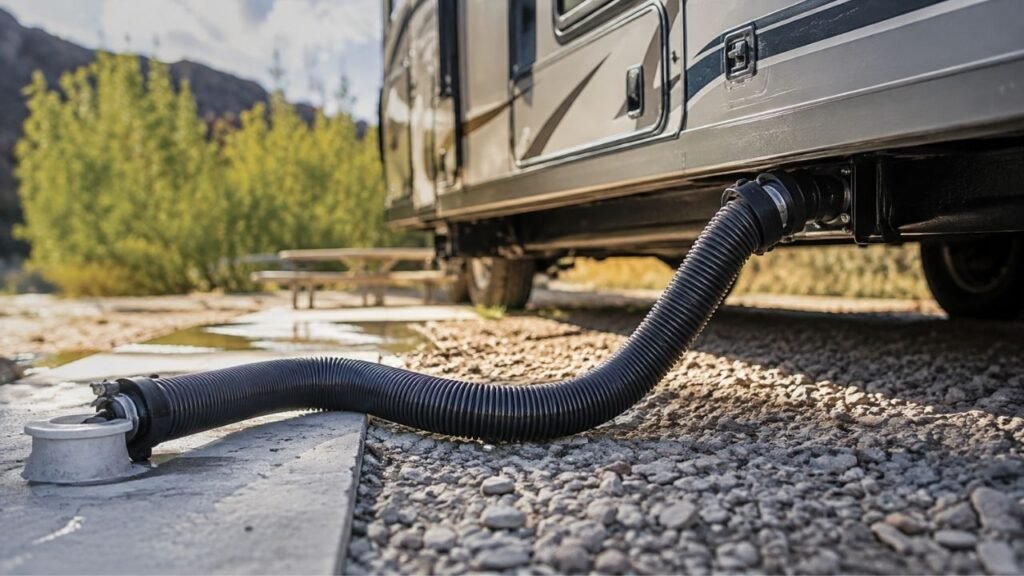
- Make sure your sewer hose is firmly connected at both ends.
- Check the hose for sharp bends, kinks, or crushed sections.
- Keep the hose running downhill toward the sewer connection.
- Confirm that you pulled the black valve instead of the gray valve.
- Dump some gray water to confirm the sewer hose flows properly.
- Look for a clogged or restricted clear sewer elbow.
- Consider whether the black tank actually contains much waste.
- Check whether temperatures recently dropped below freezing.
- Notice whether the valve handle feels normal, loose, or unusually stiff.
- Listen for gurgling sounds from the toilet while attempting to dump.
If the gray tank drains normally through the same sewer hose, you have already eliminated several external problems.
Your attention can then shift toward the black tank outlet and valve.
Quick Diagnosis: Match the Symptom to the Likely Problem
The exact symptoms can tell you quite a bit. Use this table before choosing a repair method.
| What You Notice | Most Likely Cause | Best First Step |
| Handle pulls normally but nothing drains | Outlet clog or valve gate problem | Verify tank contents and valve operation |
| Handle suddenly feels very loose | Disconnected or stretched valve cable | Inspect the valve mechanism |
| Handle is extremely difficult to pull | Sticky gate, debris, or freezing | Stop forcing the handle |
| A small trickle starts and then stops | Outlet blockage or hardened waste | Add water and allow soaking |
| Toilet works normally but tank will not dump | Outlet clog or valve issue | Focus on the discharge area |
| Toilet also drains poorly | Drop tube clog or poop pyramid | Inspect from the toilet side |
| Toilet gurgles while trying to dump | Possible vent restriction | Check the black tank roof vent |
| Gray tank dumps normally | Black-specific clog or valve problem | Inspect black valve and outlet |
| Monitor says full but nothing comes out | Possible false sensor reading | Confirm actual tank contents |
| Problem started after freezing weather | Frozen waste, outlet, or valve | Thaw the system gradually |
Do not rely on only one symptom. Combine what the handle feels like with what the toilet, sewer hose, and tank monitor are doing.
How Can You Tell Whether the Valve Is Actually Opening?
The dump handle and the internal gate are not always the same physical piece. A handle can move normally while the valve underneath barely moves.
Here are a few ways to narrow it down.
Pay Attention to Handle Resistance
Think about how your black valve normally feels.
A healthy manual gate valve generally gives you noticeable resistance as the blade slides through its seals.
If the handle suddenly pulls almost effortlessly, something may have disconnected.
Cable-operated systems can develop stretched, loose, or damaged cables. The exterior handle may travel while the actual gate moves very little.
On the other hand, extreme resistance can indicate debris, dried seals, freezing, or a damaged valve.
Do not repeatedly yank a stubborn handle.
That can turn a manageable drainage problem into a broken valve assembly.
Check Cable-Operated Dump Valves
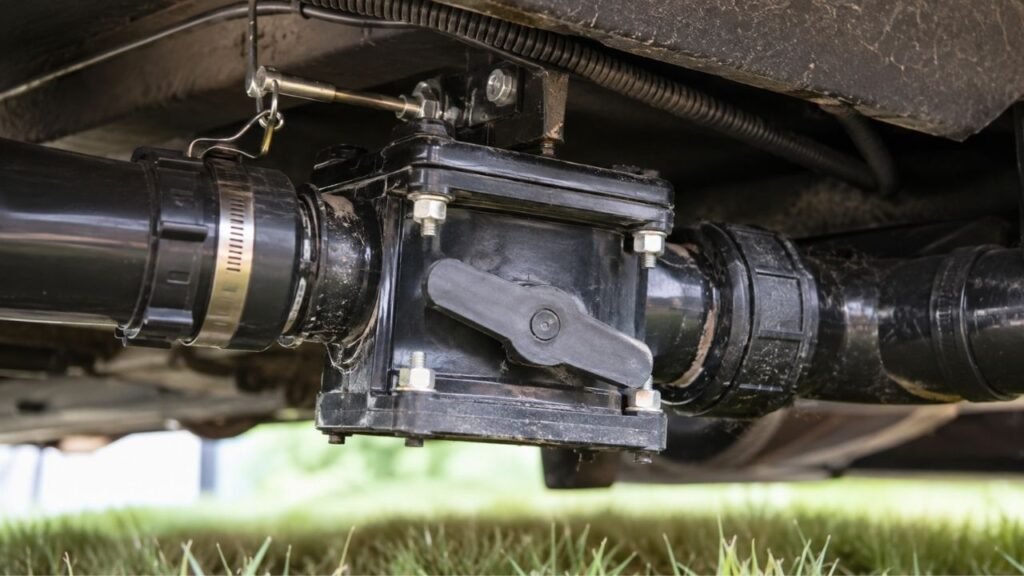
Some RVs place their waste valves farther underneath the rig. A flexible cable connects the accessible handle to the actual gate valve.
These systems are convenient, but they introduce another failure point.
A cable can:
- Stretch
- Bind inside its housing
- Come loose
- Bend
- Lose adjustment
- Fail to move the valve through its complete travel
If your handle movement suddenly feels different than before, inspect the cable mechanism when safely accessible.
Watch Through a Clear Sewer Elbow
A clear sewer elbow is extremely useful during diagnosis.
You can see whether nothing is coming out, whether liquid is slowly trickling, or whether flow starts and suddenly stops.
A trickle often suggests some portion of the outlet remains open.
Absolutely no flow could indicate either a completely blocked outlet or a valve gate that remains closed.
Compare Black and Gray Tank Flow
Try draining some gray water through the same sewer hose.
If gray water flows strongly, your hose and campground sewer connection are probably working normally.
That makes a black-tank-specific problem much more likely.
However, do not assume this proves the black valve itself works.
It only helps eliminate problems downstream from the RV outlet.
The Most Common Reasons the Valve Opens but Nothing Comes Out
Several problems can produce nearly identical symptoms. Identifying the correct one helps you avoid unnecessary chemicals, excessive pressure, and messy disassembly.
A Solid Waste or Toilet Paper Plug Is Blocking the Tank Outlet
This is one of the first problems I would suspect.
The black tank outlet is relatively narrow compared with the tank itself. Waste only needs to collect around that opening to stop drainage.
You do not necessarily need a tank completely packed with solids.
A concentrated pile of toilet paper and waste near the outlet can block gallons of liquid behind it.
This often develops after:
- Using too little water when flushing
- Allowing waste to sit for extended periods
- Repeatedly dumping a nearly empty tank
- Storing the RV without thoroughly rinsing the tank
- Using excessive toilet paper
- Allowing solids to dry inside the tank
Sometimes you will get a brief trickle before drainage stops.
That happens when a small amount of liquid works around the blockage.
If your tank definitely contains liquid but little reaches the sewer hose, an outlet blockage should be high on your list.
The Black Tank Was Used With Too Little Water
Water is one of the most important parts of an RV black tank system.
Your tank needs enough liquid to suspend waste and help carry it toward the outlet.
Without enough water, waste becomes thick and heavy.
Toilet paper also has less opportunity to soften and separate.
Eventually, the material can settle onto the tank floor and begin drying.
You may not have one obvious clog.
Instead, the entire mixture becomes too dense to move effectively.
This commonly happens when RV owners try to conserve water aggressively while dry camping.
Saving freshwater makes sense, but cutting toilet-flush water too far can create another problem.
Use enough water to keep the tank contents mobile.
A Poop Pyramid Has Formed Inside the Tank
A poop pyramid is exactly what the name suggests.
Solid waste builds upward in one concentrated area rather than mixing with liquid throughout the tank.
One of the most common ways this happens is leaving the black valve open while connected to a full-hookup campsite.
Liquid flows away continuously.
Solid waste stays behind.
Over time, that waste can dry and accumulate into a dense pile.
Eventually, the pyramid can interfere with the toilet drop tube, tank outlet, or both.
Signs can include:
- Poor toilet drainage
- Waste visible below the toilet opening
- A tank that accepts very little additional waste
- Slow dumping
- No dumping
- Persistent odors
- Repeated clogging
Keeping your black valve closed between dumps helps prevent this problem.
You want enough liquid stored in the tank to carry solids out when the valve finally opens.
The Valve Handle Moves but the Gate Stays Closed
This is an important possibility because it perfectly matches the symptom.
You pull the handle.
The handle moves.
Naturally, you assume the valve opened.
But the gate inside may still be covering the outlet.
Direct-pull valves are simpler, but remote cable-operated systems can hide mechanical problems.
Potential causes include:
- A disconnected cable
- A stretched cable
- A loose cable connection
- A bent operating rod
- Debris around the gate
- Damaged seals
- A broken internal valve component
If treatments, soaking, and flushing accomplish absolutely nothing, consider whether the blockage is mechanical rather than biological.
No amount of enzyme treatment can reconnect a broken valve cable.
Hardened Waste Has Compacted Across the Tank Floor
There is an important difference between a clog and tank compaction.
A clog is usually a concentrated blockage affecting one location.
Tank compaction is broader accumulation across the tank floor and surrounding surfaces.
A compacted tank may actually drain sometimes.
However, it might never empty completely.
You could notice:
- Reduced tank capacity
- Persistent smells after dumping
- Constantly inaccurate sensor readings
- Slow drainage
- Frequent outlet clogs
- Waste remaining after repeated flushing
This often develops over a longer period.
Simply restoring flow does not necessarily mean all that hardened material disappeared.
A heavily compacted tank may need extended soaking and repeated cleaning cycles.
Severe cases may require professional tank cleaning.
The Black Tank Roof Vent Is Restricted
Your black tank needs ventilation as liquid leaves.
The roof vent allows air movement while the tank fills and empties.
Leaves, insect nests, debris, or damaged vent components can restrict airflow.
A vent problem usually causes symptoms such as:
- Glugging
- Gurgling
- Interrupted drainage
- Slow flow
- Strong odors
- Toilet burping
I would not make the vent my first suspect when absolutely nothing drains.
A solid outlet blockage or valve problem is generally more convincing.
However, the vent deserves inspection when drainage is inconsistent and gurgling accompanies the problem.
The Tank, Outlet, or Valve Is Frozen
Cold-weather RVing adds another possibility.
Water and waste inside the tank can freeze.
The exposed dump plumbing or gate valve can also freeze separately.
Your valve handle might still move while ice blocks the discharge path farther inside.
If your drainage problem appeared after extended freezing temperatures, consider freezing before aggressively treating the system as a normal clog.
Thaw frozen components gradually.
Avoid open flames and concentrated extreme heat around plastic holding tanks or plumbing.
Once thawed, inspect everything carefully for freeze damage before dumping.
Your Sewer Hose or Dump Connection Is Blocking Flow
Sometimes the black tank is completely innocent.
A sharply kinked sewer hose can reduce flow.
A sagging hose can also hold waste and create an obstruction.
Check:
- The entire sewer hose
- Hose supports
- Clear elbows
- Bayonet fittings
- Sewer adapters
- Campground sewer inlet
Gray-water testing is useful here.
If the gray tank dumps normally through the same setup, the downstream path is probably clear.
The Tank Is Empty but the Sensor Still Says Full
This one surprises many RV owners.
Traditional holding-tank sensors can become coated with waste, paper residue, grease, or mineral deposits.
That material can make the control panel report an inaccurate level.
You might think:
“My tank says full. I opened the valve. Nothing came out. Therefore, the tank must be clogged.”
But the tank may already be nearly empty.
Look for supporting clues.
If you recently dumped successfully, your toilet works normally, there is no unusual pressure, and nothing reaches a clear sewer elbow, the level monitor deserves suspicion.
Clean the tank and sensor area before assuming the worst.
What Should You Do if This Happens at a Dump Station?
A blocked black tank can become stressful quickly, especially when other RVers are waiting. Work methodically instead of repeatedly pulling the valve.
- Stop forcing the valve. If the handle feels abnormal, repeated pulling can damage the mechanism.
- Keep the sewer hose connected securely. Assume waste could suddenly begin flowing.
- Check the complete sewer hose path. Straighten kinks and confirm a downhill slope.
- Confirm the campground sewer inlet is working. A backed-up dump connection can create misleading symptoms.
- Try a small amount of gray water. Normal gray flow helps confirm the hose is clear.
- Think about the actual black tank level. Do not blindly trust the monitor panel.
- Pay attention to valve resistance. A strangely loose handle may indicate mechanical failure.
- Add water only if the tank has safe capacity. Never keep filling a tank that may already be full.
- Allow dry waste time to soak. Hydration works better when given enough time.
- Use a controlled flushing method if appropriate. A built-in rinse or proper reverse-flush attachment can help.
- Stop if the valve appears broken. A mobile RV technician is safer than opening waste plumbing with a full tank behind it.
You do not need to solve every stubborn clog immediately at the dump station.
Your priority is keeping the system contained and avoiding a sewage spill.
How to Clear an RV Black Tank That Will Not Drain
The best unclogging method depends on where the restriction is located. Start gently and move toward more aggressive methods only when necessary.
Add Water and Let Hardened Waste Soak
Hydration is usually the safest first step.
If you know the tank has enough available capacity, add several gallons of water through the toilet.
Warm water can help soften dried waste.
I would avoid boiling water because excessive heat can damage RV plumbing components.
Let the water sit.
A light blockage may soften within an hour.
A badly dried tank can require a much longer soaking period.
You may also use an RV-compatible holding tank treatment according to its instructions.
Do not expect treatment products to instantly dissolve a dense physical obstruction.
Water and time do much of the useful work.
Use the Built-In Black Tank Flush if Your RV Has One
Many newer RVs have a dedicated black-tank flushing connection.
This system sprays fresh water inside the tank.
Make sure your sewer hose is attached properly before using it.
Open the black tank valve according to your RV manufacturer’s flushing procedure.
Then run the flush system while monitoring everything continuously.
Never turn on the black tank rinse and walk away.
An unattended rinse can overfill the tank if drainage remains blocked.
If your tank will not drain at all, be especially cautious.
You do not want to keep adding water to an already full tank.
Use a Dedicated Reverse-Flush Adapter for an Outlet Clog
Reverse flushing can be very effective when the blockage sits close to the dump outlet.
A purpose-built backflush adapter directs water backward toward the tank.
That reverse flow can disturb solids packed around the outlet.
The important part is control.
Use equipment designed for RV waste systems.
Keep all hose connections secure.
Never use excessive pressure.
Watch the tank level carefully.
Once the restriction releases, allow the tank to drain before adding more water.
Several short flushing cycles are generally safer than filling the tank aggressively.
Use a Tank Wand From the Toilet Side When Appropriate
A tank wand sends water downward through the toilet opening.
This can help when the blockage is beneath the toilet or around the drop tube.
It can also loosen waste resting on the tank floor.
Insert the wand carefully.
Avoid blindly forcing rigid tools through plumbing bends or against tank surfaces.
A wand is more useful for accessible buildup than a mechanical valve failure.
If your valve remains closed internally, rinsing from above will not repair it.
Clear the Roof Vent if the Symptoms Point to Venting
Inspect the tank vent when you also notice gurgling, burping, slow drainage, or persistent odor.
The vent typically exits through the RV roof.
Inspect the cap and visible opening for debris.
Only access the roof if your RV’s roof is designed for safe access.
If you are unsure, have an RV technician inspect it instead.
You do not need to climb onto an unsafe roof just to confirm a clogged vent.
Thaw a Frozen Tank or Valve Before Trying to Dump
Frozen holding-tank plumbing should be warmed gradually.
Use the RV’s enclosed underbelly heating system if equipped.
You can also carefully warm exposed areas with appropriate indirect heat.
Avoid open flames.
Also avoid concentrating very high heat onto one plastic fitting.
Once the system has thawed, check for leaks before opening the valve fully.
Ice expansion can sometimes crack valves or connections.
Repair or Replace a Valve That Is Not Actually Opening
When the internal gate will not move, you have a mechanical problem.
A treatment product cannot solve it.
The repair may involve:
- Cable adjustment
- Cable replacement
- Valve lubrication
- Gate valve replacement
- Seal replacement
- Accessing the enclosed underbelly
Working on a valve attached to a full black tank is particularly risky.
If the tank cannot be emptied before valve service, I recommend getting professional help.
Outlet Clog vs. Poop Pyramid vs. Compacted Tank
These problems are often grouped together, but they are not identical. Knowing the difference helps you choose the correct approach.
| Problem | Where It Usually Forms | Typical Clue | First Approach |
| Outlet clog | Near the tank discharge opening | Tank will not dump or only trickles | Soak and controlled backflush |
| Poop pyramid | Commonly below the toilet | History of leaving valve open | Rehydrate and break down buildup |
| Drop-tube clog | Between toilet and tank | Toilet itself drains poorly | Work carefully from toilet side |
| Compacted tank | Across tank floor and surfaces | Reduced capacity and recurring problems | Extended soaking and deep cleaning |
| Failed gate valve | At the waste valve | Handle moves but flow never starts | Inspect or repair valve mechanism |
You can also have more than one problem at once.
For example, long-term tank compaction can eventually contribute to a localized outlet clog.
Will a Tank Treatment Fix a Black Tank That Will Not Drain?
A black tank treatment may help soften organic waste and toilet paper, especially when combined with plenty of water and enough soaking time.
However, tank treatment is not a universal repair.
It cannot reconnect a broken valve cable.
It cannot repair a damaged gate valve.
It will not remove a foreign object.
It cannot fix cracked plumbing.
It also may not quickly dissolve years of hardened tank compaction.
Think of tank treatment as one tool in your maintenance routine.
Do not use it as a replacement for diagnosing mechanical problems.
What Not to Do When Nothing Drains
A clogged black tank is unpleasant, but rushing usually makes the situation worse. Avoid these common mistakes.
- Don’t force a dump valve that suddenly feels stuck.
- Don’t disconnect waste fittings while a full tank may be behind them.
- Don’t keep filling a tank when its actual level is unknown.
- Don’t use household drain-opening chemicals.
- Don’t pour boiling water into the waste system.
- Don’t use an open flame to thaw frozen plumbing.
- Don’t insert sharp metal objects into the holding tank.
- Don’t use uncontrolled high-pressure water against the tank.
- Don’t leave a black tank flush running unattended.
- Don’t blindly trust the control-panel tank reading.
- Don’t repeatedly open and close the valve hoping it clears.
- Don’t assume every drainage problem is a poop pyramid.
Household plumbing is very different from RV waste plumbing.
Strong drain cleaners can damage seals and other sanitation-system components.
Stick with RV-compatible cleaning products and controlled mechanical methods.
When Should You Stop Troubleshooting and Call an RV Technician?
Many black tank problems can be handled yourself. However, some situations are better left to someone with proper waste-system equipment.
Consider professional help when:
- The tank is full and absolutely nothing will drain.
- The valve handle appears disconnected.
- The operating cable is visibly damaged.
- You can see a cracked valve or plumbing fitting.
- Sewage is leaking underneath the RV.
- Controlled soaking and flushing produce no improvement.
- The valve requires underbelly removal for access.
- A foreign object may be lodged in the valve.
- The tank or plumbing suffered freeze damage.
- You are uncomfortable working around a potentially full waste tank.
There is no benefit to turning a clog into a broken valve or cracked tank.
Know when the safe DIY options have been exhausted.
How to Prevent Your Black Tank From Refusing to Drain Again
Most black tank clogs develop gradually rather than randomly. A few consistent habits can greatly reduce your chances of facing another no-flow situation.
Keep the Black Tank Valve Closed Between Dumps
Leave the black valve closed while camping, including at full-hookup sites.
You want liquids and solids to remain together inside the tank.
When the tank becomes reasonably full, opening the valve releases a larger volume of liquid that helps carry waste through the outlet.
Leaving the valve permanently open does the opposite.
Liquid escapes while solids remain behind.
That is one of the easiest ways to create a poop pyramid.
Use Plenty of Water When Flushing
Do not be overly stingy with toilet water.
Your black tank needs sufficient liquid to keep waste mobile.
Use enough water to move toilet paper and solids through the drop tube.
Adding extra water after heavier toilet use can also help.
Water is inexpensive compared with removing a hardened blockage later.
Don’t Dump a Nearly Empty Black Tank Repeatedly
Dumping too early can leave solids behind.
Whenever practical, allow the tank to accumulate enough liquid before dumping.
You want a strong gravity-assisted rush through the outlet.
If you must dump early before traveling, adding extra water first can improve evacuation.
Again, only add water when you know the tank has adequate capacity.
Add Water Back After Dumping
After a successful dump and rinse, add some fresh water back into the black tank.
Starting with a completely dry tank encourages incoming waste to stick.
A shallow layer of water helps keep the bottom wet.
It also gives the next toilet flush somewhere to disperse.
Flush or Rinse the Tank Regularly
A normal dump does not necessarily remove everything.
Use your built-in tank rinse when available.
A toilet wand can also help with tanks lacking an integrated rinse.
Periodic flushing removes material before it becomes hardened buildup.
You do not need perfectly clear water after every single dump.
The goal is preventing chronic accumulation.
Avoid Flushing Wipes and Other Non-Waste Items
RV black tanks work best with human waste, water, and suitable toilet paper.
Do not flush:
- Baby wipes
- Cleaning wipes
- Paper towels
- Feminine hygiene products
- Facial tissues in large quantities
- Food
- Grease
- Other household trash
Even products marketed as “flushable” may break apart much slower than RV toilet paper.
Your RV holding tank is not a residential sewer system.
Maintain the Dump Valve
Pay attention when a valve becomes increasingly difficult to operate.
Do not wait until it completely seizes.
Keep the valve mechanism clean and use an RV-compatible valve lubricant when appropriate.
Inspect cables, handles, and exposed valve components periodically.
Early maintenance is much easier than servicing a stuck valve behind a full tank.
Winterize the Waste System Before Freezing Weather
If your RV will sit in freezing temperatures, protect the waste system.
Drain holding tanks completely before storage.
Follow your RV manufacturer’s winterization procedure.
Pay particular attention to exposed valves and plumbing.
Even a small amount of trapped liquid can freeze and interfere with valve operation.
Final Words
When your RV black tank valve opens but nothing drains, don’t immediately assume you need an aggressive unclogging method.
First verify that the tank actually contains waste and that the sewer hose is clear. Then consider whether the internal gate valve truly opened.
If the valve is working, a blockage near the outlet or hardened waste becomes much more likely.
Start with water, soaking, and controlled flushing methods.
Avoid force, excessive pressure, harsh household chemicals, and uncontrolled disassembly.
Most importantly, prevent the problem from returning by keeping the black valve closed between dumps and using enough water every time you flush.
Related FAQs
Why Does My RV Black Tank Valve Pull Out but Nothing Comes Out?
The most likely causes are an outlet clog or a dump valve whose internal gate did not actually open. Check whether the tank truly contains waste, confirm the sewer hose flows properly, and pay attention to how the valve handle feels before attempting an unclogging method.
Can the Black Tank Valve Handle Move Without Opening the Gate?
Yes. This can happen when a cable-operated valve becomes stretched, disconnected, bent, or improperly adjusted. The exterior handle may move while the internal gate remains partly or completely closed.
How Do I Know if My RV Black Tank Valve Is Actually Open?
Check for normal resistance as you pull the handle and observe the sewer outlet through a clear elbow. If the tank definitely contains liquid but absolutely nothing appears, the gate may still be closed or the outlet may be completely blocked.
How Do I Know if My Black Tank Outlet Is Clogged?
An outlet clog is likely when the tank contains waste, the toilet still accepts water normally, the valve appears to open, and little or nothing reaches the sewer hose. A brief trickle that suddenly stops can also indicate waste packed around the outlet.
Can a Poop Pyramid Stop My Black Tank From Draining?
Yes. A large poop pyramid can interfere with both the toilet drop tube and tank outlet. It commonly develops when the black valve stays open at full hookups or when the tank repeatedly operates with too little water.
Can a Clogged RV Black Tank Vent Stop the Tank From Draining?
A severely restricted vent can interfere with drainage, although it more commonly causes slow, glugging, or interrupted flow. Gurgling from the toilet, strong odors, and inconsistent drainage make a vent problem more likely.
Can I Backflush an RV Black Tank That Won’t Drain?
Yes, a controlled backflush can help clear waste packed around the tank outlet. Use a purpose-built RV reverse-flush adapter, keep connections secure, monitor the tank continuously, and avoid adding water when the tank may already be full.
Can I Put Water Into a Black Tank That Is Clogged?
You can add water when you know there is enough empty capacity in the tank. Water can soften dry waste and toilet paper, but you should never keep adding water when the tank may already be full because it could cause a backup.
Why Does My Gray Tank Drain but My Black Tank Does Not?
If gray water drains normally through the same sewer hose, the problem is probably specific to the black tank. Common causes include an outlet clog, poop pyramid, frozen waste, or a black gate valve that is not opening fully.
Can an RV Black Tank Be Empty Even if the Gauge Says Full?
Yes. Waste and residue can coat traditional tank sensors and make the monitor show full after the tank has already emptied. Verify the actual tank contents instead of relying entirely on the control-panel reading.
Can a Frozen Black Tank Valve Open but Still Not Drain?
Yes. The gate may move while frozen waste or ice remains inside the tank outlet or discharge pipe. If the problem began during freezing weather, thaw the waste system gradually before attempting more aggressive unclogging methods.
Should I Use Drano in a Clogged RV Black Tank?
No. Household drain-opening chemicals can be too harsh for RV toilet seals, valves, and sanitation-system components. Use plenty of water, RV-compatible treatments, tank rinsing equipment, or controlled mechanical methods instead.

Steven Parker writes about everyday RV life, from setup tips to long-term living decisions. His content reflects a calm, experienced approach to RV ownership and travel. He focuses on comfort, reliability, and realistic expectations.