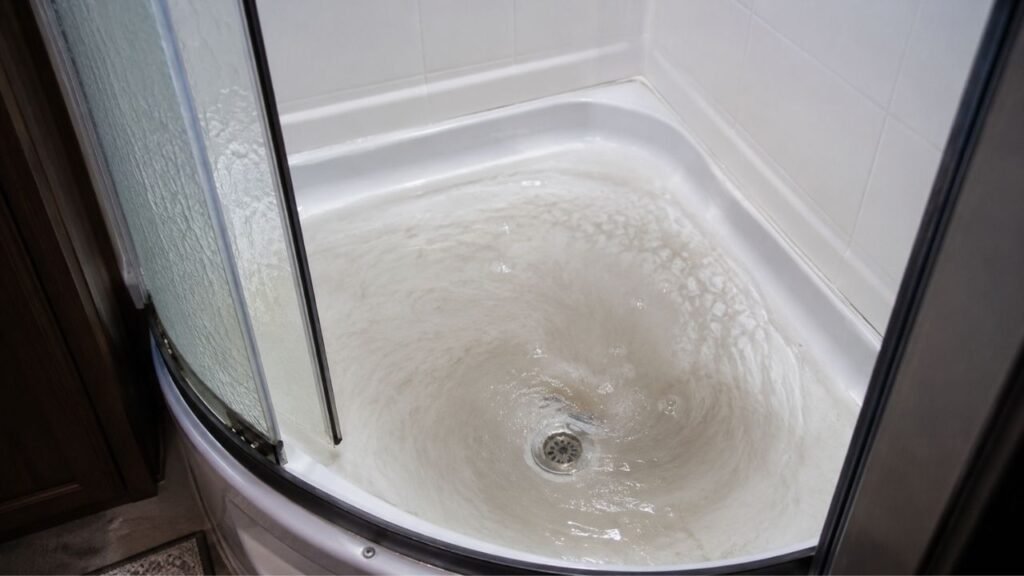
Gray water usually backs up into an RV shower because the gray tank is full or wastewater cannot reach or leave the tank properly. Since the shower drain is often the lowest drain opening in an RV, rising wastewater commonly appears there first.
If emptying the gray tank fixes the backup, tank capacity was likely the problem. If it does not, I’ll help you check the drain line, venting, sensors, valves, and other possible causes.
Key Takeaways
- A full gray tank is the most common cause of shower backup.
- The shower often backs up first because its drain sits low.
- Gray tank monitor readings can be inaccurate.
- Sink water entering the shower suggests a downstream restriction or full tank.
- A shower-only problem usually points toward its drain or trap.
- Gurgling may indicate a nearly full tank or venting problem.
- Continued backup after dumping requires further troubleshooting.
- Some RVs have two separate gray-water tanks.
- Identify waterless drain valves before using a drain snake.
- Repeated backups may require an RV technician.
Why Does Gray Water Come Up Through the RV Shower Drain?
Your RV’s shower may be working perfectly even when gray water appears inside it. In many cases, the shower is simply showing you that the gray-water system has reached its limit.
Water from your shower, bathroom sink, and sometimes kitchen sink flows toward a gray holding tank. Exact plumbing arrangements vary between RV floorplans.
As that tank fills, the wastewater level rises. Eventually, there may be nowhere for newly added water to go.
The water then begins moving backward through connected plumbing.
Your sinks normally sit considerably higher than the shower floor. That makes the shower drain one of the easiest places for backed-up water to appear.
Imagine filling a container connected to several tubes. Once the container reaches capacity, water begins rising inside those tubes.
Your RV’s plumbing can behave similarly.
That is why you may notice dirty or soapy water around the shower drain even though nobody recently used the shower.
What Is Causing Gray Water to Back Up Into My RV Shower?
Several problems can create similar symptoms. However, the way the backup behaves can usually help you narrow down the cause quickly.
The Gray Water Tank Is Full
Start here before taking anything apart.
A completely full gray tank cannot accept additional wastewater. When someone runs a faucet or shower, that water must go somewhere.
Because the shower drain usually sits low, wastewater can rise through it.
You might first notice the problem near the end of a shower. The water suddenly stops draining and begins collecting around your feet.
Another common clue appears when washing dishes. You run the kitchen or bathroom sink, then hear bubbling from the shower.
Soon afterward, water may appear in the shower pan.
If you dump the correct gray tank and the shower immediately drains, you have probably found the cause.
The tank simply became too full.
The Gray Tank Sensor Is Giving You a False Reading
Don’t assume your monitor panel always knows how much water remains inside the tank.
Gray tank sensors commonly become coated with soap residue, grease, body oils, minerals, and other deposits.
That buildup can produce misleading readings.
Your panel might show one-third or two-thirds full while the tank is actually close to capacity.
It can also show full long after dumping.
For this reason, I would trust the plumbing symptoms along with the monitor reading.
If water backs into the shower and dumping produces a large volume of wastewater, the tank was probably fuller than the monitor suggested.
The Shower Drain or Drain Line Is Clogged
Suppose the gray tank is definitely empty, but your shower still drains slowly.
Now I would look closer to the shower itself.
Hair is an obvious problem. Soap residue, conditioner, dirt, body oils, and other debris can also collect inside the drain.
The restriction may gradually reduce water flow.
A localized shower clog often behaves differently from a full tank.
Your sinks may drain normally while only the shower stays slow.
That difference is an important diagnostic clue.
The Shared Gray-Water Drain Line Is Restricted
Sometimes the blockage sits farther downstream.
Several fixtures may connect into a shared pipe before wastewater reaches the gray tank.
If that shared section becomes restricted, water from one fixture can affect another.
For example, you may run the bathroom sink and see water rising around the shower drain.
That strongly suggests the issue is not limited to hair sitting directly beneath the shower strainer.
The restriction may be farther along the shared drainage system.
The Gray Tank Vent Is Blocked or Restricted
Wastewater entering a holding tank must displace air.
The vent system gives that air somewhere to move.
If the vent is seriously restricted, drainage may become slower or noisier. You could hear gurgling or bubbling as water moves through the pipes.
Possible vent problems include leaves, insects, nesting material, damaged components, or installation issues.
However, I would not jump immediately to the roof vent.
A full tank and clogged drain are generally easier and more likely explanations.
Check those first.
If the tank has room, the drains are clear, and several fixtures still gurgle or drain poorly, venting deserves more attention.
An Air Admittance Valve Is Not Working Correctly
Some RV plumbing systems use air admittance valves beneath sinks.
These small components allow air into certain drain sections without allowing odors to escape normally.
When one fails or sticks, you may notice unusual drainage behavior.
Possible symptoms include slow draining, gurgling, or unpleasant odors around a sink.
An air admittance valve is not the same thing as the main tank roof vent.
Your RV may use both.
If the backup seems connected to one sink branch, checking an accessible air admittance valve can make sense.
Your Shower Uses a Waterless Trap or Dry-Seal Valve
Not every RV shower has a traditional household-style P-trap.
Space is tight underneath many RV shower pans. Manufacturers sometimes use compact waterless drain valves instead.
One common design uses an internal flexible membrane that opens when water passes through and closes afterward.
Hair and debris can interfere with these systems.
This matters because you should not automatically force a plumbing snake through every RV shower drain.
A mechanical tool can damage some waterless valve designs.
Before inserting anything deep into the drain, identify what type of trap or valve your RV uses.
Check your owner’s manual or inspect accessible plumbing underneath the shower if possible.
The Gray Tank Did Not Actually Empty
Pulling the gray valve does not always mean the tank emptied successfully.
Pay attention to the wastewater flow when dumping.
A reasonably full tank should normally produce a noticeable initial flow.
If you open the valve and only get a weak trickle, something else may be happening.
Possible causes include:
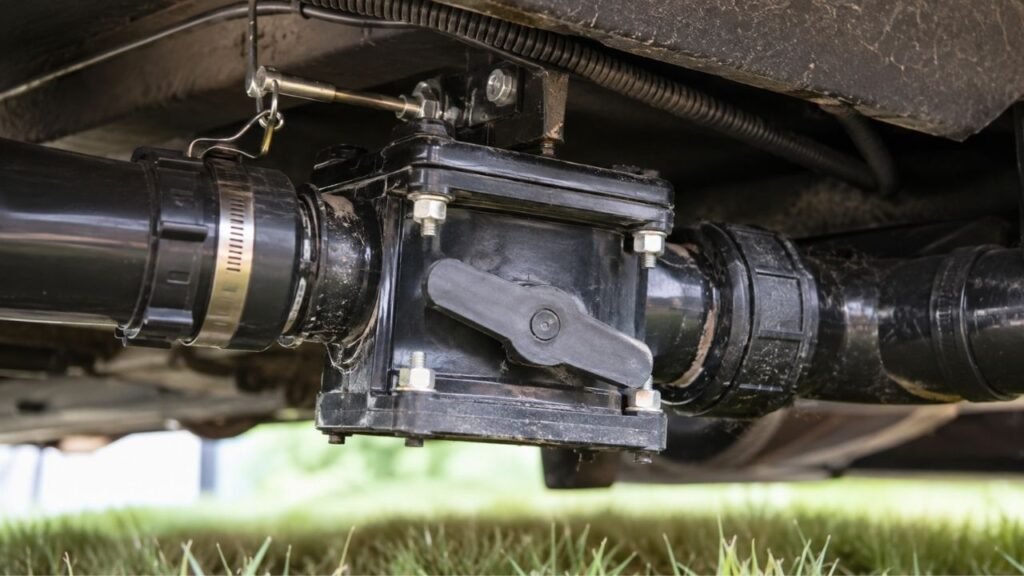
- A dump valve that does not open fully
- A problem with a cable-operated valve
- Debris near the tank outlet
- Heavy buildup inside the tank
- Frozen wastewater or plumbing
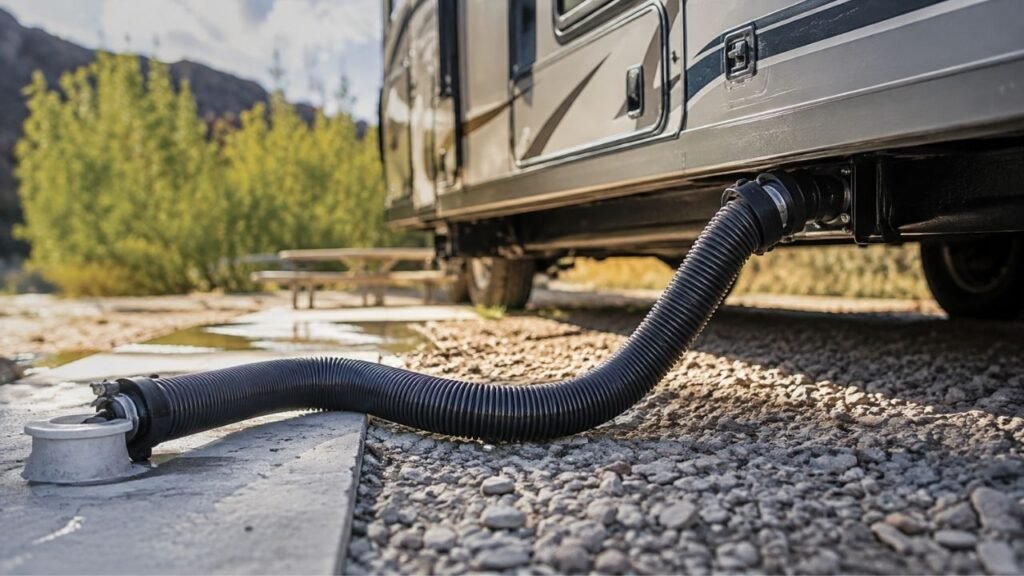
- A poorly positioned sewer hose
The tank can therefore remain partly full even though you believe you dumped it.
You Dumped the Wrong Gray Tank
This one catches RV owners surprisingly often.
Larger travel trailers, fifth wheels, and motorhomes may have more than one gray tank.
For example, you could have one tank serving the bathroom and another serving the kitchen.
The second tank is often called a galley tank.
You might dump one gray valve and assume everything is empty. Meanwhile, the tank connected to your shower remains full.
If your RV has multiple waste valves, learn which fixtures feed each tank.
Your owner’s manual or plumbing diagram can help.
Gray Water Is Sloshing Back During Travel
If the problem mainly appears while towing or driving, tank movement deserves consideration.
A partially filled holding tank contains a large moving body of water.
Acceleration, braking, hills, and sharp turns can make that water surge inside the tank.
Under certain plumbing layouts, water may temporarily move toward connected drain lines.
This is much less common than simply overfilling the tank.
Still, reducing gray-water levels before travel can help when this problem repeatedly occurs.
Always dump only at an approved location.
How Can I Tell What Is Causing the Shower Backup?
You don’t need to disassemble the entire plumbing system immediately. Match the symptoms with the most likely problem first.
| What You Notice | Most Likely Cause | What to Check First |
| Shower backs up after heavy water use | Full gray tank | Dump the correct gray tank |
| Monitor says tank has space, but dumping fixes it | Inaccurate tank sensor | Judge capacity by actual dump volume |
| Only the shower drains slowly | Local shower restriction | Check hair, drain, trap, or dry-seal valve |
| Running a sink sends water into the shower | Full tank or shared-line restriction | Dump the tank, then test again |
| Several fixtures drain slowly | Tank, main drain, or vent issue | Check tank level first |
| Shower bubbles or gurgles | Nearly full tank or airflow issue | Dump tank and observe drainage |
| Shower remains blocked after dumping | Drain, shared line, or vent problem | Test each fixture separately |
| Gray valve produces almost no wastewater | Valve or tank-outlet issue | Confirm the valve opens completely |
| One gray tank is empty but backup continues | Possible second tank | Identify which tank serves the shower |
| Backup happens mainly while driving | Water sloshing inside tank | Travel with less gray water |
What Should I Do First When Gray Water Backs Up Into the Shower?
Start with simple checks before using chemicals or dismantling plumbing.
- Stop running the shower and faucets.
- Avoid adding more wastewater to the gray system.
- Check your tank monitor for reference.
- Don’t assume the monitor reading is completely accurate.
- Determine which gray tank serves the shower.
- Connect your sewer hose securely at an approved dump point.
- Open the correct gray-water valve.
- Watch how strongly wastewater exits.
- Allow the tank to finish draining.
- Close the valve after dumping.
- Check whether water disappeared from the shower.
- Run a small amount of clean water into the shower.
- Test a nearby sink separately.
- Watch the shower while that sink drains.
This simple sequence tells you quite a lot.
If dumping restores normal drainage, capacity was likely the problem.
If only the shower remains slow afterward, investigate the shower drain.
If several fixtures remain slow, move your attention farther downstream.
What If Dumping the Gray Tank Fixes the Shower Backup?
If the shower begins draining normally immediately after dumping, the tank was probably full or extremely close to full.
You usually don’t need to start pulling plumbing apart.
Instead, determine why the tank reached capacity unexpectedly.
Maybe your monitor panel underestimated the level. Perhaps the tank is smaller than you assumed.
Extra occupants can also fill a gray tank quickly.
Showers use plenty of water. Washing dishes and running bathroom faucets adds even more.
If you have full hookups, develop a dumping routine based on actual water use instead of relying entirely on the monitor.
I still recommend keeping an eye on recurring sensor inaccuracies.
Knowing your approximate real-world tank capacity makes RV camping much easier.
What If the Shower Still Backs Up After I Empty the Gray Tank?
When dumping does not restore normal drainage, you need to separate a localized shower problem from a larger plumbing problem. A few controlled tests can narrow things down.
Confirm the Tank Really Emptied
Think about what happened during dumping.
Did a strong stream of wastewater leave the tank?
Or did you open the valve and get only a small trickle?
A weak discharge from a tank you believed was full can point toward an outlet or valve problem.
Don’t automatically assume the monitor was wrong.
The tank may still contain wastewater.
Test the Shower by Itself
With the tank emptied, add a small amount of clean water to the shower.
Watch how quickly it disappears.
If the water immediately pools while every sink works normally, the problem is probably close to the shower.
Inspect the drain opening for hair and debris first.
From there, consider the trap, dry-seal valve, or short drain section.
Run the Bathroom Sink and Watch the Shower
Next, run a nearby sink briefly.
Watch the shower drain while the sink empties.
If water rises through the shower, both fixtures may be affected by a shared downstream restriction.
That moves your troubleshooting farther away from the shower drain itself.
Listen for Gurgling
Drain sounds provide useful clues.
A brief occasional gurgle is not automatically a serious problem.
Repeated bubbling from several fixtures deserves more attention.
First confirm that the tank is not simply approaching full capacity.
If you know the tank is empty and several drains still gurgle, inspect the venting system.
Check the Gray-Water Vent System
You may be able to visually inspect the roof vent cap for obvious debris.
Do not climb onto an RV roof unless the manufacturer permits it and you can work safely.
Roof materials can be slippery and easily damaged.
If reaching the vent requires risky roof access, let an RV technician inspect it.
You may also need professional help when a vent pipe has shifted or the blockage sits deeper inside the system.
How Do I Clear a Clogged RV Shower Drain Safely?
Start gently. RV drain systems can use lightweight plumbing and compact components that differ from what you have at home.
Start With the Drain Screen
Remove the shower drain cover if your design allows it.
Pull out visible hair and debris.
You may be surprised how much material collects directly underneath the screen.
Cleaning this area alone can restore normal drainage.
Use a Flexible Hair-Removal Tool Carefully
A small flexible hair-removal tool can help with debris located just below a conventional drain.
Don’t force it deep into the plumbing.
First determine whether your shower has a regular P-trap or a waterless drain valve.
That distinction matters.
Clean an Accessible P-Trap
Some RV showers use conventional traps.
If yours does and you can access it safely, inspection may reveal hair, soap residue, or other buildup.
Place towels and a small container underneath before loosening anything.
Water will probably remain inside the trap.
Reassemble every connection carefully and check for leaks afterward.
Handle a Waterless Valve Differently
A waterless valve contains internal parts designed to seal sewer gases.
Forcing a snake or rigid tool through that valve can cause damage.
If your RV uses one, follow the cleaning method recommended for that specific component.
Sometimes removing the valve before clearing downstream plumbing is the safer approach.
Flush the Line After Removing the Obstruction
Once visible debris is removed, run a small amount of clean water.
Watch the drain carefully.
The water should move freely without backing up or producing excessive bubbling.
Then run another connected fixture.
This helps confirm that you solved the actual restriction rather than creating a temporary opening.
Should I Use Drano or Household Drain Cleaner in an RV Shower?
I would not pour household drain cleaner into an RV shower without first checking the instructions for your specific plumbing system.
RV plumbing can contain lightweight plastic pipes, rubber seals, holding-tank components, and waterless valves.
A chemical considered suitable for one plumbing system may not be approved for another.
Some cleaners can also generate heat or react aggressively with accumulated material.
That creates another concern inside compact RV plumbing.
Start with physical removal of visible hair and debris.
If you want to use a cleaning product, choose one specifically compatible with your RV’s plumbing and holding-tank components.
Follow both the RV manufacturer’s and product manufacturer’s directions.
Why Does Sink Water Back Up Into My RV Shower?
Sink water usually backs into the shower because both fixtures eventually connect to the same restricted part of the gray-water system.
That restriction could simply be a full holding tank.
When sink water cannot enter the tank, it moves backward through connected plumbing.
Because the shower sits lower, the wastewater often appears there.
There is a useful test here.
Dump the correct gray tank completely.
Then run the sink again.
If the shower stays dry, your tank was probably full.
If sink water still rises through the shower, investigate the shared drain line and venting system.
Why Does My RV Shower Gurgle Before Gray Water Backs Up?
Gurgling often occurs when water and air are struggling to move normally through the drainage system.
A nearly full gray tank is one possible cause.
As available tank capacity decreases, drainage behavior may change.
Restricted airflow can produce similar noises.
A blockage in the drain line may also create bubbling while water squeezes past the obstruction.
Don’t diagnose a clogged roof vent from gurgling alone.
First dump the tank and retest the plumbing.
If the noise disappears, tank level was probably responsible.
If several fixtures keep gurgling with an empty tank, venting or a shared drain restriction becomes more likely.
Why Does My RV Shower Back Up When the Gray Tank Says Empty?
An “empty” reading does not always mean the entire gray-water system is ready to accept water. Several different problems can create this confusing situation.
The Tank Sensor May Be Wrong
Tank monitors are useful indicators, not perfect measuring instruments.
Residue can interfere with sensor readings.
Your monitor may therefore report a level that does not match reality.
You May Have More Than One Gray Tank
Your display may be showing one tank while your shower drains into another.
This is particularly important on larger RVs.
Look for separate bathroom-gray and galley-gray valves or labels.
The Tank May Not Have Drained Completely
A partially opening valve can make dumping confusing.
You pulled the handle, so naturally you assume the tank emptied.
However, an obstruction or valve problem may leave a significant amount of wastewater behind.
The Problem May Be Before the Tank
The holding tank can be completely empty while the shower remains clogged.
A blocked shower line cannot deliver water to that empty tank.
If only one fixture has trouble, focus on that fixture’s plumbing.
The Tank May Not Be Venting Properly
A severe airflow problem can interfere with normal drainage.
This becomes more likely when multiple fixtures drain poorly despite confirmed available tank capacity.
Persistent gurgling can provide another clue.
Can an RV Gray Tank Be Full Without Me Realizing It?
Yes, and it happens more easily than many new RV owners expect.
Tank capacity numbers can sound generous until you start camping.
Showers consume water quickly. Washing dishes adds more.
Several people using the RV can fill a modest gray tank within a surprisingly short period.
You may also misunderstand which tank serves a particular fixture.
On an RV with separate bathroom and galley tanks, one tank can be full while another remains mostly empty.
Inaccurate monitor readings add another layer of confusion.
After a few trips, you will develop a better sense of how long your particular gray tank lasts.
That real-world experience can be more useful than constantly watching the monitor panel.
How Do I Prevent Gray Water From Backing Up Into My RV Shower?
A few simple habits can prevent most gray-water backups. The goal is to manage tank capacity while keeping debris out of the drain system.
- Learn the capacity of each gray tank.
- Find out which fixtures feed each tank.
- Dump before the tank reaches maximum capacity.
- Don’t depend entirely on monitor-panel readings.
- Use a hair catcher over the shower drain.
- Remove visible hair regularly.
- Keep cooking grease out of RV sink drains.
- Scrape food debris from dishes before washing.
- Investigate slow drains before they become fully blocked.
- Use only RV-compatible cleaning products.
- Pay attention to recurring gurgling.
- Watch dump flow for signs of valve problems.
- Learn whether your shower has a P-trap or waterless valve.
- Reduce gray-water levels before travel when appropriate.
- Follow your RV manufacturer’s maintenance instructions.
When Should I Call an RV Technician?
Many gray-water problems are simple enough to diagnose yourself. However, certain symptoms suggest the problem is deeper inside the RV.
Consider professional service when:
- The shower backs up immediately with a confirmed empty tank.
- Several drains remain slow after dumping.
- Almost nothing exits through an open gray valve.
- The dump-valve handle moves without normal wastewater flow.
- You suspect a broken or disconnected valve cable.
- Wastewater appears inside the RV’s underbelly.
- You suspect a cracked tank or drain fitting.
- The vent pipe may be displaced inside a wall.
- Plumbing repairs require removing sealed panels.
- A waterless valve cannot be accessed safely.
- The problem began on a new RV with possible installation defects.
- Safely checking the roof vent is not practical.
If your RV is still covered by its factory warranty, contact the dealer before modifying hidden plumbing.
Taking apart factory-installed components yourself could complicate a future warranty claim.
Final Words
Gray water appearing inside your shower looks alarming, but the diagnosis often starts with one simple question: Is the gray tank actually full?
If dumping the correct tank makes the shower drain normally, you probably found the issue. Pay closer attention to tank capacity and don’t rely completely on sensor readings.
If dumping changes nothing, start narrowing down the problem.
A shower that alone drains slowly points toward its drain, trap, or waterless valve.
Sink water entering the shower points farther downstream.
Multiple slow drains, repeated gurgling, or poor dump flow can indicate a larger restriction, venting problem, or valve issue.
Work through those clues in order instead of randomly adding chemicals or forcing tools into the plumbing.
That approach is safer for your RV and usually gets you to the real problem much faster.
Related FAQs
Can a Full Gray Tank Back Up Into an RV Shower?
Yes. When the gray tank reaches capacity, incoming wastewater has nowhere to go. Because the shower drain is often one of the lowest openings in the system, gray water may rise into the shower pan first.
Why Does My RV Shower Back Up When I Run the Sink?
The sink and shower may connect to the same gray tank or shared drain line. A full tank or downstream restriction can force sink water backward toward the lower shower drain.
Why Is My RV Shower Not Draining Even Though the Gray Tank Is Empty?
A confirmed empty tank with a slow shower usually points toward a clogged shower drain, restricted trap, waterless valve problem, shared-line blockage, or less commonly a venting issue.
Can a Clogged Gray Tank Vent Cause Shower Backup?
A seriously restricted vent can interfere with normal drainage and contribute to gurgling or slow flow. However, check for a full tank and drain blockage first because those are more common causes.
Why Does My RV Shower Gurgle When the Gray Tank Is Nearly Full?
A nearly full tank leaves less room for wastewater and air movement. As water enters the system, displaced air can create bubbling or gurgling sounds through connected drains.
How Do I Know If My RV Gray Tank Is Actually Full?
Look beyond the monitor panel. Slow drains, shower backup after heavy water use, and a large wastewater discharge when dumping can all indicate that the tank was actually full.
Can an RV Have Two Gray Water Tanks?
Yes. Larger RVs often have separate gray tanks for different areas. One may serve the bathroom while another handles the kitchen or galley, so dumping one tank may not empty the shower’s system.
Why Does My Gray Tank Show Empty When It Is Full?
Residue from soap, grease, minerals, and other wastewater deposits can interfere with tank sensors. The monitor may then display a level that does not accurately represent the tank’s actual contents.
Can I Snake an RV Shower Drain?
Sometimes, but first identify the drain design. A conventional drain may tolerate careful mechanical cleaning, while forcing a snake through certain waterless valves can damage their internal sealing components.
Is It Safe to Use Drain Cleaner in an RV Shower?
Do not assume household drain cleaners are safe for every RV. Check your RV and plumbing-component instructions first, and use only cleaners confirmed compatible with the pipes, seals, valves, and holding tank.
Why Does My RV Shower Drain When the Gray Valve Is Open but Not When It Is Closed?
This usually means the gray tank is filling to capacity or cannot provide enough usable storage. With the valve open, water exits immediately, but closing it allows the underlying tank-level problem to return.
Why Does Gray Water Come Up Through My Shower While Driving?
Water inside a partly filled gray tank can surge as the RV accelerates, brakes, turns, or travels over hills. Depending on the plumbing layout, that movement can temporarily push water toward the shower drain.

Steven Parker writes about everyday RV life, from setup tips to long-term living decisions. His content reflects a calm, experienced approach to RV ownership and travel. He focuses on comfort, reliability, and realistic expectations.