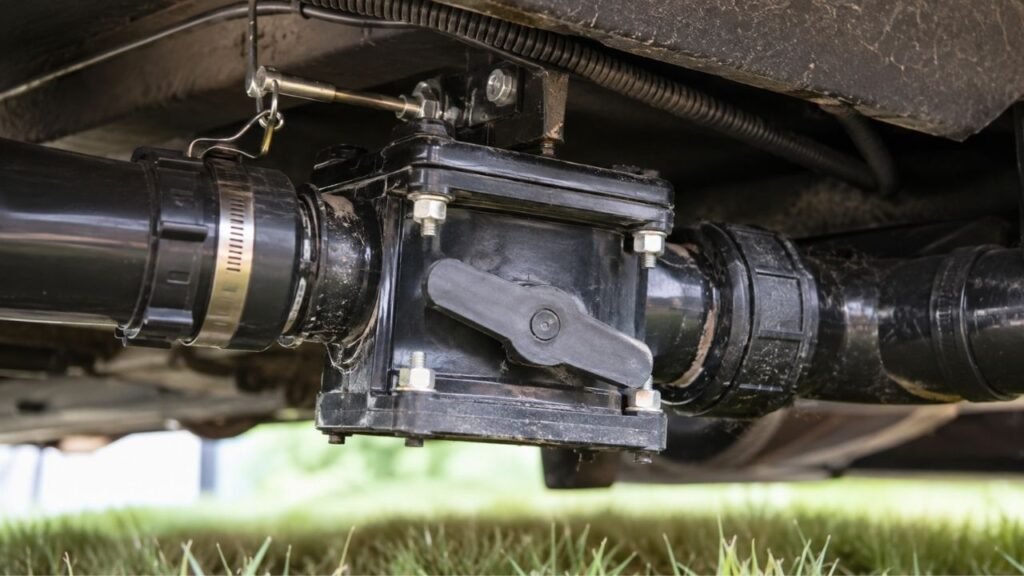
Your RV black tank valve should stay closed except when you are actively dumping or flushing the tank. Your gray tank valve is also best kept closed by default, although you can leave it open during some extended stays with full sewer hookups. Keeping both closed gives you better control over wastewater and helps prevent several common holding tank problems.
Below, I’ll show you exactly when each valve should stay open or closed. I’ll also explain full hookups, boondocking, dumping order, sewer odors, tank flushing, and the mistakes that often create clogs.
Key Takeaways
- Keep the black tank valve closed during normal RV use.
- Open the black valve only when dumping or properly flushing.
- Keep the gray tank valve closed by default for easier tank management.
- You can leave the gray valve open during some full-hookup stays.
- Close the gray valve before dumping black to collect rinse water.
- Always dump the black tank before dumping the gray tank.
- Keep both valves closed while traveling or storing your RV.
- Never assume gray water can legally drain onto the ground.
RV Black vs. Gray Tank Valves: Quick Reference
The easiest way to manage your RV tanks is by situation. Your black valve follows a fairly strict rule, while the gray valve gives you more flexibility.
| Camping Situation | Black Tank Valve | Gray Tank Valve | Recommended Approach |
| Full hookups, short stay | Closed | Closed | Best routine for most RVers |
| Full hookups, long stay | Closed | Closed or open | Open gray only when continuous drainage helps |
| Boondocking | Closed | Closed | Store wastewater until proper disposal |
| Dumping black tank | Open | Closed | Dump black first |
| Dumping gray tank | Closed | Open | Use gray water to rinse the sewer hose |
| Black tank flushing | Usually open | Closed | Follow your RV manufacturer’s procedure |
| Traveling | Closed | Closed | Secure both valves and outlet cap |
| RV storage | Closed | Closed | Prevent leaks, odors, and pests |
If you are ever unsure what to do, keeping both valves closed is usually the safest starting point.
Why Should the RV Black Tank Valve Stay Closed?
Your black tank relies on stored liquid to move toilet waste properly. Leaving the valve open removes that liquid too quickly and can create serious buildup.
Water Needs to Stay Inside the Black Tank
Your RV black tank is not designed like household plumbing.
At home, waste travels through pipes with plenty of flowing water. In an RV, toilet waste first collects inside a holding tank.
That tank needs enough liquid to suspend the solids.
When dumping time arrives, the stored water creates a stronger flow. That flow carries toilet paper and waste through the outlet.
If the valve stays open, liquids may leave immediately. Heavier material can remain behind.
That is where trouble begins.
An Open Black Valve Can Create a Poop Pyramid
The most common problem is something RVers call a poop pyramid.
The name sounds funny, but dealing with one definitely is not.
When the black valve stays open, liquid waste drains first. Solid waste may remain directly below the toilet opening.
More waste lands on top each time you flush.
Eventually, that pile can become thick, dry, and difficult to remove.
You may then notice:
- Slow black tank draining
- Toilet burping
- Strong odors
- Waste visible below the toilet
- Incorrect tank sensor readings
- A black tank valve that opens but barely drains
Clearing a severe blockage can take significant flushing and soaking.
Preventing the problem is much easier.
Keep your black valve closed and use plenty of water.
Leaving the Black Valve Open Can Increase Odors
An open black valve can also create odor problems.
Your campground sewer connection contains unpleasant gases. Your RV plumbing system normally provides barriers against those smells.
Leaving the black valve permanently open creates another pathway toward the sewer.
A properly working roof vent should still direct tank gases outside. However, damaged seals, dry traps, ventilation issues, or toilet problems can make odors easier to notice.
Keeping the valve closed gives you another layer of separation.
How Full Should the Black Tank Be Before Dumping?
I generally recommend waiting until your black tank reaches around two-thirds to three-quarters full.
You do not need to hit an exact percentage.
The important thing is having enough liquid inside the tank.
That stored water helps move waste rapidly through the outlet.
What if you are leaving the campground before the tank fills?
You can add extra water through the toilet before dumping. That gives the tank more liquid for a stronger flush.
Do not rely completely on tank sensors either.
Black tank sensors often become inaccurate because waste sticks around them.
Over time, you will learn roughly how many days your tank lasts.
Is the Black Valve Ever Supposed to Stay Open?
Yes, but only for specific situations.
During normal camping, keep it closed.
You will open it while actively dumping the tank.
Some built-in black tank flush systems also require the dump valve open while flushing.
This is important.
Never assume you should close the valve while using a tank flush.
A closed valve combined with continuous flushing can overfill the tank.
Always follow the instructions for your specific RV.
Should the RV Gray Tank Valve Stay Open or Closed?
Gray tank management gives you more flexibility than black tank management. Keeping it closed works well for most RVers, but long full-hookup stays can make an open valve convenient.
Why Keeping the Gray Valve Closed Is Usually Better
I prefer recommending a closed gray valve as the default.
That does not mean leaving it open is automatically wrong.
Keeping it closed simply gives you several useful advantages.
First, wastewater accumulates inside the tank.
When you finally open the valve, that larger volume moves quickly through the sewer hose.
The stronger flow helps carry away:
- Soap residue
- Hair
- Toothpaste
- Grease
- Small food particles
- Cooking residue
Gray tanks do not contain toilet waste.
However, they are not filled with perfectly clean water either.
Kitchen gray tanks can become especially dirty over time.
Keeping some water inside helps everything move during dumping.
You also gain another important benefit.
Stored gray water makes an excellent final rinse after dumping your black tank.
When Leaving the Gray Valve Open Makes Sense
There are situations where leaving the gray valve open is practical.
Long stays at full-hookup campgrounds are the main example.
Imagine staying several weeks at one site.
Your family might take several showers daily.
You may also use:
- An RV washing machine
- A dishwasher
- Multiple bathroom sinks
- A kitchen sink
- An outdoor kitchen
- Additional shower fixtures
That amount of wastewater can fill a small gray tank quickly.
Leaving the gray valve open allows continuous drainage.
You do not have to monitor the tank as often.
This can be especially helpful for larger families.
Still, I would not leave it open simply because you can.
For a normal weekend trip, keeping it closed is usually easier.
What Are the Downsides of Leaving the Gray Valve Open?
Leaving your gray valve open has several tradeoffs.
The biggest one is losing your stored rinse water.
If all gray water continuously drains away, you may have very little available after dumping the black tank.
Continuous low-flow drainage can also allow residue to remain.
Think about greasy kitchen water.
A small trickle may not carry everything through efficiently.
A larger tank dump usually creates better flushing action.
You may also have problems with campground sewer odors.
Even though your RV fixtures contain traps, plumbing issues can still allow unpleasant smells inside.
Campground sewer flies can occasionally become another nuisance.
For these reasons, an open gray valve works best when your entire sewer setup is functioning correctly.
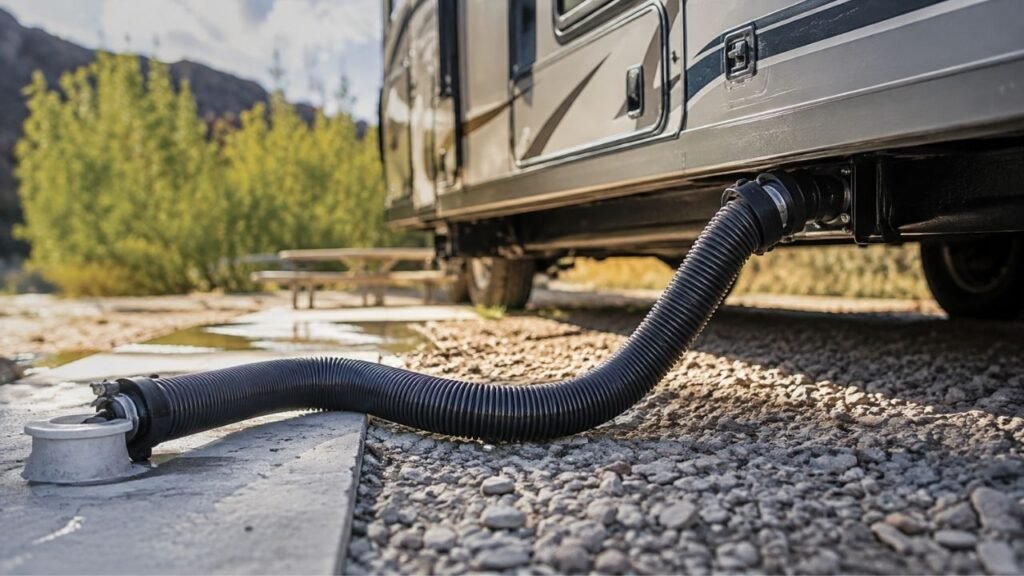
What About Making a P-Trap in the Sewer Hose?
You may have seen RVers create a low dip in their sewer hose.
The idea is similar to a household P-trap.
A small amount of water remains inside the dip.
That water can create another barrier between the RV and campground sewer.
Some long-term campers use this setup while leaving their gray valve open.
It can be useful, but I would not consider it mandatory.
Your RV sinks and shower should already have plumbing traps or equivalent odor-control systems.
You also need to consider campground hose rules.
Some campgrounds require sewer hoses to remain elevated on supports.
Do not create such a deep sag that wastewater stops flowing properly.
If you use the method, keep the hose secure and properly supported.
Should You Leave the Gray Valve Open at Full Hookups?
You can leave the gray tank valve open at full hookups, but you do not need to. For short stays, keeping it closed is usually the easiest and most useful routine.
During extended stays, an open gray valve can make sense. It becomes especially convenient if you use lots of water, have a washing machine, or take several showers every day.
There is also a useful middle-ground approach. Leave the gray valve open when necessary, then close it before your next black tank dump. Let several gallons collect so you can use that gray water to rinse the sewer hose afterward.
That gives you convenience without sacrificing your rinse water.
When Should Both RV Tank Valves Stay Closed?
There are several situations where keeping both valves closed makes the most sense. Doing so keeps wastewater contained until you can dispose of it properly.
Keep both tank valves closed:
- While boondocking
- When camping without sewer hookups
- During short campground stays
- While traveling
- During RV storage
- When campground sewer odors are noticeable
- When sewer flies are present
- When your sewer connection is questionable
- When campground rules require wastewater containment
- When you are unsure about your RV manufacturer’s instructions
Be especially careful with gray water while boondocking.
Gray water disposal rules vary across the United States.
Rules can differ between states, federal lands, campgrounds, forests, and recreation areas.
Do not assume that gray water can be released onto the ground.
The safer approach is to keep it contained unless you know discharge is permitted.
How to Use Your Black and Gray Valves at a Full-Hookup Site
A simple routine can prevent most holding tank problems. You do not need to constantly adjust your valves once your sewer hose is connected.
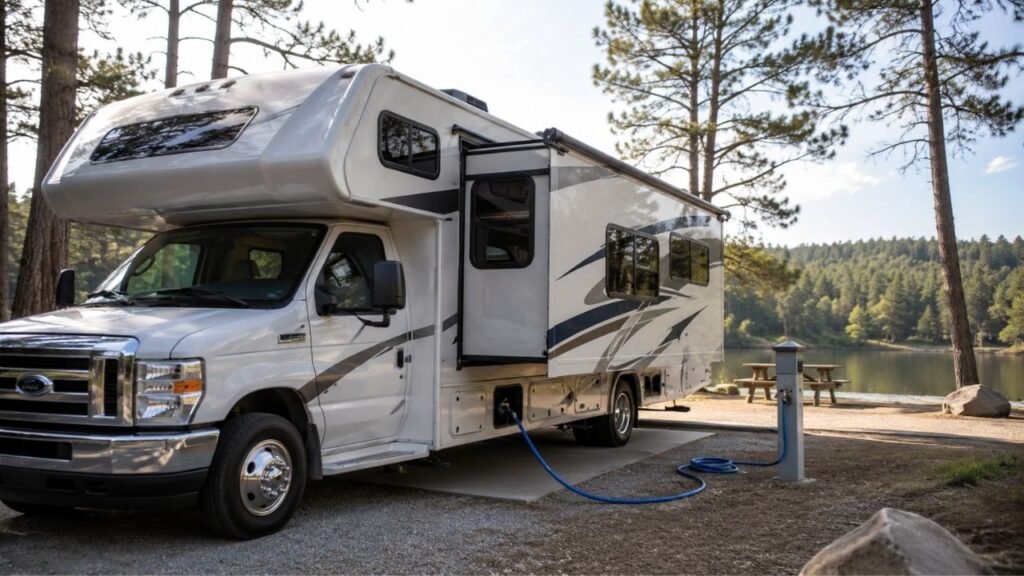
- Connect your sewer hose securely to the RV outlet.
- Secure the other end to the campground sewer connection.
- Keep the black tank valve closed during your stay.
- Keep the gray valve closed unless continuous drainage is needed.
- Use plenty of water whenever you flush the RV toilet.
- Allow the black tank to become reasonably full.
- Close the gray valve ahead of dumping if it was open.
- Let some gray water collect inside the tank.
- Open the black valve and let the tank drain completely.
- Use your tank flush if equipped and appropriate.
- Close the black tank valve when finished.
- Open the gray tank valve.
- Let the gray wastewater rinse the sewer hose.
- Close the gray valve after dumping.
This order is simple for a reason.
The dirtiest wastewater leaves first.
The cleaner gray water follows behind it.
That reduces the amount of black tank residue left inside your hose.
Why Should You Dump the Black Tank Before the Gray Tank?
Dumping black first allows gray wastewater to rinse the shared plumbing afterward.
Your black tank contains toilet waste and toilet paper.
Naturally, that is the messiest material leaving your RV.
Once the black tank finishes draining, close its valve.
Then open your gray tank.
Gray wastewater contains soap and considerably less sewage contamination.
As it moves through the outlet, it helps push leftover material through the sewer hose.
You still need to rinse and handle your equipment properly.
However, dumping gray second makes cleanup much easier.
I would avoid opening black and gray valves together.
You lose the benefit of that separate gray-water rinse.
What Happens If You Leave the Wrong RV Tank Valve Open?
Leaving a valve open does not always cause immediate damage. The problems usually develop gradually, which is why noticing the warning signs matters.
Black Tank Valve Left Open
This is the situation I would fix immediately.
Close the valve and start adding water to the tank.
If waste has already started accumulating, you may need repeated soaking and flushing.
Avoid aggressively forcing tools through the toilet or valve.
You do not want to damage the tank or plumbing.
A severe blockage may require professional tank cleaning.
The sooner you catch the problem, the easier it usually becomes.
Gray Tank Valve Left Open
Leaving the gray valve open is much less serious.
At full hookups, it may not be a problem at all.
You simply lose stored wastewater and dumping pressure.
Over time, grease, soap, hair, and food residue may still accumulate.
Closing the valve periodically and allowing a normal dump can help.
Gray Tank Valve Left Closed Too Long
A closed gray valve can cause problems if you forget about it.
Eventually, the tank fills completely.
The first warning may be slow shower drainage.
You may then notice water appearing in the shower pan.
That happens because the shower drain is often one of the lowest plumbing points inside an RV.
If that happens, stop using water and dump the gray tank.
Black Tank Gets Too Full
An overfilled black tank creates more serious concerns.
You may notice the toilet burping when you flush.
Odors may increase.
Waste may appear unusually close beneath the toilet opening.
Eventually, the toilet may stop draining into the tank properly.
Dump the tank before it reaches that point.
Should You Trust RV Tank Sensors Before Opening a Valve?
RV tank sensors are useful, but I would not trust them blindly.
Holding tank sensors often become inaccurate over time.
Waste or toilet paper can coat black tank sensors.
Soap, grease, and residue can affect gray tank readings.
You may see a tank showing one-third full after dumping.
Another tank might show empty when you suspect otherwise.
Do not solve that problem by permanently leaving the valves open.
Instead, learn your RV’s normal water usage.
Pay attention to how many days usually pass between dumps.
Know your tank capacities if possible.
You can also watch for physical signs of a filling tank.
Experience eventually becomes more reliable than the gauge alone.
Does Your RV Type Change Which Valves You Should Leave Open?
Not every RV uses the same holding tank layout. Larger motorhomes and fifth wheels can have extra tanks, appliances, or dumping equipment that changes your routine.
RVs With a Washer or Dishwasher
An RV washing machine can send several gallons into the gray tank.
Dishwashers also increase wastewater volume.
If you use these appliances frequently at full hookups, an open gray valve may become practical.
Just make sure you know where each appliance drains.
Some RVs route kitchen appliances into a separate galley tank.
RVs With Two Gray Tanks or a Separate Galley Tank
Larger RVs sometimes have more than one gray tank.
You might have one tank serving the bathroom.
Another may collect kitchen wastewater.
That means you can have several dump valves.
Do not assume one gray handle empties everything.
Identify each valve before your first dump.
Your owner’s manual or plumbing diagram can help.
RVs With a Macerator Waste System
Macerator systems work differently from traditional gravity sewer hoses.
A pump grinds and moves waste through a smaller hose.
Your dumping sequence may still involve separate tanks.
However, valve operation can vary by system.
Follow the instructions provided for your macerator setup.
RVs With Unusual Holding Tank Layouts
Some small campers use plumbing systems that differ from standard motorhomes.
You may encounter combined systems or portable waste tanks.
That can change normal dumping procedures.
Whenever your RV setup looks different, check the manufacturer’s instructions.
Generic RV advice should never override your specific plumbing design.
Common RV Tank Valve Mistakes to Avoid
Most holding tank problems come from a few repeated habits. Avoiding these mistakes can save you from unpleasant repairs later.
- Leaving the black valve open at full hookups
- Dumping the black tank with too little water inside
- Opening black and gray valves at the same time
- Dumping gray before black
- Forgetting to collect gray water before dumping black
- Trusting inaccurate tank sensors completely
- Using too little water when flushing
- Walking away while operating a tank flush
- Closing the dump valve during an incompatible flush procedure
- Leaving valves open during storage
- Assuming gray water can be dumped anywhere
- Ignoring campground wastewater rules
- Ignoring your RV manufacturer’s instructions
Holding tank maintenance does not need to be complicated.
Good valve habits prevent most problems before they start.
My Recommended Valve Routine for Most RV Owners
If you want a simple routine you can use on almost every trip, keep things conservative. You can always adjust your gray tank strategy later.
- Keep the black tank valve closed.
- Keep the gray tank valve closed by default.
- Use plenty of water when flushing the toilet.
- Let the black tank reach roughly two-thirds full.
- Dump the black tank first.
- Close the black valve afterward.
- Dump the gray tank second.
- Leave gray open only when full-hookup water use makes it useful.
- Close gray before your next black tank dump.
- Keep both valves closed during travel and storage.
This routine works especially well for new RV owners.
It gives you predictable dumping habits.
It also makes troubleshooting much easier if something goes wrong.
Final Verdict: Should RV Black and Gray Tank Valves Stay Open or Closed?
Your black tank valve should stay closed during normal RV use. Open it only when you are actively dumping or following the proper procedure for your black tank flush system. Leaving it open continuously can remove the liquid needed to carry solid waste and may eventually create a serious blockage.
Your gray tank valve should also stay closed by default, especially during short stays. At full hookups, you can leave it open when heavy water use makes continuous drainage useful. Just close it before your next black tank dump so you can collect enough gray water for a final sewer-hose rinse.
If you are new to RVing and want one simple rule, keep both valves closed. Dump them deliberately, with the black tank first and gray tank second. That routine is easy to remember and prevents many common holding tank problems.
Related FAQs
Here are quick answers to several common questions RV owners have about black and gray tank valve positions.
Should I Leave Both RV Tank Valves Open When Connected to Sewer?
No. Keep your black valve closed even when you have full sewer hookups. Your gray valve can remain closed or be opened during extended stays when continuous drainage is useful.
Can I Leave My RV Gray Tank Valve Open All the Time?
You can leave it open while properly connected to sewer hookups, but keeping it closed periodically helps collect water for a stronger dump and final sewer-hose rinse.
How Full Should My RV Black Tank Be Before I Open the Valve?
Try to let the tank reach around two-thirds to three-quarters full. Having plenty of liquid inside helps carry toilet paper and waste out more effectively.
Should I Close My Gray Tank Before Dumping the Black Tank?
Yes. If your gray valve has been open, close it beforehand and collect several gallons of wastewater. You can then dump that water after the black tank.
Why Do You Dump the Black Tank Before the Gray Tank?
Black wastewater is the dirtiest. Dumping gray afterward lets the soapy wastewater rinse some remaining black tank residue from the shared outlet and sewer hose.
Can Leaving the Gray Tank Open Cause Sewer Smells?
It can contribute to odor problems in some setups. Plumbing traps and vents normally block sewer gas, but problems with those components can make campground sewer odors noticeable.
What Happens If I Accidentally Leave My Black Tank Valve Open?
Close the valve and begin adding plenty of water. If solids have already accumulated, soaking and repeated flushing may help before the blockage becomes severe.
Should RV Tank Valves Be Open or Closed During a Black Tank Flush?
The black valve often needs to stay open while a built-in flush system operates, but procedures vary. Always follow the instructions for your specific RV and flush system.
Should RV Tank Valves Be Open or Closed During Winter?
Both valves should normally remain closed during winter storage. Properly drain, winterize, and protect the plumbing system according to your RV manufacturer’s winterization procedure.
Can I Leave the Gray Valve Open While Boondocking?
No. Without a proper sewer connection, keep your gray water contained. Disposal rules vary by location, so use an approved dump station unless local rules specifically allow otherwise.
Is It Legal to Dump RV Gray Water on the Ground?
Rules vary across states, campgrounds, federal lands, and recreation areas. Never assume dumping is allowed. Keep gray water contained unless you have confirmed the location permits discharge.
Should RV Tank Valves Be Open or Closed During Storage?
Keep both valves closed during storage after properly draining and cleaning the tanks. This helps prevent leaks, pests, odors, and accidental discharge around the RV.

Steven Parker writes about everyday RV life, from setup tips to long-term living decisions. His content reflects a calm, experienced approach to RV ownership and travel. He focuses on comfort, reliability, and realistic expectations.