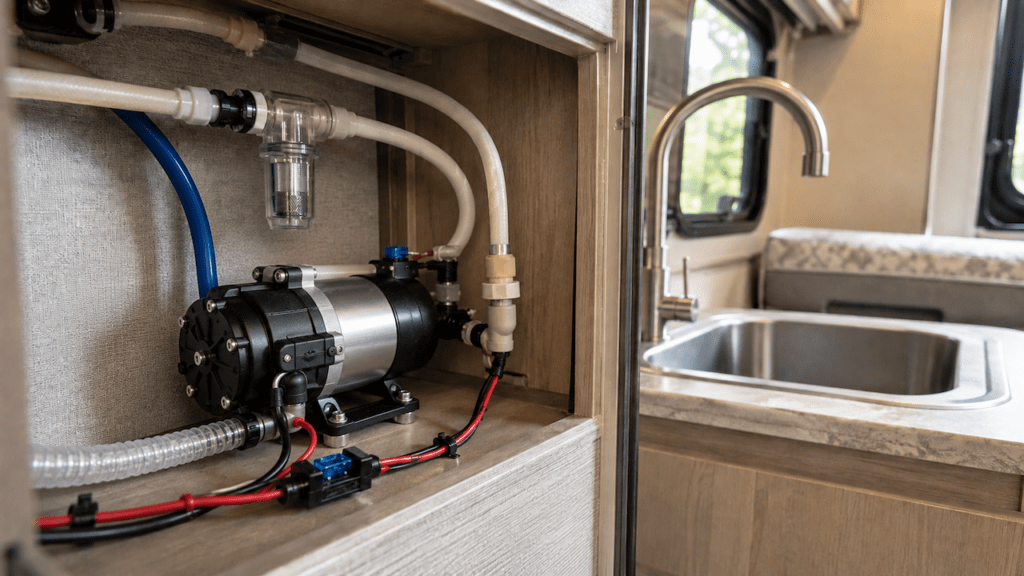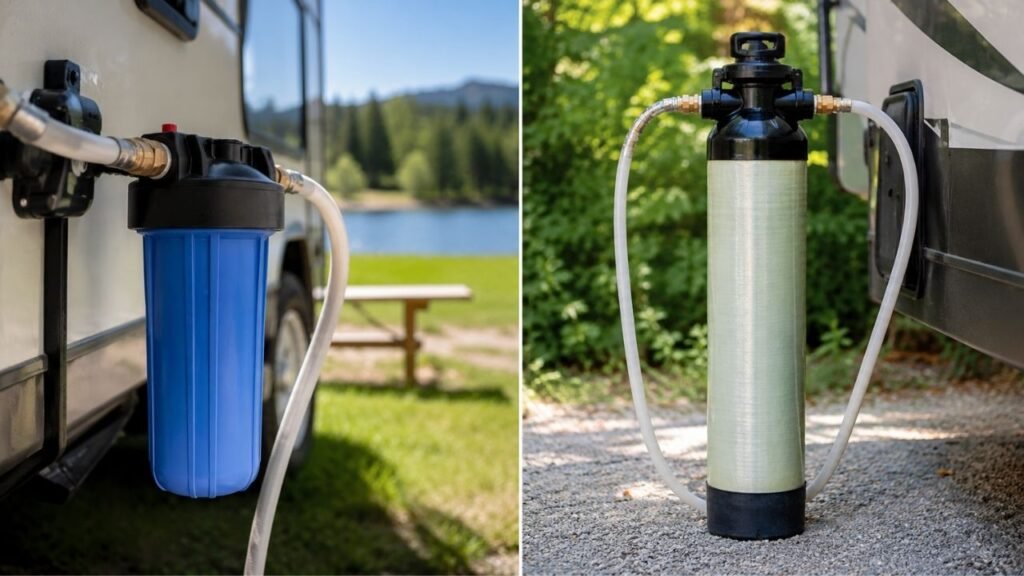
An RV water filter and an RV water softener do different jobs. A water filter reduces specific sediment, chlorine, tastes, odors, or contaminants based on its filter media. A water softener removes calcium and magnesium that cause hard-water scale inside your RV plumbing and appliances.
If you are unsure which one belongs in your setup, I’ll help you sort it out. We’ll compare how each system works, what problems each solves, when you need both, and how to connect them correctly at your campsite.
Key Takeaways
- An RV water filter and softener are not interchangeable.
- Water filters target sediment, chlorine, odors, and specific contaminants.
- Water softeners mainly remove calcium and magnesium hardness.
- Standard carbon or sediment filters normally cannot soften hard water.
- A water softener does not make questionable water safe to drink.
- Many RVers use a filter and softener together.
- Testing your water helps you choose the correct treatment.
- Filter capabilities depend on the cartridge and its actual certifications.
RV Water Filter vs Water Softener: Quick Comparison
The easiest way to understand the difference is to look at the problem each system solves. Your filter focuses mainly on water quality, while your softener focuses on hardness and scale.
| Feature | RV Water Filter | RV Water Softener |
| Primary purpose | Improves specific aspects of water quality | Reduces hard-water minerals |
| Main targets | Sediment, chlorine, taste, odor, specific contaminants | Calcium and magnesium |
| Prevents hard-water scale | Usually no | Yes |
| Removes sediment | Yes, with sediment filtration | No |
| Reduces chlorine | Yes, with appropriate carbon media | Normally no |
| Improves taste and odor | Often | Not its main purpose |
| Removes hardness minerals | Normally no | Yes |
| Treats bacteria | Only with appropriate treatment designed for it | No |
| Main technology | Mechanical filtration, carbon, specialty media, membranes | Ion-exchange resin |
| Typical maintenance | Replace or clean cartridges | Regenerate resin with salt |
| Best use | Water-quality problems | Hard-water problems |
| Can you use both? | Yes | Yes |
The biggest thing I want you to remember is this: filtered water does not automatically mean softened water, and softened water does not automatically mean purified water.
Each device has its own job.
What Does an RV Water Filter Actually Do?
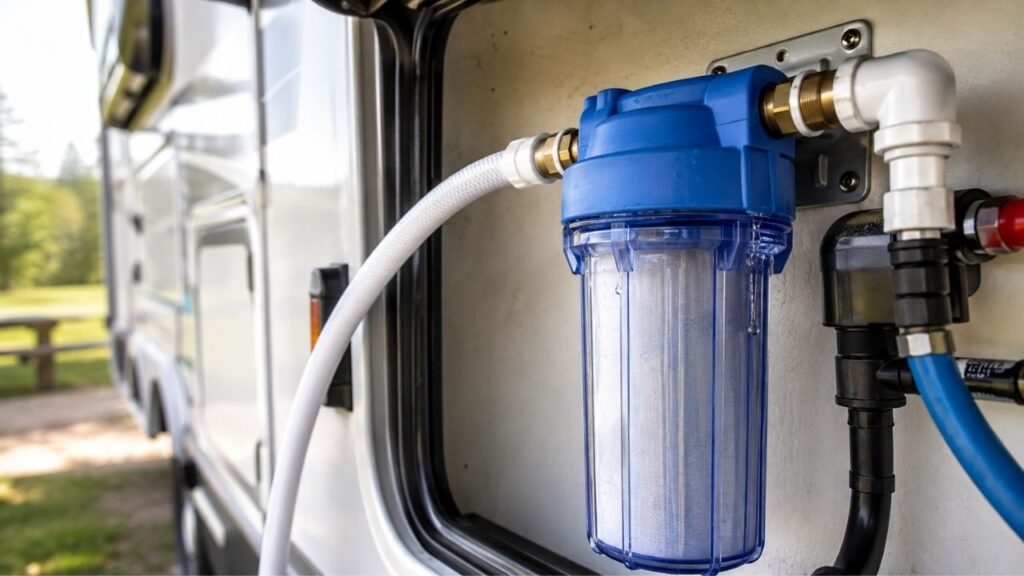
The term RV water filter covers several different technologies. That matters because one filter may only catch sand, while another may reduce chlorine, odors, or certain contaminants.
Sediment Filters Remove Dirt, Sand, Rust, and Silt
A sediment filter is usually the simplest part of an RV filtration system.
It works like a physical barrier. Water passes through the filter media while larger particles remain trapped inside.
A sediment filter can help when you notice:
- Sand coming from a campground water connection
- Rust particles from older plumbing
- Dirt or grit inside faucet aerators
- Cloudy water caused by suspended particles
- Sediment collecting inside hoses or fixtures
Sediment filtration is also useful before other treatment equipment. Removing debris first can help protect smaller filters and softener components farther down the line.
You will often see sediment filters rated in microns. A lower micron number generally means the filter traps smaller particles.
However, smaller is not automatically better.
A very restrictive filter can reduce water flow, especially when it starts getting dirty.
Carbon Filters Reduce Chlorine, Taste, and Odor
Activated carbon is commonly used in RV water filters.
Carbon does not work exactly like a sediment screen. Instead, many chemicals are attracted to the surface of the carbon through a process called adsorption.
A suitable carbon filter can help reduce:
- Chlorine taste
- Chlorine odor
- Some unpleasant tastes
- Certain organic compounds
- Other substances specifically covered by the cartridge design
This is why your campground water may taste noticeably better after passing through a carbon filter.
Still, I would not assume every carbon cartridge removes every chemical.
Always check what the actual filter is designed to reduce.
Specialty, Fine, UV, and RO Systems Handle Different Problems
Basic inline RV filters are only one part of the filtration world.
Other systems may use:
- Fine mechanical filtration
- Specialty contaminant-removal media
- Reverse osmosis membranes
- Ultraviolet treatment
- Multiple filtration stages
Reverse osmosis can remove many dissolved substances that ordinary carbon filtration cannot handle.
UV equipment has a completely different purpose. It is commonly used as part of systems intended to address microorganisms.
The important lesson is simple.
The word “filter” alone does not tell you what the system removes.
You need to know the actual filtration technology.
What an RV Water Filter Usually Does Not Do
A standard sediment or carbon RV filter should not be expected to solve every water problem.
Most ordinary RV filters:
- Do not remove calcium hardness
- Do not remove magnesium hardness
- Do not completely prevent mineral scale
- Do not automatically remove bacteria
- Do not automatically remove viruses
- Do not guarantee lead removal
- Do not guarantee PFAS removal
- Do not guarantee arsenic removal
- Do not make every unknown water source safe
This distinction becomes especially important while traveling.
You may fill your RV from several different water systems during one trip. Their water quality can vary considerably.
What Does an RV Water Softener Actually Do?
An RV water softener has a much narrower job. It primarily deals with hard water, which contains dissolved calcium and magnesium.
How Ion Exchange Softens RV Water
Most portable RV water softeners use ion exchange.
Inside the softener is a bed of tiny resin beads.
When hard water flows through the tank, calcium and magnesium ions are attracted to those resin beads. Sodium or another exchange ion takes their place in the water.
The softened water then continues toward your RV.
You do not see this process happening, but you can often see the results afterward.
There may be less white scale around your fixtures and fewer mineral spots after water dries.
Eventually, the resin becomes loaded with hardness minerals.
That is when the softener needs regeneration.
A concentrated salt solution is passed through the resin. This helps release the accumulated calcium and magnesium and restores the resin for another service cycle.
What Problems Soft Water Helps Prevent
Hard water is not usually dramatic at first.
The problems develop slowly as minerals repeatedly dry or heat inside your RV water system.
Softening can help reduce:
- White crust around faucets
- Mineral scale on showerheads
- Spots on dishes and glassware
- Scale inside the RV water heater
- Clogged faucet aerators
- Soap scum
- Mineral residue around sinks
- Long-term buildup inside plumbing components
Your water heater deserves particular attention.
When hard water is heated, scale can collect on surfaces inside the heater. Over time, that buildup can interfere with heat transfer and increase maintenance.
Tankless RV water heaters can also be affected by mineral buildup inside narrow water passages.
What an RV Water Softener Does Not Remove
A softener can make a major difference with hard water, but it is not a general-purpose purification device.
A typical RV softener does not primarily remove:
- Sand
- Dirt
- Rust
- Chlorine
- Bad odors
- Bacteria
- Viruses
- Most organic chemicals
- Most drinking-water contaminants
That means you should never think of softened water as automatically purified water.
Soft water describes hardness. It does not describe overall water safety.
How Can You Tell Whether Your RV Has Hard Water?
Hard water often leaves visible clues around your RV. However, testing gives you a much better answer than relying only on appearance.
Common Signs of Hard Water in an RV
Watch for these symptoms:
- White crust around faucets
- Chalky showerhead deposits
- Mineral spots on dishes
- Cloudy-looking spots after water dries
- Scale around sink fixtures
- Soap that does not lather easily
- Frequent aerator clogging
- Mineral deposits in your water heater
- White residue around plumbing connections
One small patch of white residue does not necessarily mean you have extremely hard water.
Repeated buildup across several fixtures is a stronger clue.
RV Water Hardness Levels
Water hardness is commonly expressed as milligrams per liter of calcium carbonate.
A useful general classification looks like this:
| Hardness | General Classification |
| 0–60 mg/L | Soft |
| 61–120 mg/L | Moderately hard |
| 121–180 mg/L | Hard |
| More than 180 mg/L | Very hard |
You may also see RV softener owners discuss hardness in grains per gallon, usually shortened to GPG.
Higher hardness means the softener’s resin will reach its capacity faster.
That means you may need to regenerate it more frequently.
Should You Test Campground Water Hardness?
Yes, especially if scale keeps appearing inside your RV.
Basic hardness test strips are inexpensive and easy to carry.
You can test campground water before connecting everything. That gives you a better idea of whether using your portable softener is worthwhile.
Hardness testing should not be confused with comprehensive water-quality testing.
A hardness strip tells you about hardness minerals. It does not tell you whether bacteria, lead, pesticides, or other contaminants are present.
How Do You Know When You Need an RV Water Filter?
Choose filtration based on the specific water problem you are trying to correct.
An RV water filter makes sense when:
- You see sediment in campground water.
- Water has a noticeable chlorine taste.
- The water has an unpleasant odor.
- Rust particles appear in your fixtures.
- You want cleaner-tasting campground water.
- You want to protect plumbing from incoming debris.
- Testing identifies something your chosen filter can reduce.
I recommend choosing your filter by what it actually removes, not by how many stages are printed on the package.
A five-stage system is not automatically better than a two-stage system if those stages do not address your actual problem.
How Do You Know When You Need an RV Water Softener?
A softener makes more sense when hardness is the main problem.
Consider one when:
- Hardness testing shows high mineral levels.
- White mineral deposits return quickly.
- Your showerhead frequently develops scale.
- Faucet aerators keep clogging with mineral residue.
- Water spots are difficult to remove.
- You stay in one hard-water area for weeks.
- You regularly travel through hard-water regions.
- Protecting your RV water heater from scale matters to you.
I would still test the campground supply when possible.
Water conditions can change significantly between campgrounds, even within the same state.
You may need your softener at one campground and barely need it at the next.
Do You Need Both a Water Filter and Water Softener in an RV?
For many RV owners, using both is the most complete setup because filters and softeners solve different problems.
Imagine you connect to a campground well.
The water contains visible sediment, has an unpleasant taste, and measures very hard.
A sediment filter can catch the particles.
A carbon filter may improve the taste.
Your softener can then handle calcium and magnesium.
One system cannot necessarily replace the others.
This combination is particularly useful for full-time RVers because your water source constantly changes.
You may spend one week connected to good municipal water and the next at a campground with very hard well water.
Having both gives you more flexibility.
However, using both does not automatically make an unknown water source safe.
If a source is marked non-potable or contamination is suspected, normal RV filtering and softening should not be treated as a substitute for appropriate water treatment.
Which Comes First: RV Water Filter or Water Softener?
You will see different hookup recommendations online. That can make this part unnecessarily confusing, so I prefer looking at what each component needs rather than treating one arrangement as universal.
A Practical Default Hookup Order
For many RV setups, a practical arrangement is:
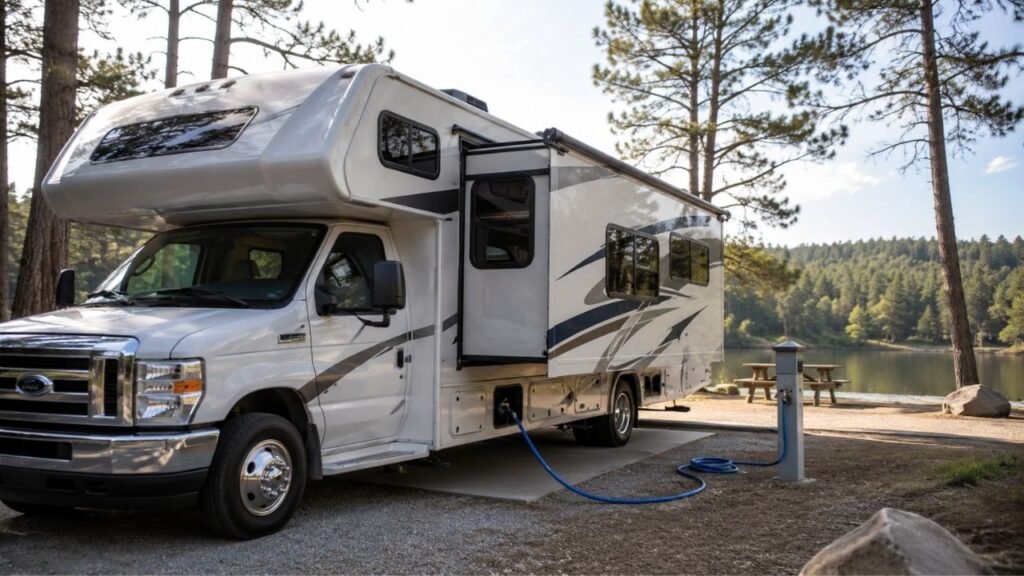
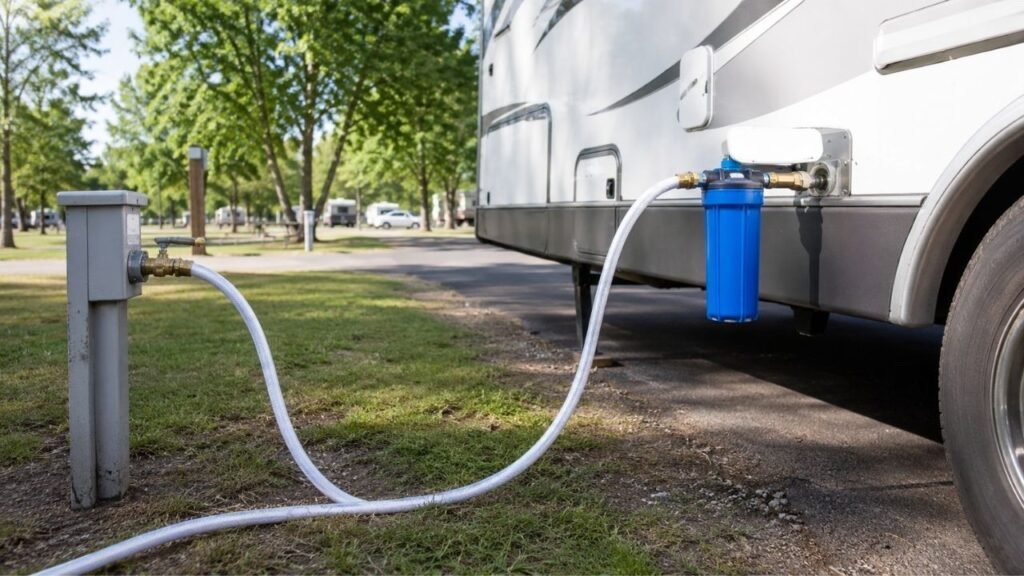
Campground spigot → pressure regulator → sediment/filter system → water softener → potable-water hose → RV city-water inlet
Putting sediment filtration ahead of the softener can help keep sand, dirt, and rust away from the resin bed.
That is especially useful when campground water contains visible debris.
Your carbon filtration arrangement may vary depending on the equipment.
Why You May See Different Recommendations
Not every manufacturer uses the same system design.
You may also see arrangements such as:
Spigot → sediment filter → softener → carbon filter → RV
There can be several reasons for doing this.
For example, a sediment filter may protect the softener while a final carbon stage improves taste immediately before water enters the RV.
Some manufacturers may also specify where chlorine-reduction media should sit relative to the softener resin.
That is why I would use the manufacturer’s recommended sequence whenever your particular system specifies one.
Think of the sequence as a system, not a universal rule.
Where Should the RV Water Pressure Regulator Go?
Your pressure regulator normally belongs near the campground water connection.
A typical setup looks like:
Spigot → pressure regulator → water-treatment equipment → hose → RV
Putting the regulator near the supply helps prevent unnecessarily high campground pressure from reaching downstream hoses and components.
Some individual components have their own pressure limits, so always check their specifications.
RV Water Filter vs Softener Maintenance
Neither system is completely maintenance-free. The good news is that RV filtration and softening maintenance is usually manageable once you develop a routine.
| Maintenance Task | RV Water Filter | RV Water Softener |
| Replace cartridge | Yes | Usually not regularly |
| Regenerate with salt | No | Yes |
| Flush system | Often recommended | Often recommended |
| Monitor water flow | Yes | Yes |
| Test performance | Depends on filtration goal | Hardness testing works well |
| Protect from freezing | Yes | Yes |
| Drain for storage | Usually | Usually |
| Watch for leaks | Yes | Yes |
Filter cartridges eventually become loaded with material.
How quickly that happens depends on:
- Water quality
- Cartridge size
- Micron rating
- Water consumption
- Sediment levels
- Filter type
That is why I would not depend only on a universal replacement schedule.
Follow your cartridge manufacturer’s service interval while also watching water pressure and condition.
A portable softener requires different maintenance.
Instead of replacing cartridges frequently, you normally regenerate the resin with salt after it has treated a certain amount of hardness.
Harder water means more frequent regeneration.
Does a Water Filter or Softener Reduce RV Water Pressure?
Both can create some resistance to water flow, although filters are often the first place I would inspect when pressure suddenly drops.
A dirty cartridge can restrict flow substantially.
Very fine filtration can also create more resistance than a larger-pore filter.
If your RV pressure suddenly becomes weak, check:
- Filter cartridges
- Hose kinks
- Faucet aerators
- Inlet screens
- Pressure regulator
- Hose diameter
- Softener connections
- Softener flow rating
Do not immediately assume the campground has low pressure.
If pressure was good yesterday and poor today, a clogged filter deserves inspection.
A properly sized softener should normally provide reasonable RV flow, but every component adds some restriction.
Using several undersized filters, tiny hoses, and restrictive fittings together can make the problem more noticeable.
Does a Water Softener Make RV Water Safe to Drink?
No. A water softener should not be treated as a drinking-water purifier.
Its primary purpose is controlling hardness.
Ion exchange removes calcium and magnesium and replaces those ions during the softening process.
That does not mean bacteria, viruses, chlorine, pesticides, or every other contaminant have been removed.
If you are concerned about drinking-water safety, evaluate the source and choose appropriate treatment for the actual concern.
Do not rely on a softener simply because the water looks clear.
Is Filtered RV Water Automatically Safe to Drink?
Not necessarily.
This is one of the biggest misunderstandings I see with RV filtration.
A basic carbon filter might make campground water taste dramatically better without removing every health-related contaminant.
A sediment filter can make water look clearer while doing almost nothing about dissolved chemicals.
Even very fine filtration should only be trusted for the specific claims that system is designed to meet.
When evaluating an RV filter, look at its actual reduction claims and certifications rather than assuming that the word “filtered” means completely purified.
You may see standards such as:
- NSF/ANSI 42 for certain aesthetic effects like chlorine, taste, odor, and particulates.
- NSF/ANSI 53 for specific health-related contaminant reduction claims.
- NSF/ANSI 58 for reverse-osmosis treatment systems.
The certification still needs to cover the contaminant you care about.
That gives you much more useful information than marketing phrases like “advanced filtration.”
RV Water Filter vs Water Softener: Which Should You Choose?
The best choice comes down to the problem you actually have. Instead of asking which device is better, ask what is wrong with your water.
Choose a Water Filter If…
Start with appropriate filtration when:
- Water tastes strongly of chlorine.
- Water has an unpleasant odor.
- Sand or rust enters your hose.
- Sediment collects in faucet screens.
- Water looks cloudy from particles.
- You want better-tasting campground water.
- You need treatment for a specifically identified contaminant.
Match the filter media to the problem.
Choose a Water Softener If…
Choose a softener when:
- Hardness testing shows high mineral levels.
- White deposits repeatedly cover fixtures.
- Water spots are difficult to prevent.
- Your showerhead scales quickly.
- Hardness affects soap performance.
- Your water heater develops mineral scale.
- You regularly camp with hard water.
A portable softener is particularly convenient because you can regenerate it instead of constantly replacing the entire treatment media.
Choose Both If…
Running both makes sense when:
- You travel frequently.
- Campground water quality varies.
- Your water has sediment and hardness.
- You have chlorine taste and hard-water scale.
- You live in your RV full time.
- You spend long periods connected to campground water.
- You want filtration plus scale protection.
The two devices complement each other.
They are teammates, not competitors.
Choose Neither Until You Check the Water If…
Sometimes buying another filter is not the first step.
Investigate the source first when:
- Water has a strong unusual chemical smell.
- Contamination is suspected.
- The campground has issued a water warning.
- A boil-water advisory is active.
- The connection is labeled non-potable.
- You do not know where the water comes from.
A filter designed for chlorine taste cannot solve an unknown microbial problem.
A softener certainly cannot solve it either.
Quick Decision Chart: Filter, Softener, or Both?
If you are standing beside your RV trying to decide what equipment to connect, this table gives you a useful starting point.
| What You Notice | Likely Problem | Start With |
| Strong chlorine taste | Chlorine/taste issue | Appropriate carbon filter |
| Sand or grit | Sediment | Sediment filter |
| Rust particles | Sediment/corrosion debris | Sediment filtration |
| White faucet crust | Hardness | Water softener |
| Water spots | Hardness | Water softener |
| Soap scum | Hardness | Water softener |
| Hard water and chlorine taste | Two separate issues | Filter + softener |
| Unknown contaminant | Unknown water quality | Test first |
| Suspected microorganisms | Microbial concern | Appropriate treatment, not softener |
| Low pressure after weeks of use | Possible clogged filter | Inspect filter first |
Do not treat this chart as a substitute for water testing.
It is simply a practical way to narrow down the problem.
What About Salt-Free RV Water Conditioners?
You may also come across portable products described as salt-free softeners or water conditioners.
These systems should not always be treated as identical to conventional ion-exchange softeners.
A traditional softener actually removes hardness ions from the water through ion exchange.
Many salt-free conditioners work differently. Instead of removing calcium and magnesium, they change how those minerals behave so they are less likely to attach to surfaces as hard scale.
That distinction matters.
If your goal is measurable reduction in water hardness, conventional ion-exchange softening is the more direct approach.
If your main concern is scale control without salt regeneration, a conditioner may be worth considering.
Just check exactly what the product claims to do.
Does Softened RV Water Contain Sodium?
Traditional ion-exchange softening normally replaces calcium and magnesium ions with sodium ions.
How much sodium enters the treated water depends partly on how hard the incoming water was.
Very hard water requires more ion exchange than mildly hard water.
For most RV owners, this is mainly something to understand rather than panic about.
However, people who must follow sodium-restricted diets should consider their individual needs when deciding how they handle drinking water.
Some RVers use softened water throughout the plumbing while using a separate drinking-water treatment system.
What Size RV Water Softener Do You Need?
Portable RV softeners are commonly sold according to grain capacity.
You may see sizes such as:
- 8,000-grain systems
- 10,000-grain systems
- 16,000-grain systems
- Larger portable systems
A larger softener can usually remove more hardness before regeneration.
However, bigger also means:
- More storage space
- More weight
- A larger tank to transport
Weekend campers may prefer a smaller portable unit.
Full-time RVers may appreciate more capacity, especially when staying in areas with very hard water.
Your actual regeneration interval depends on two things:
how hard your water is and how much water you use.
That is more useful than choosing based on capacity alone.
Common Mistakes When Comparing RV Filters and Softeners
It is easy to spend money on the wrong equipment when the problem has not been identified first.
Avoid these common mistakes:
- Expecting a carbon filter to soften water
- Expecting a softener to purify drinking water
- Assuming every RV filter removes bacteria
- Assuming more filter stages always mean better filtration
- Buying a softener without checking hardness
- Ignoring filter flow ratings
- Forgetting to replace clogged cartridges
- Forgetting to regenerate softener resin
- Letting dirty sediment enter treatment equipment
- Using the wrong hookup sequence for your system
- Ignoring maximum pressure ratings
- Allowing filters or softeners to freeze
- Assuming clear water is automatically safe
- Using non-potable water because it passes through a filter
A little testing and planning usually prevents most of these problems.
Final Verdict
The difference between an RV water filter and water softener becomes much easier once you stop treating them as competing products.
Your filter handles specific water-quality problems. Your softener handles hardness.
If you see sand, rust, chlorine taste, or unpleasant odors, look toward the appropriate filtration system.
If you see white crust, water spots, soap scum, and repeated mineral buildup, test your hardness and consider a portable softener.
And if you have both problems, there is nothing wrong with using both systems.
That is often the setup I would choose for an RV that moves regularly between different campground water supplies.
Just remember that neither device can compensate for an unsafe water source unless the treatment system is specifically designed and verified for that problem.
Identify the issue first. Then treat that issue.
That approach gives you better water without carrying equipment you do not actually need.
Related FAQs
Here are a few additional questions that usually come up when RV owners start comparing filtration and softening systems.
Does an RV Water Filter Remove Hard Water?
Most standard RV sediment and carbon filters do not remove the dissolved calcium and magnesium that cause hard water. You normally need an ion-exchange water softener if your goal is reducing actual water hardness and preventing mineral scale.
Does an RV Water Softener Filter Drinking Water?
An RV water softener treats calcium and magnesium hardness but should not be considered a general drinking-water filter. It does not automatically remove sediment, chlorine, microorganisms, or other contaminants from campground water.
Can I Use an RV Water Filter and Softener Together?
Yes. A water filter and softener work well together because they address different problems. Filtration can handle sediment, taste, odor, or selected contaminants, while the softener deals with calcium and magnesium hardness.
Should the RV Water Filter Go Before or After the Softener?
A sediment filter commonly goes before the softener so dirt and debris do not enter the resin tank. Other filtration stages may go before or after it depending on the system design, so follow the equipment manufacturer’s recommended hookup order.
Do RV Water Softeners Remove Chlorine?
Standard ion-exchange RV water softeners are not primarily designed to remove chlorine. If chlorine taste or odor is a problem, an appropriate activated-carbon filter is usually the more suitable treatment.
Does a Carbon RV Filter Remove Calcium?
Standard activated-carbon filtration does not meaningfully remove the dissolved calcium and magnesium responsible for hard water. Carbon is primarily useful for reducing substances such as chlorine and certain taste or odor problems.
How Do I Test RV Water Hardness?
You can use portable hardness test strips or a hardness test kit at the campground spigot. Test the incoming water before the softener, then test softened water afterward if you want to confirm that the system is still working effectively.
Is Hard Water Bad for an RV Water Heater?
Hard water can leave calcium and magnesium scale inside an RV water heater. That buildup may interfere with heat transfer, collect on internal surfaces, and increase maintenance over time, especially when very hard water is used regularly.
Can Hard Water Reduce RV Water Pressure?
Hard water can eventually contribute to reduced flow when mineral scale accumulates inside faucet aerators, showerheads, valves, and narrow plumbing passages. However, sudden pressure loss is more commonly caused by a clogged filter, regulator problem, restricted hose, or blocked screen.
Do I Need a Water Softener at Every Campground?
No. Some campground water supplies are already relatively soft. Others can be extremely hard. Testing the water gives you a better answer than automatically using your softener at every stop.
Can I Drink Softened Water in My RV?
Softened water is not automatically unsafe to drink, but softening changes its mineral composition and may increase sodium depending on incoming hardness. More importantly, a softener does not remove other possible contaminants, so drinking-water decisions should also consider the original water source and any additional treatment being used.
What Is the Difference Between a Water Softener and Salt-Free Water Conditioner?
A conventional ion-exchange softener removes calcium and magnesium hardness ions and replaces them with sodium or another exchange ion. Many salt-free conditioners do not actually remove hardness minerals; instead, they alter how those minerals form scale on plumbing and appliances.
Will a Water Filter Make My RV Water Taste Better?
It can, particularly when an appropriate activated-carbon filter reduces chlorine and other taste or odor compounds. A sediment-only filter may improve clarity but will not necessarily change the taste much.
How Often Should I Regenerate an RV Water Softener?
Regeneration frequency depends on your softener capacity, incoming water hardness, and water usage. Very hard water exhausts the resin faster, while softer water allows more gallons to pass before regeneration becomes necessary.
Can I Use an RV Water Softener Without a Filter?
Yes, you can use a softener alone if hardness is your only concern and the incoming water is otherwise suitable. However, a sediment pre-filter can be useful when campground water contains dirt, rust, sand, or other particles that could enter the softener.
Can I Use an RV Water Filter Without a Softener?
Absolutely. If campground water has good hardness levels but you want to reduce sediment, chlorine taste, or another specific issue, filtration alone may be all you need.

Steven Parker writes about everyday RV life, from setup tips to long-term living decisions. His content reflects a calm, experienced approach to RV ownership and travel. He focuses on comfort, reliability, and realistic expectations.