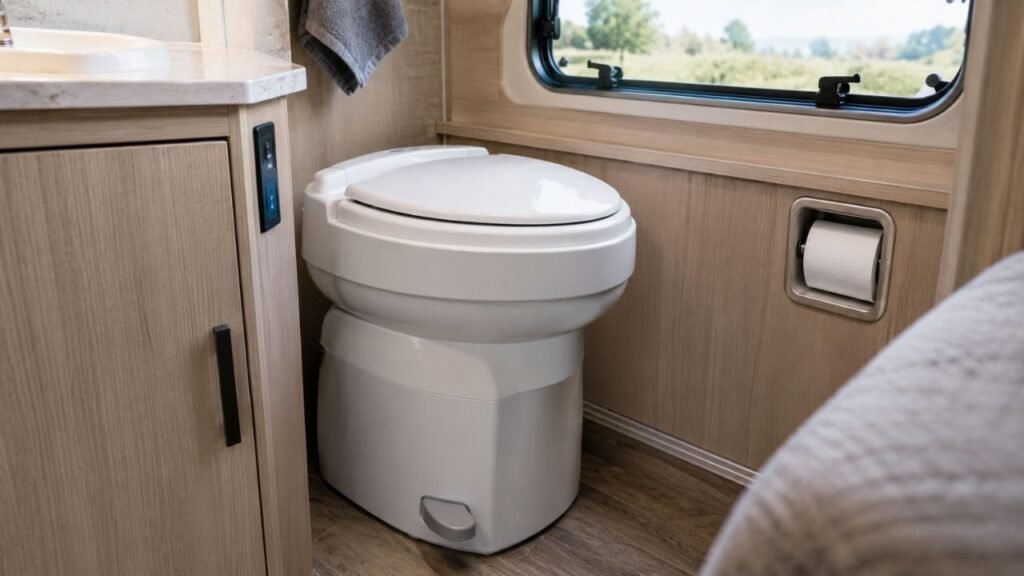
An RV toilet pedal usually sticks after flushing because dirt, mineral buildup, a dry flush seal, binding linkage, or a worn return mechanism creates too much resistance. A sticking water valve or misaligned flush-ball mechanism can also keep the pedal from returning normally.
The good news is that many sticky pedal problems are easy to diagnose. I’ll show you what each symptom means, what to check first, and when a simple cleaning is enough versus when a part needs replacement.
Key Takeaways
- Dirt and hard-water buildup can make the flush mechanism bind.
- A dry flush-ball seal often makes the pedal feel stiff.
- A damaged return spring or linkage can hold the pedal down.
- Running water after releasing the pedal may indicate a bad water valve.
- Dometic and Thetford toilets do not use identical pedal mechanisms.
- Always identify your toilet model before removing or replacing parts.
- Shut off the water immediately if the toilet keeps filling.
Why Does My RV Toilet Pedal Stick After Flushing?
Your toilet pedal is connected to more than just the visible pedal assembly. Pressing it can operate the water valve, flush ball or blade, linkage, and return mechanism at the same time.
That means a sticky pedal does not always mean the pedal itself is damaged.
Sometimes the pedal feels hard because the flush ball is dragging against a dry rubber seal. In other situations, mineral buildup prevents the flush mechanism from moving smoothly.
A weakened or displaced return component can also prevent the pedal from coming back up.
If water continues flowing after you release your foot, the water valve deserves special attention.
The easiest way to find the problem is to watch exactly what happens when you release the pedal.
Quick Diagnosis: What Is Your RV Toilet Doing?
Before taking anything apart, compare your symptoms with the table below. It can save you from replacing a perfectly good pedal.
| What You Notice | Most Likely Cause | What to Check First | Likely Fix |
| Pedal stays fully down | Return mechanism or heavy buildup | Pedal pivot and linkage | Clean and inspect linkage |
| Pedal rises very slowly | Seal friction or dirty mechanism | Flush ball and seal | Clean and lubricate |
| Pedal returns but flush ball stays open | Seal or drive mechanism problem | Ball, seal, and drive arm | Clean or repair mechanism |
| Water keeps running | Water valve sticking | Water valve | Inspect or replace valve |
| Pedal feels unusually hard | Dry seal or mineral buildup | Seal and flush ball | Clean and condition seal |
| Pedal suddenly feels loose | Broken or disconnected linkage | Pedal connection | Reconnect or replace component |
| Problem appeared after storage | Dry seal or storage damage | Seal and valve | Clean, lubricate, and inspect |
| Problem appeared after freezing weather | Possible valve or mechanism damage | Water valve and moving parts | Inspect for freeze damage |
The behavior of the toilet usually gives you a better clue than the pedal alone.
Common Reasons an RV Toilet Foot Pedal Sticks
Several parts move together every time you flush. A problem with any one of them can make the pedal feel sticky, slow, or completely stuck.
Dirt and Debris Around the Flush Mechanism
RV toilets work in a small, wet environment where residue can easily accumulate.
Waste residue, toilet paper fibers, dirt, and cleaning-product buildup may collect around moving components.
You may notice the pedal becoming gradually harder to press or release.
Cleaning accessible areas around the flush mechanism is a good first step. Avoid aggressively forcing tools into places you cannot clearly see.
Hard-Water Mineral Buildup on the Flush Ball and Seal
Hard water can leave calcium and mineral deposits on toilet components.
These deposits often develop where the flush ball touches the rubber seal.
The surface may no longer slide smoothly when you operate the pedal.
Instead, the flush ball drags across the seal and creates resistance.
If you regularly camp in hard-water areas, check this area whenever pedal movement starts becoming stiff.
Cleaning mineral buildup early can prevent seal damage later.
A Dry or Sticky Flush Ball Seal
The rubber seal around the flush opening has two jobs.
It must seal tightly enough to hold water in the bowl. It also needs to stay flexible enough for the flush ball or blade to move across it.
When the seal dries out, friction increases.
You may press the pedal normally but feel resistance as you release it.
Sometimes the pedal rises slowly. Other times the flush ball remains slightly open.
Cleaning and conditioning the seal often improves movement when the rubber is still healthy.
A cracked, hardened, flattened, or badly distorted seal usually needs replacement.
A Binding or Damaged Pedal Return Mechanism
Your pedal needs some form of return mechanism to move back to its resting position.
Depending on the toilet, this may involve a spring, drive arm, linkage, cable, pivot, or combination of components.
A spring can weaken or move out of position.
A linkage can bend.
Plastic parts can wear around pivot points.
If your pedal stays down even though the flush ball moves freely, look more closely at the return mechanism.
A Disconnected or Misaligned Drive Arm
The pedal must transfer movement to the flush mechanism.
If that connection becomes displaced, the pedal and flush ball may stop moving together correctly.
You might notice unusual symptoms.
The pedal could feel loose. The flush ball may remain open. Or the pedal might move without completing a normal flush cycle.
Do not immediately assume the pedal needs replacement.
Inspect the drive connection first.
A Sticking or Worn Water Valve
The water valve controls fresh water entering the toilet.
A sticky internal valve can interfere with the normal return action.
One of the strongest clues is water continuing to enter after you release the pedal.
If the pedal comes back up but the water keeps running, focus on the valve instead of the flush seal.
Sometimes cleaning helps.
A worn or damaged valve usually needs replacement.
Storage or Freeze-Related Damage
Storage can create several pedal problems at once.
Rubber seals may dry out when the toilet sits unused for months.
Small amounts of water may also remain inside valves or plumbing components.
If that water freezes, expanding ice can damage plastic parts.
That is why sticky pedals sometimes appear during the first trip after winter storage.
Inspect the seal, valve, and return mechanism before forcing the pedal.
What Should You Do If the Pedal Stays Down and Water Keeps Running?
A pedal that stays down while water continues flowing needs immediate attention. Stop the water before doing anything else.
- Take your foot off the pedal and avoid repeatedly forcing it.
- Turn off your RV’s onboard water pump.
- Shut off campground or city-water service if connected.
- Open another faucet briefly to relieve remaining pressure.
- Check whether the flush ball can return normally.
- Inspect the pedal mechanism only after water flow stops.
- Do not leave the toilet unattended while it continues filling.
A continuously filling RV toilet can overflow surprisingly quickly.
Stopping the water first gives you time to diagnose the actual problem safely.
How to Fix an RV Toilet Pedal That Sticks After Flushing
You usually do not need to start by dismantling the toilet. Work from the simplest cause toward the more mechanical possibilities.
Step 1: Shut Off the Water Supply
Turn off the RV water pump.
If you are connected to campground water, close that supply too.
Press the pedal briefly if possible to release remaining pressure.
Place a towel near the toilet base in case a small amount of water escapes during inspection.
Step 2: Identify Your RV Toilet Model
Find the manufacturer’s label before removing parts.
Look around the toilet base, rear housing, or documentation.
Write down the complete model number.
This step matters because Dometic, Thetford, and other toilets use different assemblies.
A repair video for one toilet can be completely wrong for another.
Never order a spring, seal, pedal, or valve based only on appearance.
Step 3: Watch How the Pedal Returns
Slowly press the pedal.
Then release it while watching the entire flushing sequence.
Ask yourself four questions.
Does the pedal come back up?
Does the flush ball completely close?
Does water stop flowing?
Does anything feel rough, loose, or unusually stiff?
Those answers can quickly narrow the problem.
If the pedal itself remains down, inspect the return mechanism.
If the pedal rises but the flush ball stays open, inspect the ball, seal, and drive mechanism.
If everything moves normally but water continues flowing, inspect the water valve.
Step 4: Clean the Flush Ball or Blade and Seal
Look inside the toilet at the flush opening.
Inspect the visible ball or blade and the rubber seal around it.
Remove toilet-paper residue, dirt, and mineral deposits.
Use a soft brush or cloth with an RV-safe cleaner.
Avoid sharp screwdrivers or metal tools against the rubber seal.
You do not want to turn a dirty seal into a damaged seal.
Operate the pedal several times after cleaning.
Sometimes removing the buildup is all that is needed.
Step 5: Clean Accessible Pedal and Linkage Areas
Next, inspect areas around the pedal that you can safely access.
Remove visible dirt and dried residue.
Pay attention to pivot points and moving connections.
If you see something trapped around the mechanism, remove it gently.
Do not spray cleaner blindly into enclosed assemblies.
Some toilet mechanisms contain plastic components and seals that can react poorly to harsh chemicals.
Step 6: Lubricate the Seal Correctly
If the rubber seal looks healthy but feels dry, conditioning it may restore smooth movement.
Use a lubricant or toilet-seal conditioner approved for RV toilet components.
Silicone-based products are commonly used with many RV toilet seals.
Apply the product where the flush ball or blade contacts the seal.
You usually need only a light coating.
Cycle the pedal several times afterward.
This helps distribute the lubricant around the contact surface.
Avoid soaking the entire pedal mechanism with lubricant.
More product does not necessarily create a better repair.
Step 7: Inspect the Return Linkage, Drive Arm, or Spring
If cleaning and lubrication do not help, look at the mechanical connection.
Check for a spring that has moved out of position if your model uses one.
Look for cracked plastic, bent linkage, disconnected rods, or excessive movement around pivot points.
A pedal that suddenly becomes loose often points toward this area.
Avoid bending components back into position unless your service instructions specifically allow it.
A weakened plastic part may break completely when forced.
Step 8: Check the Water Valve
Pay particular attention to the water valve when water continues flowing after pedal release.
Operate the pedal while watching how the valve responds.
It should open during the appropriate part of the pedal movement and close afterward.
A valve that repeatedly hangs open may be internally worn or damaged.
Replacing the valve is usually more reliable than repeatedly freeing a failing one.
Step 9: Test Several Flush Cycles
Restore the water supply after completing your inspection or repair.
Cycle the pedal several times.
Check that the pedal returns quickly.
Make sure the flush ball closes completely.
Confirm that water stops when you release the pedal.
Then check whether the bowl holds water.
Finally, inspect around the toilet and water connection for leaks.
Do several tests before considering the repair complete.
Is the Pedal Really Sticking, or Is the Flush Ball Sticking?
These two problems can feel almost identical from your foot.
If the pedal physically remains down, the return linkage or pedal mechanism deserves attention.
If the pedal rises but the flush ball stays partly open, excessive friction or a drive-mechanism problem is more likely.
If the pedal returns and the flush ball closes but water continues flowing, the water valve becomes the main suspect.
Watching each component separately helps prevent unnecessary repairs.
Dometic vs. Thetford Sticky Pedal Repairs
Dometic and Thetford toilets perform similar jobs, but their internal construction can be very different. Always follow instructions for your exact model.
Dometic 300, 310, and 320 Series
Be careful with generic advice telling you to remove the foot pedal.
The Dometic 300, 310, and 320 series use a factory-assembled bowl-to-base design.
The pedal should not simply be removed as part of routine troubleshooting.
Instead, diagnose accessible items such as the flush-ball seal, water valve, and operating mechanism according to the toilet’s service instructions.
Trying to separate factory-assembled components can turn a small problem into a toilet replacement.
Thetford Aqua-Magic Toilets
Many Thetford Aqua-Magic toilets use more serviceable individual components.
Depending on the exact model, replacement parts may include the pedal, water valve, waste-ball seal, and drive components.
That does not mean every Thetford pedal is interchangeable.
Check the model number and toilet profile before ordering anything.
Matching the correct part saves both time and frustration.
What Lubricant Should You Use on an RV Toilet Pedal?
Do not treat the entire pedal assembly like a squeaky door hinge.
The area that often needs lubrication is the flush seal where the ball or blade slides against the rubber.
A silicone-based RV toilet seal lubricant or conditioner is suitable for many models.
However, your owner’s manual should be your first reference.
Avoid automatically using petroleum grease, automotive lubricants, or random household oils around rubber seals.
Some products can cause rubber to soften, swell, dry out, or deteriorate over time.
Also avoid spraying lubricant everywhere inside the pedal housing.
Apply it only where the manufacturer recommends.
How Do You Know If the Return Spring or Linkage Is Bad?
A mechanical return problem usually behaves differently from a dirty seal. Look for several clues before buying replacement parts.
- The pedal stays down even when the flush ball moves freely.
- The pedal suddenly feels loose.
- Pedal movement no longer operates the toilet normally.
- You can see a disconnected linkage component.
- A return spring is visibly displaced or broken.
- Cleaning the flush area makes no difference.
- Lubricating the seal makes no difference.
- Pedal resistance feels uneven rather than simply stiff.
Remember that not every toilet uses the same spring arrangement.
Confirm the model before disassembling anything.
When Should You Replace the Flush Seal?
Try cleaning first if the seal is simply dirty.
Lubrication or seal conditioner may also help when the rubber is dry but otherwise healthy.
Replacement becomes more likely when the seal is cracked, torn, hardened, permanently flattened, or badly distorted.
Another clue is poor bowl-water retention.
If the bowl slowly loses water even after cleaning the seal, the sealing surface may already be worn.
Replacing the seal can solve both water loss and excess friction.
When Does a Sticky Water Valve Need Replacement?
A water valve deserves attention when fresh water continues entering after you release the pedal.
Occasional sticking caused by dirt may improve after cleaning accessible areas.
Repeated sticking is different.
If the valve fails to reset consistently, leaks, binds, or continues allowing water through, replacement is usually the safer long-term repair.
Do not rely on manually pulling the pedal back every time you use the toilet.
A valve that fails completely can cause an overflow.
When Cleaning and Lubricating Will Not Fix the Problem
Cleaning is a good first repair, but it cannot fix physically damaged components. Look for signs that the problem has moved beyond basic maintenance.
- Pedal housing is cracked.
- Pedal is physically broken.
- Return mechanism has failed.
- Drive arm is broken or disconnected.
- Water valve repeatedly sticks open.
- Flush seal is cracked or permanently deformed.
- Flush ball cannot fully close.
- Toilet leaks after pedal operation.
- Components show obvious freeze damage.
- Pedal remains stuck after cleaning and lubrication.
At that point, replace the failed component if your toilet allows it.
For some sealed or heavily damaged toilet designs, replacing the entire toilet may make more sense.
Can You Keep Using an RV Toilet With a Sticky Pedal?
You can sometimes use the toilet temporarily if the pedal still returns completely, the flush ball closes, the water stops, and nothing leaks.
I would not keep using it normally if you must pull the pedal back with your foot.
Stop using it if water continues running or the flush opening remains partly open.
A partially open flush ball can also allow black-tank odors into the RV.
Continuing to force a stiff pedal may eventually break the linkage or plastic housing.
A minor sticky-pedal problem is usually much cheaper to fix before something snaps.
How to Prevent Your RV Toilet Pedal From Sticking Again
A little routine maintenance can prevent many sticky-pedal problems. Most of these checks take only a few minutes.
- Keep the flush ball or blade clean.
- Remove hard-water deposits before they become heavy.
- Condition the seal with an approved product.
- Avoid stomping or forcing a stiff pedal.
- Check pedal movement before each camping season.
- Inspect the toilet after long-term storage.
- Winterize the toilet correctly before freezing weather.
- Fix a running water valve immediately.
- Avoid harsh cleaners around rubber seals.
- Check that the bowl continues holding water properly.
Pay attention when pedal movement starts changing.
A pedal that slowly gets stiffer is giving you an early warning.
Final Words
A sticky RV toilet pedal usually does not mean you need a new toilet. Start with the simple causes first. Clean the flush ball and seal, remove mineral buildup, lubricate the appropriate sealing surface, and then inspect the linkage and water valve.
Most importantly, diagnose what is actually staying stuck. A pedal that remains down, a flush ball that remains open, and a water valve that keeps running are three different symptoms. Identifying that difference makes the repair much easier.
Related FAQs
A few related problems often appear alongside a sticky pedal. These quick answers can help you narrow down what your toilet is doing.
Why Won’t My RV Toilet Foot Pedal Come Back Up?
An RV toilet pedal may stay down because the return mechanism is binding, debris is restricting movement, the flush seal has too much friction, or a spring or linkage component has moved out of position. Clean and lubricate the flush area first, then inspect the mechanical return components.
Why Does My RV Toilet Pedal Return Slowly?
A slowly returning pedal often points to friction around the flush ball or blade seal. Dirt, hard-water deposits, and dry rubber can all make movement sluggish. Cleaning the sealing area and using an approved seal conditioner often restores smoother operation.
Why Does My RV Toilet Keep Running After I Release the Pedal?
Water continuing to flow after pedal release usually points toward a water valve that is sticking or failing to close properly. Shut off your water supply if the flow does not stop, then inspect the valve and pedal mechanism before using the toilet again.
Can I Use WD-40 on an RV Toilet Pedal?
It is better to use the lubricant recommended by your toilet manufacturer rather than treating WD-40 as a universal solution. RV toilet seals and plastic components require compatible products, and a silicone-based toilet seal lubricant is commonly preferred for the sealing surfaces.
Should I Use Silicone Spray on an RV Toilet Seal?
Silicone-based products are suitable for many RV toilet seals and are commonly used to reduce friction between the flush ball and rubber seal. Still, check your toilet manual first because manufacturers may specify particular lubricants or conditioners for their components.
Why Does My RV Toilet Pedal Stick After Winter Storage?
Long storage can allow rubber seals to dry out and mineral residue to harden around moving parts. Improper winterization can also leave water inside valves, where freezing may damage components. Inspect the seal, valve, and return mechanism before forcing a stiff pedal.
Can I Replace Just the Foot Pedal on a Dometic 310 Toilet?
The Dometic 310 uses a factory-assembled toilet base, so you should not assume the pedal can be removed like a separate universal part. Identify the exact failure first and follow the model-specific repair procedure for the seal, water valve, or operating mechanism.
Can I Replace the Pedal on a Thetford Aqua-Magic Style II?
Many Thetford Aqua-Magic Style II components are available separately, including model-specific pedal and drive parts. However, several versions and profiles exist, so always confirm the exact toilet model before ordering a replacement pedal or internal component.
Can a Sticky RV Toilet Pedal Cause an Overflow?
Yes, it can if the sticking mechanism prevents the water valve from closing. If water continues entering the bowl after you release the pedal, immediately turn off the water pump or campground supply and repair the problem before using the toilet again.
Does a Sticky Pedal Mean I Need a New RV Toilet?
Usually not. Cleaning, lubricating the seal, replacing a water valve, or repairing a serviceable linkage component often solves the problem. Full toilet replacement becomes more reasonable when the base is cracked, multiple components have failed, or the damaged assembly is not serviceable.

Steven Parker writes about everyday RV life, from setup tips to long-term living decisions. His content reflects a calm, experienced approach to RV ownership and travel. He focuses on comfort, reliability, and realistic expectations.